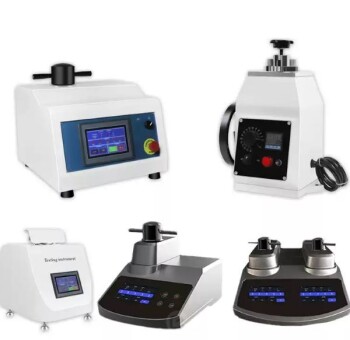
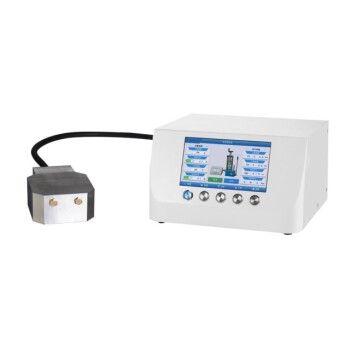
The primary purpose of a metallographic mounting press is to encapsulate oxidized zirconium samples within a protective mounting material—such as epoxy resin—to safeguard extremely thin and fragile oxide layers. This process applies controlled heat and pressure to ensure the brittle zirconium oxide remains structurally intact during the rigorous cutting and polishing stages required for cross-sectional analysis.
Hot mounting provides a rigid support system that prevents the oxide layer from peeling or cracking, which is essential for maintaining the interface integrity needed for accurate Raman depth profiling and microstructural observation.
Protecting the Fragile Oxide Interface
Preventing Mechanical Peeling and Cracking
Oxidized zirconium layers, often formed in high-temperature steam environments, are inherently brittle and susceptible to mechanical failure. Without the support of a mounting medium, the forces generated during sectioning would cause the oxide to delaminate or shatter.
The metallographic press creates a dense, void-free encapsulation that "locks" the oxide layer in place. This stabilization allows the sample to withstand the shear forces of a diamond saw or abrasive grinding papers without losing its original morphology.
Ensuring Edge Retention During Polishing
To obtain a clear view of the oxide-metal interface, the sample must be polished to a mirror finish. If the sample is not mounted properly, the edges of the oxide layer tend to "round off" because the polishing cloth compresses differently at the sample boundaries.
By using a mounting press to embed the sample in a material with similar hardness, the planar integrity of the cross-section is preserved. This ensures that the interface remains sharp and in the same focal plane during microscopy.
Facilitating High-Precision Analysis
Supporting Raman Depth Profiling
Raman depth profiling requires a perfectly flat and intact cross-section to measure chemical composition and phase transitions across the oxide layer. Any cracking or separation at the interface would introduce optical artifacts and lead to erroneous data.
The mounting press ensures that the epoxy resin fully penetrates any surface irregularities. This creates a continuous surface that allows the laser to transition smoothly from the mounting medium into the zirconium dioxide coating.
Simulating Reactor-Grade Integrity
Zirconium alloys are often tested in high-pressure steam apparatuses to simulate light water reactor conditions (300°C to 1200°C). Because these samples are used to evaluate oxygen diffusion barriers, even microscopic damage during preparation can mask the material's true performance.
Proper hot mounting ensures that the researcher is observing the effects of the experimental environment, rather than damage introduced in the laboratory. This distinction is vital for accurately assessing how zirconium dioxide inhibits exothermic reactions and hydrogen production.
Understanding the Trade-offs
Temperature Sensitivity of the Sample
While hot mounting is effective, it requires subjecting the sample to temperatures typically between 150°C and 200°C. For certain oxidized samples, this additional heat cycle could potentially induce thermal stresses or minor phase changes in sensitive coatings.
Pressure Limits and Brittle Failure
The hydraulic pressure used in the press must be carefully calibrated. If the pressure is too high before the mounting resin has softened, it can cause uniaxial compression damage to the very oxide layer the process is intended to protect.
How to Apply This to Your Project
Making the Right Choice for Your Goal
- If your primary focus is Raman depth profiling: Use a high-quality, low-shrinkage resin in your mounting press to ensure there are no gaps between the resin and the oxide layer.
- If your primary focus is evaluating oxygen diffusion barriers: Prioritize edge retention by choosing a mounting medium with a hardness level that closely matches the zirconium alloy.
- If your primary focus is characterizing extremely thick, porous oxides: Consider vacuum impregnation with liquid epoxy before hot mounting to fill internal voids and prevent crumbling during sectioning.
By utilizing a metallographic mounting press correctly, you transform a fragile, oxidized specimen into a durable, high-fidelity sample ready for definitive technical analysis.
Summary Table:
| Key Benefit | Impact on Sample Analysis | Why It Matters |
|---|---|---|
| Layer Protection | Prevents delamination and cracking | Maintains original morphology for accurate results |
| Edge Retention | Eliminates "rounding" during polishing | Ensures sharp, clear focus on the oxide-metal interface |
| Void-free Bonding | Provides continuous laser transition | Vital for high-precision Raman depth profiling |
| Structural Support | Resists shear forces during cutting | Protects sample from lab-induced mechanical damage |
Optimize Your Material Analysis with KINTEK Precision
Ensure the integrity of your most delicate specimens with KINTEK’s industry-leading laboratory solutions. From advanced metallographic mounting presses and high-pressure hydraulic presses to a wide range of high-temperature furnaces and specialized consumables (PTFE, ceramics, and resins), we provide the tools you need for high-fidelity sample preparation.
Whether you are characterizing nuclear-grade zirconium alloys or developing advanced oxygen diffusion barriers, KINTEK specializes in equipment that delivers repeatable, precise results. Contact us today to discuss your specific application needs and discover how our comprehensive portfolio can enhance your research and quality control workflows.
References
- Kinga Suchorab, Ł. Kurpaska. Comparison of Raman imaging assessment methods in phase determination and stress analysis of zirconium oxide layer. DOI: 10.1016/j.saa.2023.122625
This article is also based on technical information from Kintek Solution Knowledge Base .
Related Products
- Metallographic Specimen Mounting Machine for Laboratory Materials and Analysis
- Vacuum Cold Mounting Machine for Sample Preparation
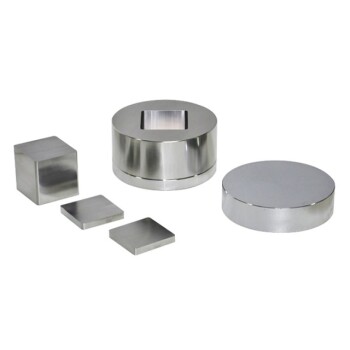
- Special Shape Press Mold for Lab
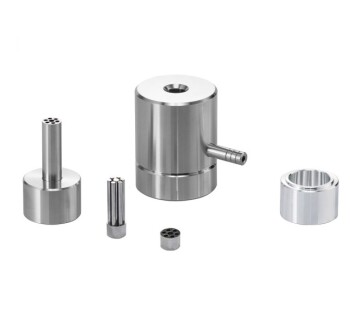
- Cylindrical Press Mold with Scale for Lab
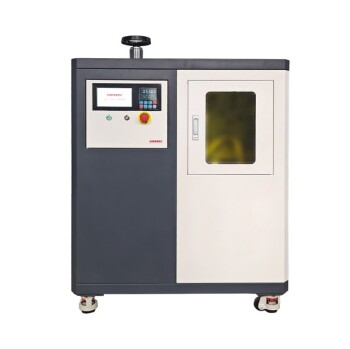
- Warm Isostatic Press for Solid State Battery Research
People Also Ask
- What is the purpose of using epoxy resin and laboratory mounting equipment? Precision in U71Mn Weld Area Analysis
- What is the process of mounting in metallurgy? A Guide to Perfect Specimen Preparation
- What machine is used to press metal? Choose the Right Press for Your Application
- What key indicators does a laboratory pressure testing machine measure? Essential T91 Alloy Steel Weld Testing
- What is a hot mounting press machine? Precision Control for Metallurgy & Electronics Assembly