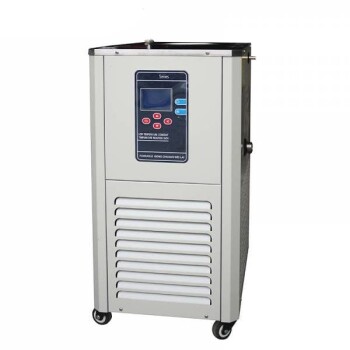
A batch reactor equipped with a water-cooled condenser serves as the primary regulation system during the production of triacetin from glycerine. Its most immediate function is to facilitate effective reflux, capturing reactant vapors that would otherwise escape and returning them to the liquid mixture. This setup ensures that volatile components, particularly acetic anhydride, are conserved within the reaction vessel.
By preventing the evaporation of key reactants, the water-cooled condenser preserves the intended molar ratio throughout the process. When paired with constant temperature control, this configuration allows for the precise regulation necessary to maximize both the selectivity and yield of the final product.
The Mechanics of Reflux and Reactant Preservation
Preventing Reactant Loss
During esterification, the reaction mixture must be heated, which naturally causes volatile components to vaporize.
Without intervention, reactants such as acetic anhydride would be lost to evaporation.
The water-cooled condenser acts as a trap, cooling these vapors until they condense back into liquid form.
Maintaining Stoichiometric Balance
When the condensed liquid drips back into the reactor, it re-enters the active process.
This cycle, known as reflux, is critical for maintaining the intended molar ratio between glycerine and the acetylating agent.
If this ratio were to shift due to evaporation, the reaction efficiency would plummet, and the chemical balance would be disrupted.
Temperature Control and Process Optimization
Regulating Reaction Conditions
Beyond reactant retention, the batch reactor system utilizes a constant temperature control mechanism.
This ensures the environment remains stable throughout the duration of the batch.
Fluctuations in heat can lead to incomplete reactions or the formation of unwanted by-products.
Driving Selectivity and Yield
Precise thermal regulation is the primary driver for process optimization.
By maintaining a specific temperature profile, operators can influence the selectivity of the reaction, ensuring triacetin is produced rather than mono- or diacetin.
Consequently, this control maximizes the overall yield of the high-value triacetin product.
Operational Considerations and Trade-offs
Batch Process Limitations
While this setup offers superior control over reaction parameters, batch reactors generally suffer from lower throughput compared to continuous flow reactors.
The necessity of a reflux cycle implies a time-intensive process where the reaction must run to completion before the vessel can be emptied and refilled.
Energy and Resource Demands
The "water-cooled" aspect of the condenser introduces a utility requirement.
Maintaining a temperature differential large enough to condense acetic anhydride requires a consistent flow of cooling water.
This creates an operational trade-off where energy is expended to heat the reactor while simultaneously expended to cool the escaping vapors.
Maximizing Production Efficiency
To leverage this equipment effectively, you must balance the need for containment with the energy costs of operation.
- If your primary focus is chemical consistency: Prioritize the efficiency of the condenser to ensure zero loss of acetic anhydride, thereby locking in the precise molar ratio.
- If your primary focus is product purity: Focus strictly on the reactor's temperature control capabilities to optimize selectivity and reduce by-product formation.
Ultimately, the condenser acts not merely as a cooling accessory, but as the guardian of the reaction's stoichiometric integrity.
Summary Table:
| Feature | Role in Triacetin Production | Primary Benefit |
|---|---|---|
| Water-Cooled Condenser | Facilitates effective reflux of vapors | Prevents reactant loss (e.g., acetic anhydride) |
| Reflux Cycle | Returns condensed liquid to the vessel | Maintains precise molar ratio and chemical balance |
| Temperature Control | Ensures stable thermal environment | Enhances reaction selectivity and product purity |
| Batch Configuration | Allows for controlled reaction duration | Maximizes yield of high-value triacetin |
Elevate Your Chemical Synthesis with KINTEK Precision
Achieving peak selectivity and yield in triacetin production requires more than just standard hardware—it demands high-performance thermal regulation and containment systems. KINTEK specializes in advanced laboratory equipment designed for rigorous chemical processing.
Whether you are scaling up esterification or refining your batch protocols, our comprehensive range of high-temperature high-pressure reactors and autoclaves, precision cooling solutions (including advanced condensers), and specialized consumables like PTFE products and crucibles ensure your lab maintains absolute stoichiometric integrity.
Ready to optimize your reaction efficiency? Contact KINTEK today to discover how our tailor-made equipment solutions can enhance your laboratory's throughput and precision.
References
- Juan Francisco García Martín, Paloma Álvarez Mateos. Production of Oxygenated Fuel Additives from Residual Glycerine Using Biocatalysts Obtained from Heavy-Metal-Contaminated Jatropha curcas L. Roots. DOI: 10.3390/en12040740
This article is also based on technical information from Kintek Solution Knowledge Base .
Related Products
- Customizable Laboratory High Temperature High Pressure Reactors for Diverse Scientific Applications
- Stainless High Pressure Autoclave Reactor Laboratory Pressure Reactor
- High Pressure Laboratory Autoclave Reactor for Hydrothermal Synthesis
- Mini SS High Pressure Autoclave Reactor for Laboratory Use
- Customizable High Pressure Reactors for Advanced Scientific and Industrial Applications
People Also Ask
- How do high-pressure and high-temperature reactors ensure the effective treatment of lignocellulosic wastewater in WAO?
- What equipment is required for high-pressure high-temperature reactions? Master Extreme Chemistry Safely
- How do you control high pressure in a reactor? A Guide to Safe & Stable Operation
- Why is argon better than nitrogen for inert atmosphere? Ensure Absolute Reactivity & Stability
- How does initial oxygen pressure affect the wet oxidation of pharmaceutical sludge? Master Your Oxidation Depth