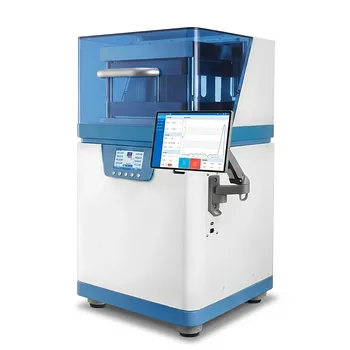
The high-temperature high-pressure reactor is the fundamental driver of the solvothermal process, providing the sealed environment necessary to force the hydrolysis and polycondensation of cerium precursors. By maintaining solvents in a liquid state well above their atmospheric boiling points, the reactor creates the extreme physical conditions required to guide crystal growth along specific axes, ultimately producing the high-aspect-ratio nanorods and rich porous structures essential for advanced catalytic applications.
The reactor serves as a controlled, high-energy vessel that bypasses standard thermodynamic limits, allowing for the precise manipulation of cerium oxide's morphology, crystallinity, and surface porosity through autogenous pressure and accelerated reaction kinetics.
Facilitating Core Chemical Pathways
Driving Hydrolysis and Polycondensation
In the synthesis of cerium oxide (CeO2) nanorods, the reactor provides a sealed environment that facilitates the critical hydrolysis and polycondensation reactions of cerium precursors. These chemical steps are essential for transforming liquid-phase precursors into solid-state oxide frameworks.
Bypassing Standard Boiling Points
The high-pressure environment allows the reaction solvent to remain in a liquid state even at temperatures far exceeding its standard boiling point. This state increases the solubility of reactants and promotes the thorough dissolution and subsequent crystallization of precursor components.
Accelerating Reaction Kinetics
The combination of high temperature and autogenous pressure significantly accelerates reaction kinetics. This energy input ensures that the nucleation and growth phases occur with enough speed and uniformity to produce consistent particle size distributions.
Structural Evolution and Morphology Control
Guiding Anisotropic Growth
The extreme conditions within the reactor guide crystal growth along specific directions. This targeted growth is what results in the formation of nanorod morphologies rather than simple spherical particles, providing the high aspect ratios required for specific industrial uses.
Developing Rich Porous Structures
The reactor's environment is instrumental in creating rich porous structures within the nanorods. These pores are vital for increasing the surface area of the CeO2, which directly impacts its effectiveness in catalysis and adsorption.
Exposing Specific Crystal Planes
By precisely regulating the temperature and pressure, the reactor allows researchers to expose specific crystal planes. This is a critical factor for enhancing the strong metal-support interaction (SMSI) when the nanorods are used as a base for other metal active components.
Understanding the Trade-offs
Equipment Limitations and Safety
Operating at high temperatures and pressures requires specialized autoclaves with PTFE (Teflon) liners to ensure chemical purity and prevent corrosion of the reactor body. However, these liners have strict temperature limits (typically below 250°C), which can constrain the synthesis parameters.
Complexity of Kinetic Control
While the high-energy environment accelerates reactions, it also makes the process highly sensitive to minor fluctuations. Small deviations in reaction time or temperature can cause the morphology to shift from nanorods to other shapes like nanocubes or octahedra, potentially ruining the batch for its intended purpose.
Scaling and Energy Intensity
Solvothermal synthesis in high-pressure reactors is often more energy-intensive and harder to scale than open-beaker methods. The need for batch processing in sealed vessels can lead to higher production costs and lower throughput compared to continuous manufacturing processes.
How to Apply This to Your Project
Making the Right Choice for Your Goal
To achieve the best results with cerium oxide nanorods, align your reactor settings with your specific structural requirements.
- If your primary focus is maximizing surface area: Prioritize a reactor setup that allows for precise control over "rich porous structures" through steady, moderate autogenous pressure.
- If your primary focus is catalytic activity: Focus on regulating temperature and reaction time to expose the specific crystal planes that enhance metal-support interactions.
- If your primary focus is morphological uniformity: Ensure your reactor uses a high-quality PTFE liner and uniform heating to maintain consistent fluid dynamics and prevent irregular crystal growth.
The high-pressure reactor is the indispensable tool that transforms simple cerium precursors into highly engineered, porous nanostructures through the masterful application of heat and confinement.
Summary Table:
| Feature/Function | Role in Solvothermal Synthesis | Impact on CeO2 Nanorods |
|---|---|---|
| Hydrolysis & Polycondensation | Facilitates precursor transformation in a sealed vessel | Forms the solid-state oxide framework |
| Autogenous Pressure | Maintains solvents in liquid state above boiling points | Increases reactant solubility and crystal growth |
| Anisotropic Growth | Guides crystal development along specific axes | Achieves high-aspect-ratio nanorod morphology |
| Porosity Control | Manages internal structural evolution | Creates rich porous structures for catalysis |
| Kinetic Acceleration | Increases energy input and reaction speed | Ensures uniform particle size distribution |
Precision Engineering for Advanced Material Science with KINTEK
Achieving the perfect morphology and porosity in cerium oxide nanorods requires uncompromising control over thermal and pressure variables. KINTEK specializes in high-performance laboratory equipment designed to meet the rigorous demands of solvothermal synthesis.
We provide a comprehensive range of high-temperature high-pressure reactors and autoclaves, featuring high-quality PTFE and ceramic liners to ensure chemical purity and corrosion resistance. Our portfolio extends to muffle and vacuum furnaces, hydraulic presses, and advanced milling systems, supporting your research from precursor preparation to final characterization.
Ready to optimize your catalytic applications? Contact our technical experts today to discover how KINTEK’s precision tools can enhance your lab's efficiency and experimental reproducibility.
References
- Jiankang Zhang, Yong Qin. Catalyzing Generation and Stabilization of Oxygen Vacancies on CeO <sub>2−x</sub> Nanorods by Pt Nanoclusters as Nanozymes for Catalytic Therapy. DOI: 10.1002/adhm.202302056
This article is also based on technical information from Kintek Solution Knowledge Base .
Related Products
- Customizable Laboratory High Temperature High Pressure Reactors for Diverse Scientific Applications
- High Pressure Laboratory Autoclave Reactor for Hydrothermal Synthesis
- Mini SS High Pressure Autoclave Reactor for Laboratory Use
- Stainless High Pressure Autoclave Reactor Laboratory Pressure Reactor
- Customizable High Pressure Reactors for Advanced Scientific and Industrial Applications
People Also Ask
- How do high-pressure and high-temperature reactors ensure the effective treatment of lignocellulosic wastewater in WAO?
- What equipment is required for high-pressure high-temperature reactions? Master Extreme Chemistry Safely
- How do you control high pressure in a reactor? A Guide to Safe & Stable Operation
- How does initial oxygen pressure affect the wet oxidation of pharmaceutical sludge? Master Your Oxidation Depth
- Why is argon better than nitrogen for inert atmosphere? Ensure Absolute Reactivity & Stability