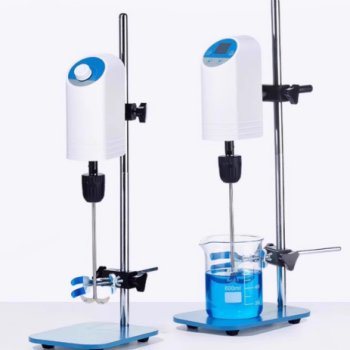
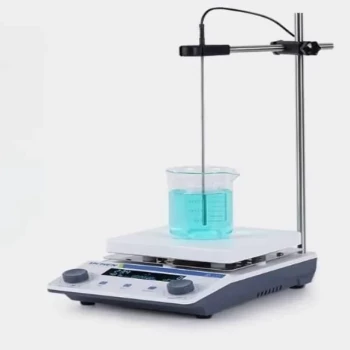
The primary role of an industrial stirrer is to provide high-intensity mechanical agitation that acts as the governing force for the chemical reaction. In the co-precipitation of Mn-Ce/Al2O3, this equipment ensures rigorous contact between the manganese, cerium, and aluminum precursor solutions and the ammonia water. This mechanical energy is required to stabilize the reaction pH at approximately 10, enabling the active components to mix and precipitate uniformly at the molecular level.
The industrial stirrer serves as a critical process stabilizer, not just a mixing device. By maintaining a consistent pH of 10 through intense agitation, it ensures the creation of uniform high-performance active centers, which are the fundamental drivers of the catalyst's efficiency.
Mechanisms of Agitation in Co-Precipitation
Achieving Molecular-Level Contact
The stirrer must generate enough force to ensure the manganese, cerium, and aluminum precursors interact immediately with the ammonia water.
Without high-intensity agitation, these components may not mix thoroughly before the reaction begins.
This mechanical force facilitates mixing at the molecular level, preventing the segregation of components during the liquid phase.
Stabilization of Reaction pH
The chemistry of co-precipitation is highly sensitive to local variations in acidity.
The stirrer distributes the ammonia water instantly throughout the solution, preventing localized "hot spots" of high or low pH.
This ensures the entire system remains stable at a pH of approximately 10, a specific threshold required for the correct chemical phase to form.
Formation of Active Centers
The ultimate goal of this mechanical process is the quality of the final solid structure.
By ensuring the precursors precipitate uniformly, the stirrer allows for the development of high-performance active centers.
These active centers are the specific sites on the catalyst surface where future chemical reactions will take place, directly dictating the material's effectiveness.
Understanding the Trade-offs
The Risk of Insufficient Intensity
If the mechanical agitation is weak or inconsistent, the reaction mixture will develop pH gradients.
This lack of uniformity means different parts of the batch may precipitate at different rates or compositions.
Consequently, the active components will fail to integrate evenly, leading to a heterogeneous mixture rather than a uniform compound.
Impact on Catalyst Morphology
While the primary reference focuses on active centers, consistency in agitation is generally linked to particle morphology.
Inconsistent stirring can lead to uncontrolled nucleation, resulting in irregular particle sizes.
This irregularity compromises the structural integrity and surface area of the final catalyst powder.
Making the Right Choice for Your Goal
To maximize the quality of your Mn-Ce/Al2O3 catalyst, apply these principles:
- If your primary focus is Chemical Homogeneity: Ensure your agitation speed is high enough to eliminate concentration gradients and maintain a strict pH of 10 throughout the vessel.
- If your primary focus is Catalyst Performance: Prioritize the uniformity of the mixing phase, as molecular-level integration is the prerequisite for forming effective active centers.
Precise mechanical control is the bridge between raw chemical precursors and a high-efficiency industrial catalyst.
Summary Table:
| Feature | Role in Co-Precipitation | Impact on Catalyst |
|---|---|---|
| Mechanical Agitation | Ensures molecular-level precursor contact | Prevents component segregation |
| pH Stabilization | Maintains constant pH ~10 | Ensures correct chemical phase formation |
| Mixing Uniformity | Eliminates concentration gradients | Creates high-performance active centers |
| Process Control | Prevents localized pH 'hot spots' | Results in uniform particle morphology |
Elevate Your Catalyst Synthesis with KINTEK Precision
At KINTEK, we understand that high-performance catalysts like Mn-Ce/Al2O3 demand rigorous process control. Our industrial stirring solutions provide the high-intensity mechanical agitation necessary to stabilize reaction pH and ensure molecular-level homogeneity for your active centers.
Beyond advanced mixing, KINTEK offers a comprehensive suite of laboratory and industrial equipment to support your entire material science workflow:
- High-Temperature Furnaces & Reactors: Precise thermal processing for calcining catalyst powders.
- Crushing, Milling & Sieving: Achieve the perfect particle size for your catalytic applications.
- Hydraulic Presses: High-quality pelleting for structured catalyst testing.
- Analytical & Cooling Solutions: Complete your lab with everything from ULT freezers to rotary evaporators.
Ready to optimize your chemical processing? Contact KINTEK today to discover how our expertise and equipment can enhance your lab's efficiency and material quality.
References
- Chengzhi Wang, Peng Cao. Poisoning Effect of SO2 on Honeycomb Cordierite-Based Mn–Ce/Al2O3Catalysts for NO Reduction with NH3 at Low Temperature. DOI: 10.3390/app8010095
This article is also based on technical information from Kintek Solution Knowledge Base .
Related Products
- High Performance Laboratory Stirrers for Diverse Applications
- Engineering Advanced Fine Alumina Al2O3 Ceramic Rod Insulated for Industrial Applications
- Engineering Advanced Fine Ceramics Aluminium Oxide Al2O3 Ceramic Washer for Wear-Resistant Applications
- Advanced Engineering Fine Ceramics Alumina Ceramic Saggar for Fine Corundum
- Engineering Advanced Fine Alumina Al2O3 Ceramic Crucible for Laboratory Muffle Furnace
People Also Ask
- How does a laboratory stirrer influence MOF product quality? Master Precision in Non-Solvothermal Synthesis
- What critical role does a Laboratory Stirrer play during leaching? Enhance Titanium-Magnesium Waste Recovery
- What is the primary function of laboratory stirring equipment in the preparation of compost leachate? Optimize Extraction
- What is a laboratory mixer? A Guide to Achieving Perfect Sample Homogeneity
- What is a laboratory mixer used for? Choose the Right Tool for Liquids or Solids