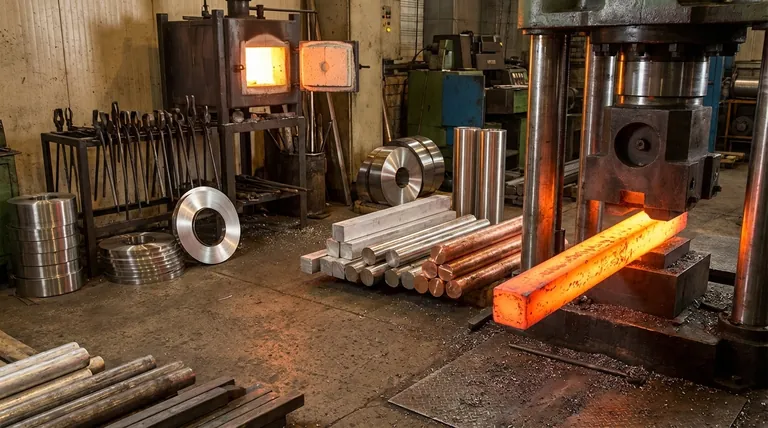
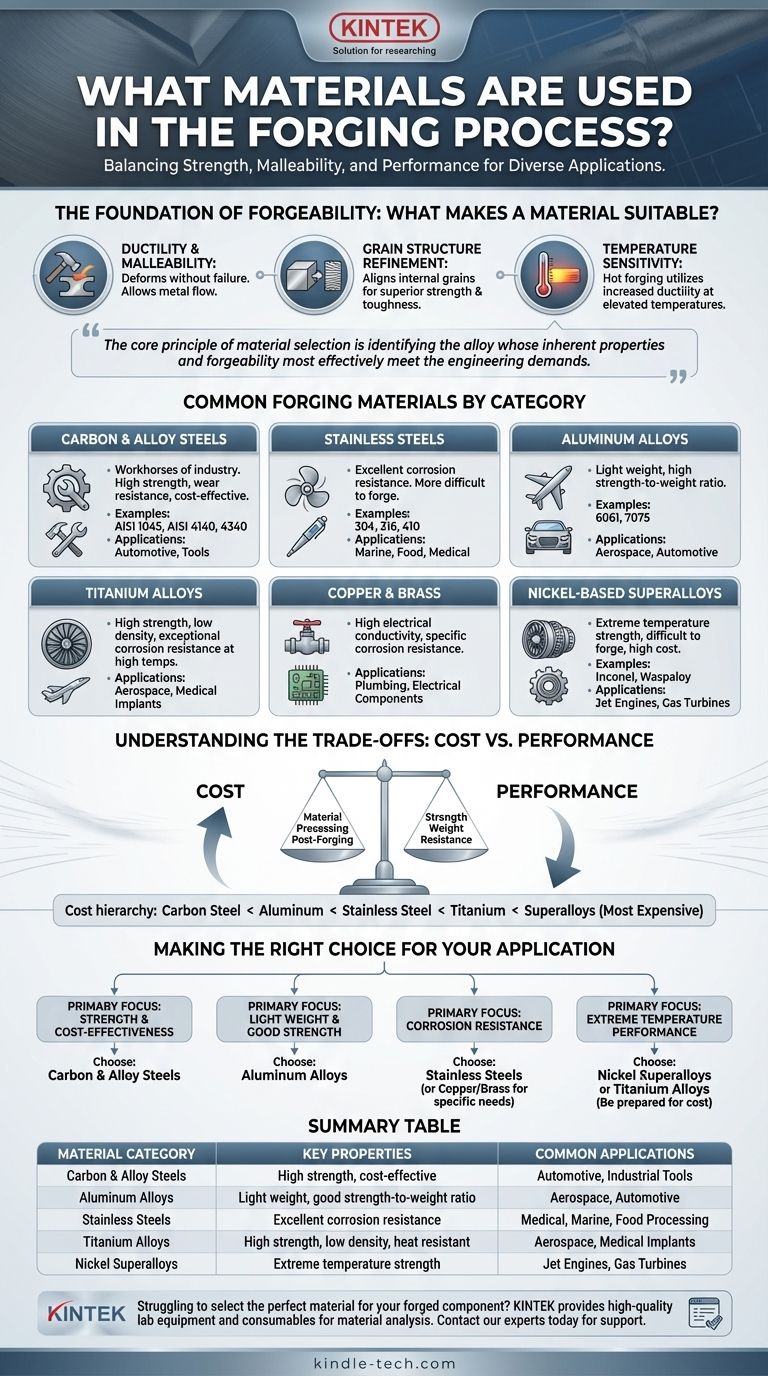
While a wide variety of metals possess the necessary properties for forging, the process is dominated by materials prized for their strength, malleability, and performance characteristics. The most common materials are carbon and alloy steels, followed by specialized alloys of aluminum, titanium, and copper. The selection is not arbitrary; it is a deliberate choice dictated by the final component's required strength, weight, corrosion resistance, and operating temperature.
The core principle of material selection in forging is not finding a single "best" metal, but rather identifying the alloy whose inherent properties and forgeability most effectively and economically meet the engineering demands of the final application.
The Foundation of Forgeability: What Makes a Material Suitable?
Before listing materials, it's crucial to understand what makes a metal suitable for the intense deformation of the forging process. The primary factor is the material's ability to be plastically deformed without failing.
Ductility and Malleability
A forgeable material must be ductile (able to be deformed without fracture) and malleable (able to be hammered or pressed into shape). This allows the metal billet to flow and fill the die cavity under immense pressure, creating the desired shape.
Grain Structure Refinement
One of the main benefits of forging is that it refines and directs the metal's internal grain structure. This process aligns the grains with the shape of the part, eliminating porosity and producing a component that is significantly stronger and tougher than a cast or machined equivalent.
Temperature Sensitivity
Most forging is performed on heated metal (hot forging) because metals become more ductile and less resistant to deformation at elevated temperatures. The material's response to heat and its optimal forging temperature range are critical selection criteria.
Common Forging Materials by Category
The choice of material is a direct function of the part's intended use. Each category offers a distinct profile of cost, performance, and manufacturing complexity.
Carbon and Alloy Steels
These are the workhorses of the forging industry due to their excellent strength, wear resistance, and cost-effectiveness. They are used in everything from automotive crankshafts to industrial tools.
- Common Examples: AISI 1045 (Carbon Steel), AISI 4140, 4340 (Alloy Steels).
Stainless Steels
Chosen when corrosion resistance is the primary requirement. While generally more difficult to forge than carbon steels, they are essential for applications in the food processing, medical, and marine industries.
- Common Examples: 304, 316 (Austenitic), 410 (Martensitic).
Aluminum Alloys
When light weight is critical, aluminum is the material of choice. The aerospace and high-performance automotive industries rely heavily on forged aluminum for its high strength-to-weight ratio.
- Common Examples: 6061, 7075.
Titanium Alloys
Titanium offers a unique combination of high strength, low density, and exceptional corrosion resistance, even at elevated temperatures. This makes it ideal for critical aerospace components, jet engine parts, and medical implants.
Copper and Brass
These alloys are forged for applications requiring high electrical conductivity or specific corrosion resistance properties not met by stainless steel. They are commonly found in plumbing fittings, valves, and electrical components.
Nickel-Based Superalloys
These materials are reserved for the most demanding environments, such as the hot sections of jet engines and gas turbines. They retain incredible strength at extreme temperatures but are very expensive and difficult to forge.
- Common Examples: Inconel, Waspaloy.
Understanding the Trade-offs: Cost vs. Performance
Choosing a material is a balancing act between the desired performance and the total cost of the finished part. The raw material is only one part of the equation.
The Cost of Material
There is a clear cost hierarchy. Carbon steels are the least expensive, followed by aluminum, stainless steel, titanium, and finally, the extremely expensive nickel-based superalloys.
The Cost of Processing (Forgeability)
A material's forgeability has a direct impact on production cost. Materials like titanium and superalloys are far more resistant to deformation than steel, requiring more energy, more powerful equipment, and causing significantly higher wear on the forging dies.
Post-Forging Requirements
The total cost must also include any necessary secondary operations. Many high-strength alloys require complex and expensive heat treatments after forging to achieve their final properties, adding to the overall expense.
Making the Right Choice for Your Application
Your material selection should be guided by the single most important requirement for your component.
- If your primary focus is strength and cost-effectiveness: Carbon and alloy steels are almost always the correct starting point for a wide range of industrial and mechanical applications.
- If your primary focus is light weight with good strength: Aluminum alloys offer the best balance for aerospace, automotive, and other applications where weight reduction is critical.
- If your primary focus is corrosion resistance: Stainless steels are ideal for marine, food, and medical environments, while copper alloys serve specialized needs in plumbing and electrical systems.
- If your primary focus is performance at extreme temperatures: Nickel-based superalloys or titanium alloys are necessary, but you must be prepared for their significant cost and manufacturing challenges.
Ultimately, selecting the right forging material is a calculated decision that balances the engineering demands of the part with the economic realities of production.
Summary Table:
| Material Category | Key Properties | Common Applications |
|---|---|---|
| Carbon & Alloy Steels | High strength, cost-effective | Automotive parts, industrial tools |
| Aluminum Alloys | Light weight, good strength-to-weight ratio | Aerospace, automotive components |
| Stainless Steels | Excellent corrosion resistance | Medical, marine, food processing |
| Titanium Alloys | High strength, low density, heat resistant | Aerospace, medical implants |
| Nickel Superalloys | Extreme temperature strength | Jet engines, gas turbines |
Struggling to select the perfect material for your forged component? The right choice is critical for performance, durability, and cost-efficiency. KINTEK specializes in providing the high-quality lab equipment and consumables needed to analyze and test these materials, ensuring your forging process is a success. Our experts can help you navigate the complexities of material science. Contact us today to discuss your project requirements and discover how we can support your laboratory needs. Get in touch via our Contact Form
Visual Guide
Related Products
- Electrode Polishing Material for Electrochemical Experiments
- Bomb Type Probe for Steelmaking Production Process
- Laboratory CVD Boron Doped Diamond Materials
- Cylindrical Press Mold with Scale for Lab
- Ring Press Mold for Lab Applications
People Also Ask
- How do you prepare the polishing setup for an electrode? Achieve a Flawless Mirror Finish for Reliable Electrochemistry
- What is the mechanism and purpose of using fine sandpaper for electrode grinding? Restore Peak Electrode Performance
- What are the electrode materials? A Guide to Choosing the Right Conductor for Your Application
- What criteria are used during the visual inspection of electrodes? Essential Quality Assessment for Your Lab
- Which types of materials are basically polished by electrolytic polishing? A Guide to Metals & Alloys