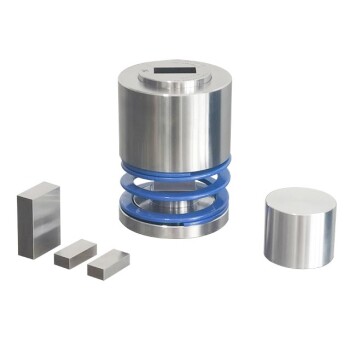
A high-pressure stainless steel reactor functions as a specialized containment vessel designed to create and sustain the specific environmental conditions required for supercritical carbon dioxide (scCO2) applications. Its primary physical role is to provide a strictly sealed environment capable of maintaining elevated pressures, such as 9.0 MPa, which allows the carbon dioxide to achieve the high permeability necessary for modifying aramid fibers.
The reactor's ability to maintain a stable, high-pressure state is the catalyst that transforms CO2 into a powerful solvent. This enables the deep penetration of chemical modifiers into the fiber's microstructure, ultimately enhancing the mechanical properties of the final composite.
The Physical Environment Created
The reactor is not merely a container; it is an active component in facilitating the phase change of carbon dioxide.
Sustaining Elevated Pressure
The most critical physical condition provided by the reactor is high pressure. The reference specifies a pressure environment of 9.0 MPa (megapascals). The stainless steel construction ensures the vessel can safely withstand these forces without deformation or failure.
A Hermetically Sealed System
To maintain the supercritical state of CO2, the system must be completely sealed. This isolation prevents pressure loss and ensures that the fluid dynamics within the reactor remain constant throughout the treatment process.
Mechanism of Interaction with Aramid Fibers
Once the physical conditions of the reactor are met, the behavior of the carbon dioxide changes, directly impacting the aramid fibers.
High Permeability
Under the sealed, high-pressure conditions provided by the reactor, scCO2 exhibits high permeability. This physical property allows the fluid to bypass the natural resistance of the dense aramid fiber structure.
Transporting Modifiers
The reactor environment enables the scCO2 to act as a carrier vehicle. It transports specific modifiers directly into the fiber’s microstructure. Without the pressure conditions maintained by the reactor, these modifiers would likely remain on the surface or fail to interact effectively with the fiber.
Impact on Material Properties
The physical conditions maintained by the reactor lead to specific, tangible changes in the aramid fibers.
Increased Surface Roughness
The infiltration of modifiers causes physical changes to the fiber's topography. The treatment results in increased surface roughness, which is essential for creating mechanical interlocking sites in composite materials.
Enhanced Surface Energy
Beyond texture, the process increases the surface energy of the fibers. This thermodynamic change improves the fiber's chemical compatibility with matrix materials.
Understanding the Operational Trade-offs
While the high-pressure reactor enables advanced modification, it introduces specific constraints that must be managed.
Absolute Dependence on Seal Integrity
The process relies entirely on the reactor's ability to maintain a sealed environment at high pressure (e.g., 9.0 MPa). Any fluctuation or leak compromises the supercritical state of the CO2, instantly halting the modification process and potentially wasting the batch.
Equipment Rigidity
The requirement for laboratory-grade stainless steel capable of withstanding these pressures implies a rigid, heavy-duty setup. This is not a flexible, low-infrastructure process; it requires precise engineering to ensure safety and consistency.
Making the Right Choice for Your Goal
When evaluating the use of a high-pressure reactor for aramid modification, consider your specific engineering objectives.
- If your primary focus is Composite Strength: The reactor conditions are essential to improve the tensile strength of the final material by ensuring deep structural modification rather than just surface coating.
- If your primary focus is Chemical Bonding: The high-pressure environment is the key variable that allows for increased surface energy, facilitating better adhesion between the fiber and the matrix.
The reactor provides the critical pressure threshold that unlocks the unique solvent properties of CO2, bridging the gap between raw fiber and high-performance composite.
Summary Table:
| Feature | Physical Condition/Effect | Significance in Modification |
|---|---|---|
| Pressure Level | 9.0 MPa (Stable) | Achieves supercritical state for deep penetration |
| Containment | Hermetically Sealed System | Prevents pressure loss and maintains fluid dynamics |
| Fluid Property | High Permeability | Bypasses fiber density to transport chemical modifiers |
| Surface Impact | Increased Roughness | Creates mechanical interlocking sites for composites |
| Thermodynamics | Enhanced Surface Energy | Improves chemical compatibility with matrix materials |
| Material | Stainless Steel | Ensures safety and durability under high-stress loads |
Elevate Your Material Research with KINTEK
Maximize the potential of your aramid fiber modifications with KINTEK’s precision-engineered high-pressure high-pressure reactors and autoclaves. Our laboratory-grade stainless steel systems are designed to maintain the critical 9.0 MPa thresholds and hermetic seals required for advanced scCO2 technology.
Beyond reactors, KINTEK offers a full suite of laboratory solutions, including high-temperature furnaces, crushing systems, and hydraulic presses, ensuring your research team has the tools to achieve superior tensile strength and chemical bonding in every composite.
Ready to optimize your lab's performance? Contact us today to find the perfect reactor for your application!
References
- Azira Muratovna Yermakhanova, Berdiyar Baiserikov. Investigation of dielectric and strength properties of organoplastics. Review. DOI: 10.31643/2022/6445.33
This article is also based on technical information from Kintek Solution Knowledge Base .
Related Products
- Stainless High Pressure Autoclave Reactor Laboratory Pressure Reactor
- Mini SS High Pressure Autoclave Reactor for Laboratory Use
- Customizable High Pressure Reactors for Advanced Scientific and Industrial Applications
- Customizable Laboratory High Temperature High Pressure Reactors for Diverse Scientific Applications
- High Pressure Laboratory Autoclave Reactor for Hydrothermal Synthesis
People Also Ask
- Why is a laboratory high-pressure reactor used in the hydrothermal synthesis of hydroxyapatite catalysts?
- Why is a laboratory high-pressure reactor necessary for synthesizing fly ash-based zeolite? Achieve Pure Crystallization
- What role does a laboratory high-pressure reactor play in the leaching process of spent cathode materials? Optimize Recovery
- What conditions do laboratory high-pressure reactors provide for HTC? Optimize Your Biochar Production Processes
- How are high-pressure reactors used to prepare metaphosphate electrocatalysts? Master In-Situ Precursor Growth