Knowledge What role do Petri dishes play in TiO2-MoS2-PMMA solution casting? Enhance Film Quality with Lab-Grade Molds
Author avatar

Tech Team · Kintek Solution

Updated 18 hours ago

What role do Petri dishes play in TiO2-MoS2-PMMA solution casting? Enhance Film Quality with Lab-Grade Molds


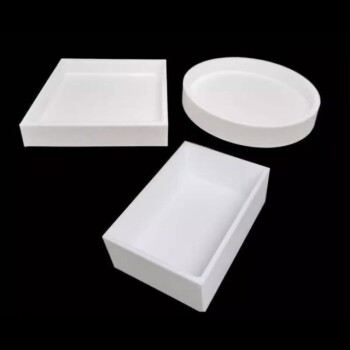
In the solution casting of TiO2-MoS2-PMMA nanocomposites, laboratory-grade glass or fluoroplastic Petri dishes function as the primary molds during the critical formation phase.

These dishes provide a controlled physical environment where the liquid solution is poured and allowed to rest while the solvent evaporates. This process transforms the de-agglomerated mixture into a solid, cohesive composite film.

The choice of molding material is not merely a logistical detail but a quality control measure; high-quality glass or fluoroplastic ensures the resulting films possess uniform thickness and high chemical purity.

The Critical Role of Surface Geometry

Ensuring Uniform Thickness

The primary technical requirement for a casting mold is surface flatness. Laboratory-grade dishes are manufactured to strict tolerances to ensure the bottom surface is perfectly level.

Preventing Gravitational Pooling

If a mold has even microscopic irregularities or a slight curvature, the liquid solution will pool in lower areas before solidifying.

By using high-flatness glass or fluoroplastic, the solution spreads evenly across the dish. This guarantees that the final solidified film maintains a consistent thickness throughout its diameter.

Chemical Properties and Film Purity

Maintaining Chemical Inertness

The solution casting process involves solvents (such as acetone) evaporating over time. The mold material must be chemically inert to prevent interaction with these solvents.

Glass and fluoroplastic are resistant to chemical attack. This prevents the leaching of foreign substances from the dish into the nanocomposite, ensuring no impurities are introduced during the evaporation phase.

Facilitating Clean Detachment

Once the solvent has evaporated and the PMMA matrix has solidified around the TiO2 and MoS2 nanofillers, the film must be removed from the mold.

Laboratory-grade fluoroplastic and glass provide low-friction surfaces. This facilitates the complete detachment of the composite film without tearing or inducing mechanical stress, preserving the integrity of the sample.

Understanding the Trade-offs

The Risk of Lower-Grade Materials

Using standard plastic Petri dishes rather than laboratory-grade glass or fluoroplastic is a common pitfall. Standard plastics often lack the necessary solvent resistance.

This can lead to the dish partially dissolving or warping during the evaporation process. Such degradation results in contaminated films with variable thickness, rendering them unsuitable for precise characterization.

Protecting the Homogeneity

Successful casting relies on the prior step of ultrasonic de-agglomeration, which ensures fillers are uniformly distributed.

However, if the casting dish causes the film to stick or warp, that homogeneity is compromised. High-quality dishes ensure that the uniform distribution achieved during mixing is preserved in the final solid state.

Making the Right Choice for Your Goal

To ensure the success of your solution casting process, select your equipment based on your specific quality metrics:

  • If your primary focus is Film Consistency: Prioritize laboratory-grade dishes with verified surface flatness to eliminate thickness gradients across the sample.
  • If your primary focus is Chemical Purity: Ensure the use of fluoroplastic or high-quality glass to prevent solvent interaction and facilitate easy, residue-free detachment.

The quality of your substrate defines the structural integrity of your final nanocomposite.

Summary Table:

Feature Laboratory-Grade Glass/Fluoroplastic Standard Plastic Alternatives
Surface Flatness High (Ensures uniform film thickness) Low (Leads to gravitational pooling)
Chemical Inertness Excellent (Resistant to solvents like acetone) Poor (Risk of warping or dissolving)
Film Purity High (No leaching of contaminants) Low (Potential chemical contamination)
Detachment Easy (Low-friction for clean removal) Difficult (Risk of tearing or sticking)

Elevate Your Nanocomposite Research with KINTEK

Precision in material science starts with the right substrate. KINTEK specializes in providing high-performance laboratory equipment and consumables designed for the most demanding research applications. Whether you are performing solution casting for TiO2-MoS2-PMMA nanocomposites or conducting complex battery research, our premium laboratory-grade glass and PTFE (fluoroplastic) products ensure maximum chemical purity and structural integrity.

From high-temperature furnaces and vacuum systems to specialized ceramics, crucibles, and PTFE consumables, KINTEK is your partner in achieving reproducible, high-quality results. Don't compromise your data with sub-par materials—let our experts help you select the perfect tools for your lab.

Ready to optimize your casting process? Contact KINTEK today for expert guidance and premium supplies!

References

  1. Vanessa Spanò, G. Impellizzeri. TiO2—MoS2—PMMA Nanocomposites for an Efficient Water Remediation. DOI: 10.3390/polym16091200

This article is also based on technical information from Kintek Solution Knowledge Base .

Related Products

People Also Ask

Related Products

Custom PTFE Teflon Parts Manufacturer for Culture Dish and Evaporation Dish

Custom PTFE Teflon Parts Manufacturer for Culture Dish and Evaporation Dish

The PTFE culture dish evaporating dish is a versatile laboratory tool known for its chemical resistance and high-temperature stability. PTFE, a fluoropolymer, offers exceptional non-stick properties and durability, making it ideal for various applications in research and industry, including filtration, pyrolysis, and membrane technology.

Custom PTFE Teflon Parts Manufacturer PTFE Beaker and Lids

Custom PTFE Teflon Parts Manufacturer PTFE Beaker and Lids

The PTFE beaker is a laboratory container that is resistant to acid, alkali, high and low temperatures and is suitable for temperatures ranging from -200ºC to +250ºC. This beaker has excellent chemical stability and is widely used for heat treatment samples and volume analysis.

Ring Press Mold for Lab Applications

Ring Press Mold for Lab Applications

Ring Press Dies, also known as Circular Pellet Press Die Sets, are integral components in various industrial and laboratory processes.

Custom PTFE Teflon Parts Manufacturer for PTFE Measuring Cylinder 10/50/100ml

Custom PTFE Teflon Parts Manufacturer for PTFE Measuring Cylinder 10/50/100ml

PTFE measuring cylinder are a rugged alternative to traditional glass cylinders. They are chemically inert over a wide temperature range (up to 260º C), have excellent corrosion resistance and maintain a low coefficient of friction, ensuring ease of use and cleaning.

Custom PTFE Teflon Parts Manufacturer for Hollow Cleaning Basket and Rack Carrier

Custom PTFE Teflon Parts Manufacturer for Hollow Cleaning Basket and Rack Carrier

The PTFE hollow cleaning flower basket is a specialized laboratory tool designed for efficient and safe cleaning processes. Made from high-quality polytetrafluoroethylene (PTFE), this basket offers exceptional resistance to acids, alkalis, and organic solvents, ensuring durability and reliability in various chemical environments.

Vibratory Sieve Shaker Machine Dry Three-Dimensional Vibrating Sieve

Vibratory Sieve Shaker Machine Dry Three-Dimensional Vibrating Sieve

The KT-V200 product focuses on solving common sieving tasks in the laboratory. It is suitable for sieving 20g-3kg dry samples.

Metallographic Specimen Mounting Machine for Laboratory Materials and Analysis

Metallographic Specimen Mounting Machine for Laboratory Materials and Analysis

Precision metallographic mounting machines for labs—automated, versatile, and efficient. Ideal for sample prep in research and quality control. Contact KINTEK today!

Custom PTFE Teflon Parts Manufacturer for Acid and Alkali Resistant Chemical Powder Material Scoops

Custom PTFE Teflon Parts Manufacturer for Acid and Alkali Resistant Chemical Powder Material Scoops

Known for its excellent thermal stability, chemical resistance and electrical insulating properties, PTFE is a versatile thermoplastic material.

Laboratory Jaw Crusher

Laboratory Jaw Crusher

Discover the small jaw crusher for efficient, flexible, and affordable crushing in labs and small mines. Ideal for coal, ores, and rocks. Learn more now!

Twin Screw Extruder Plastic Granulation Machine

Twin Screw Extruder Plastic Granulation Machine

Twin screw extruder plastic granulation machine is designed for the mixing and processing experiments of engineering plastics, modified plastics, waste plastics and masterbatches.

Square Bidirectional Pressure Mold for Lab Use

Square Bidirectional Pressure Mold for Lab Use

Discover precision in molding with our Square Bidirectional Pressure Mold. Ideal for creating diverse shapes and sizes, from squares to hexagons, under high pressure and uniform heating. Perfect for advanced material processing.

Laboratory Sterilizer Lab Autoclave Pulse Vacuum Lifting Sterilizer

Laboratory Sterilizer Lab Autoclave Pulse Vacuum Lifting Sterilizer

The pulse vacuum lifting sterilizer is a state-of-the-art equipment for efficient and precise sterilization. It uses pulsating vacuum technology, customizable cycles, and a user-friendly design for easy operation and safety.

Custom PTFE Teflon Parts Manufacturer for Sampling Solution Sample and Dry Powder Spoons

Custom PTFE Teflon Parts Manufacturer for Sampling Solution Sample and Dry Powder Spoons

The PTFE sampling spoon, also known as a solution spoon or sample spoon, is a crucial tool for accurately introducing dry powder samples in various analytical processes. Made from PTFE, these spoons offer excellent chemical stability, corrosion resistance, and non-stick properties, making them ideal for handling delicate and reactive substances in laboratory settings.

VHP Sterilization Equipment Hydrogen Peroxide H2O2 Space Sterilizer

VHP Sterilization Equipment Hydrogen Peroxide H2O2 Space Sterilizer

A hydrogen peroxide space sterilizer is a device that uses vaporized hydrogen peroxide to decontaminate enclosed spaces. It kills microorganisms by damaging their cellular components and genetic material.

Portable High Pressure Laboratory Autoclave Steam Sterilizer for Lab Use

Portable High Pressure Laboratory Autoclave Steam Sterilizer for Lab Use

Portable autoclave sterilization pressure is a device that uses pressure saturated steam to quickly and effectively sterilize items.

Custom PTFE Teflon Parts Manufacturer for PTFE Mesh F4 Sieve

Custom PTFE Teflon Parts Manufacturer for PTFE Mesh F4 Sieve

PTFE mesh sieve is a specialized test sieve designed for particle analysis in various industries, featuring a non-metallic mesh woven from PTFE filament. This synthetic mesh is ideal for applications where metal contamination is a concern . PTFE sieves are crucial for maintaining the integrity of samples in sensitive environments, ensuring accurate and reliable results in particle size distribution analysis.

Portable Digital Display Automatic Laboratory Sterilizer Lab Autoclave for Sterilization Pressure

Portable Digital Display Automatic Laboratory Sterilizer Lab Autoclave for Sterilization Pressure

Portable autoclave sterilization pressure is a device that uses pressure saturated steam to quickly and effectively sterilize items.


Leave Your Message