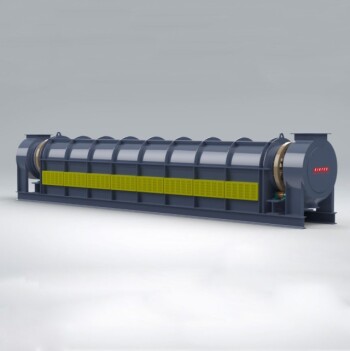
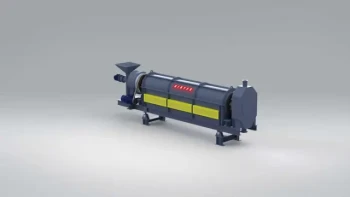
Laboratory rotary kilns and muffle furnaces serve as the essential thermal reactors for transforming raw biomass into carbon-rich intermediates. By providing a controlled, anaerobic environment typically between 450°C and 550°C, these devices facilitate the thermochemical decomposition required to strip away volatiles and establish a stable carbon skeleton. This primary carbonization phase is the foundational step for creating biochar, high-energy-density briquettes, or precursors for activated carbon.
The primary role of these furnaces is to provide a precise, oxygen-free thermal environment that drives de-volatilization and concentrates fixed carbon. This process effectively converts loose biomass into a structured, energy-dense carbon intermediate while managing the release of gaseous byproducts.
Facilitating Thermochemical Decomposition
Achieving Precise Temperature Control
Laboratory furnaces allow researchers to maintain specific temperatures, often ranging from 450°C to 550°C, to optimize the pyrolysis process. This precision ensures that the biomass reaches the exact thermal threshold required to break chemical bonds without over-calcining the material.
The temperature stability directly influences the graphitization degree and the retention of valuable heteroatoms like nitrogen and sulfur. By controlling the heat, the furnace dictates the final calorific value and the chemical reactivity of the resulting biochar.
Maintaining an Anaerobic Environment
To prevent combustion, these furnaces operate in an anaerobic or oxygen-deficient environment, often using inert gases like nitrogen or argon. This isolation is critical for "cooking" the biomass rather than burning it, allowing the material to undergo pyrolysis rather than simple incineration.
Advanced setups may also operate under micro-negative pressure (e.g., -0.10 kPa). This environment aids in the continuous removal of volatile substances and ensures the process remains stable and repeatable.
Engineering the Carbon Intermediate
Volatile Removal and Fixed Carbon Enrichment
The primary carbonization phase focuses on the de-volatilization of raw materials such as rice husks or corncobs. Furnaces utilize preset discharge ports to effectively exclude and collect water vapor, tar, and non-condensable gases.
As these volatile components are driven off, the fixed carbon content of the material increases significantly. This transformation turns loose, low-energy-density biomass into a high-quality carbonized product suitable for grinding or pressing into briquettes.
Forming the Primary Carbon Skeleton
During heating, the biomass undergoes structural changes that build the primary mechanical skeleton of the carbon. This skeleton serves as the foundation for all subsequent processing steps, such as pore activation.
The furnace environment determines how the internal structure develops. Proper carbonization ensures the material retains enough structural integrity to be used in industrial applications while beginning the pre-development of pores.
Rotary vs. Static Furnaces: Operational Impact
Enhancing Heat Transfer via Mechanical Action
Laboratory rotary kilns provide a distinct advantage by forcing the biomass to tumble during the heating process. This mechanical rotation ensures comprehensive contact between the solid matter and the gas phase.
The resulting uniform thermal environment is superior to that of static muffle furnaces, where material in the center of a crucible may heat slower than the edges. This uniformity leads to a more consistent product quality across the entire batch.
Efficiency and Pore Pre-development
Because rotary kilns provide more efficient heat transfer, they can significantly reduce carbonization time. This rapid but even heating is particularly beneficial for the early-stage development of the pore structure.
In contrast, static muffle furnaces are often used for smaller batches or precise quality testing, such as determining ash and volatile matter content according to international standards. They offer high atmospheric stability but lack the throughput and uniformity of rotary designs.
Understanding the Trade-offs
Mechanical Complexity vs. Static Simplicity
Rotary kilns involve moving parts and seals that must withstand high temperatures, which increases the mechanical maintenance requirements. If a seal fails, oxygen can enter the chamber, ruining the batch and potentially creating a fire hazard.
Muffle furnaces are mechanically simpler and easier to operate but may suffer from thermal gradients. In a static environment, the biomass layer's thickness can limit heat penetration, leading to uneven carbonization if not carefully managed.
Energy Consumption and Throughput
Maintaining high temperatures for extended periods requires significant energy, especially in larger muffle furnaces with high thermal mass. Rotary kilns are generally more energy-efficient for larger volumes due to the constant movement of material, but they may be overkill for simple laboratory-scale testing.
Strategic Selection for Your Pyrolysis Goals
How to Apply This to Your Project
- If your primary focus is uniform pore development: Utilize a rotary kiln to ensure consistent heat distribution and better pre-activation of the carbon skeleton.
- If your primary focus is precise chemical analysis or small-scale testing: Opt for a muffle furnace to maintain a static, highly controlled atmosphere for determining ash and volatile content.
- If your primary focus is creating high-density fuel briquettes: Use a furnace capable of reaching at least 500°C to maximize fixed carbon enrichment and calorific value.
- If your primary focus is nitrogen-doped carbon materials: Ensure your furnace supports a strict inert gas flow (N2/Ar) to prevent the loss of heteroatoms during the de-volatilization stage.
Mastering the primary carbonization environment is the single most important factor in determining the quality and structural integrity of the resulting biochar.
Summary Table:
| Feature | Laboratory Rotary Kiln | Muffle Furnace |
|---|---|---|
| Heating Method | Continuous tumbling (mechanical) | Static (crucible-based) |
| Temperature Range | 450°C to 550°C (optimized) | Up to 1200°C+ |
| Heat Uniformity | Excellent (uniform thermal environment) | Moderate (potential thermal gradients) |
| Primary Application | Large-scale biochar production, pore development | Small-scale testing, ash/volatile analysis |
| Atmosphere Control | Anaerobic / Micro-negative pressure | Strict inert gas flow (N2/Ar) |
Maximize Your Biomass Research Potential with KINTEK
Precise carbonization is the foundation of high-quality biochar and activated carbon. KINTEK specializes in high-performance laboratory equipment designed to give you total control over your thermochemical processes. From rotary and muffle furnaces that ensure perfect anaerobic conditions to crushing and milling systems and hydraulic presses for sample preparation and briquetting, we provide the end-to-end tools your lab needs.
Why choose KINTEK?
- Precision Engineering: Achieve exact temperature thresholds (450°C-550°C) for optimal de-volatilization.
- Comprehensive Solutions: Access a full range of reactors, furnaces, and essential consumables like crucibles and ceramics.
- Reliable Results: Ensure repeatable, stable environments for advanced material research.
Ready to elevate your pyrolysis workflow? Contact KINTEK today to discuss your specific laboratory requirements and discover how our advanced thermal solutions can drive your innovation forward.
References
- Iwona Skoczko, Remigiusz Gumiński. Tests on the Application of Various Types of Biomass for Activated Carbon Production. DOI: 10.12911/22998993/174223
This article is also based on technical information from Kintek Solution Knowledge Base .
Related Products
- Electric Rotary Kiln Small Rotary Furnace Biomass Pyrolysis Plant
- Electric Rotary Kiln Pyrolysis Furnace Plant Machine Calciner Small Rotary Kiln Rotating Furnace
- Electric Rotary Kiln Continuous Working Small Rotary Furnace Heating Pyrolysis Plant
- Electric Rotary Kiln Small Rotary Furnace for Activated Carbon Regeneration
- Vacuum Sealed Continuous Working Rotary Tube Furnace Rotating Tube Furnace
People Also Ask
- What is the temperature of a rotating kiln? It Depends on Your Material and Process Goal
- What are the principles of a rotary kiln? Master the Mechanics of High-Temperature Processing
- What are the different types of calciners? A Guide to Selecting the Right Thermal Processing Equipment
- How are rotary kilns heated? Direct vs. Indirect Heating Methods Explained
- Is rotary kiln a furnace? Discover the Key Differences for Industrial Processing