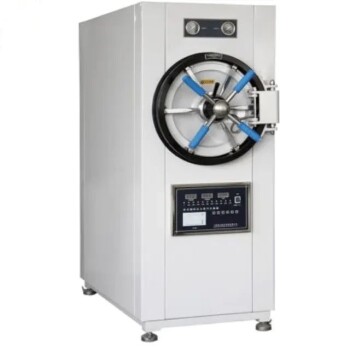
In the synthesis of ordered mesoporous carbon nanospheres, a high-pressure hydrothermal autoclave functions as a necessary vessel for thermodynamic control, creating a sealed environment capable of sustaining high temperatures and pressures. These specific conditions are required to drive the self-assembly of carbon precursors around template agents, a process that is thermodynamically difficult or impossible under standard atmospheric conditions.
The autoclave provides the kinetic and thermodynamic energy needed to force carbon precursors into organized structures, directly resulting in uniform spherical shapes and ordered, internal pore channels.
The Physics of the Reaction Environment
The Role of the Closed System
The autoclave acts as a closed reaction environment. By sealing the reactants, it prevents the loss of solvents and volatile components during the heating process.
Surpassing Atmospheric Limits
This sealed nature allows the system to reach high temperatures and high pressures simultaneously. Crucially, it enables solvents to remain liquid at temperatures far exceeding their atmospheric boiling points, creating a supercritical or near-supercritical fluid state.
Driving the Mechanism of Self-Assembly
Facilitating Precursor-Template Interaction
The core function of the autoclave in this context is to promote self-assembly. The high-pressure environment forces carbon precursors (the building blocks) to arrange themselves precisely around template agents (the structural guides).
Inducing Structural Order
Without this specific high-pressure induction, carbon precursors might aggregate randomly. The hydrothermal conditions ensure the carbon organizes into a coherent lattice structure, mimicking the geometry of the template.
Defining Morphology and Structure
Achieving Regular Spherical Morphologies
The autoclave controls the nucleation and growth kinetics of the particles. This control is what allows for the formation of regular spherical morphologies, ensuring the final nanospheres are uniform rather than irregular clumps.
Creating Ordered Mesoporous Channels
Beyond the external shape, the autoclave determines the internal architecture. The conditions facilitate the formation of ordered mesoporous channel structures, which are critical for applications requiring high surface area and specific pore accessibility.
Understanding the Trade-offs
Sensitivity to Parameters
While the autoclave enables precision, it also introduces high sensitivity. Slight deviations in the filling degree (how full the vessel is) or temperature can drastically alter the internal pressure, potentially leading to inconsistent particle sizes or collapsed pores.
Kinetic Complexities
The high-pressure environment accelerates reaction rates significantly. If not carefully managed, this acceleration can lead to rapid, uncontrolled nucleation, resulting in polydisperse (non-uniform) spheres rather than the desired monodisperse product.
Making the Right Choice for Your Goal
To optimize the synthesis of ordered mesoporous carbon nanospheres, you must tune the autoclave parameters to your specific structural requirements.
- If your primary focus is Uniformity (Monodispersity): Prioritize the precise control of the temperature ramp rate to manage nucleation kinetics, ensuring all spheres grow at the same speed.
- If your primary focus is Pore Architecture: Focus on maintaining stable high pressure to ensure the self-assembly of the precursor around the template is complete and robust before carbonization.
The high-pressure hydrothermal autoclave is not merely a heating vessel; it is the tool that imposes order upon the chaotic behavior of carbon precursors.
Summary Table:
| Feature | Role in Nanosphere Synthesis | Impact on Final Product |
|---|---|---|
| Closed System | Prevents solvent loss and increases internal pressure | Enables supercritical fluid states for reaction |
| Thermal Control | Manages nucleation and growth kinetics | Ensures regular spherical morphology and uniformity |
| High Pressure | Drives precursor-template self-assembly | Creates ordered internal mesoporous channels |
| Kinetic Energy | Accelerates reaction rates beyond atmospheric limits | Achieves structural order and lattice coherence |
Elevate Your Nanomaterial Synthesis with KINTEK Precision
Unlock the full potential of your research with KINTEK’s premium high-pressure hydrothermal autoclaves and reactors. Whether you are developing ordered mesoporous carbon nanospheres or advanced battery materials, our equipment provides the precise thermodynamic control and safety required for complex self-assembly processes.
Why choose KINTEK for your laboratory?
- Comprehensive Range: From high-temperature furnaces (muffle, vacuum, CVD) to hydraulic presses and crushing systems.
- Specialized Solutions: High-performance electrolytic cells, battery research tools, and ultra-low temperature cooling solutions.
- Quality Consumables: Durable PTFE products, ceramics, and crucibles designed for extreme environments.
Don't let inconsistent pressure or temperature hinder your results. Contact us today to find the perfect autoclave for your lab and experience the KINTEK difference in scientific excellence.
References
- Apoorva Shetty, Gurumurthy Hegde. Biomass-Derived Carbon Materials in Heterogeneous Catalysis: A Step towards Sustainable Future. DOI: 10.3390/catal13010020
This article is also based on technical information from Kintek Solution Knowledge Base .
Related Products
- High Pressure Laboratory Autoclave Reactor for Hydrothermal Synthesis
- Mini SS High Pressure Autoclave Reactor for Laboratory Use
- Stainless High Pressure Autoclave Reactor Laboratory Pressure Reactor
- Automatic High Temperature Heated Hydraulic Press Machine with Heated Plates for Lab
- Customizable High Pressure Reactors for Advanced Scientific and Industrial Applications
People Also Ask
- What role does a high-pressure reactor (autoclave) play in the synthesis of NiCuFe-LDH? Master Hydrothermal Growth
- What Role Does a High-Pressure Reactor or Autoclave Play in HA Catalyst Synthesis? Achieve High Surface Area Materials
- What equipment is required for hydrothermal synthesis of Ga0.25Zn4.67S5.08? Optimize Your Semiconductor Production
- What is the function of a high-pressure reactor in the hydrothermal synthesis of boehmite? Expert Process Insights
- What role does an autoclave play in the synthesis of MnO2 nanofibers? Mastering Hydrothermal Growth