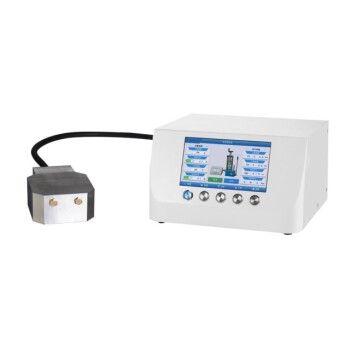
A laboratory thermostatic shaker is the foundational tool for ensuring experimental consistency in fluoride removal studies. It provides the precise mechanical energy and thermal stability required to move fluoride ions from a liquid solution onto the surface of an adsorbent. By maintaining these conditions, the device allows researchers to measure the true speed and capacity of a material’s performance without interference from environmental variables.
The primary role of a thermostatic shaker is to eliminate "liquid film diffusion resistance" by providing continuous mechanical agitation. This ensures that the data collected during a study reflects the intrinsic properties of the adsorbent rather than the limitations of the testing environment.
Overcoming Mass Transfer Resistance
Eliminating the Boundary Layer
In a static solution, a thin, stagnant layer of liquid surrounds every particle of the adsorbent, acting as a physical barrier to fluoride ions. The shaker uses continuous mechanical agitation—often calibrated to specific speeds like 240 rpm—to disrupt this boundary layer. This process, known as overcoming liquid film diffusion resistance, allows fluoride ions to move freely from the water to the active sites of the adsorbent.
Maximizing Surface Area Contact
To obtain accurate kinetic data, every part of the adsorbent material must be in contact with the fluoride-containing water. The shaker keeps particles, such as activated carbon or biochar, suspended in the solution rather than allowing them to settle at the bottom of the flask. This suspension ensures that the total available surface area of the material is utilized throughout the duration of the experiment.
The Role of Precise Thermal Control
Validating Thermodynamic Parameters
Adsorption is a temperature-sensitive process that can be either exothermic (releasing heat) or endothermic (absorbing heat). The thermostatic component of the shaker maintains a constant temperature, which is essential for calculating thermodynamic values like enthalpy, entropy, and Gibbs free energy. Without this stability, temperature fluctuations would introduce "noise" into the data, making it impossible to fit the results to standard kinetic models.
Simulating Real-World Conditions
Water treatment occurs in diverse climates, and a thermostatic shaker allows researchers to simulate these specific environmental conditions. By testing at various controlled temperatures, scientists can predict how a specific adsorbent will perform in hot groundwater versus cooler industrial wastewater. This predictive power is vital for scaling laboratory discoveries into functional, real-world water filtration systems.
Understanding the Trade-offs and Limitations
Agitation Speed vs. Particle Attrition
While increasing the rotation speed reduces diffusion resistance, there is a point of diminishing returns. Excessive agitation can cause mechanical "attrition," where the adsorbent particles physically break down into smaller fragments. This unintended breakdown artificially increases the surface area, which can lead to overestimating the material's effectiveness and skewing the kinetic results.
Thermal Gradients and Placement
Not all shakers distribute heat perfectly across their entire platform, which can create subtle "cold spots." If multiple samples are being tested simultaneously, a slight variance in temperature between flasks can lead to inconsistent data points. Researchers must ensure their equipment is properly calibrated and that flasks are positioned to receive uniform thermal exposure.
How to Apply This to Your Kinetic Study
Ensuring the integrity of your fluoride removal study requires matching your shaker settings to your specific research goals.
- If your primary focus is determining maximum adsorption capacity: Set the agitation speed high enough to eliminate diffusion resistance but low enough to maintain the physical integrity of your adsorbent particles.
- If your primary focus is environmental simulation: Use the thermostatic controls to run a series of identical kinetic tests at different temperature intervals (e.g., 15°C, 25°C, and 35°C) to map the material's thermal sensitivity.
- If your primary focus is industrial scalability: Standardize your agitation speed across all trials to ensure that your kinetic data can be accurately translated into the design of large-scale stirred-tank reactors.
By mastering the balance of mechanical force and thermal stability, you transform a simple piece of laboratory equipment into a precision instrument for chemical discovery.
Summary Table:
| Feature | Primary Function | Research Impact |
|---|---|---|
| Mechanical Agitation | Eliminates liquid film diffusion resistance | Ensures data reflects intrinsic adsorbent properties. |
| Particle Suspension | Maximizes adsorbent-liquid surface contact | Guarantees full utilization of available surface area. |
| Thermal Stability | Maintains constant temperature gradients | Enables validation of thermodynamic parameters (Enthalpy). |
| Environmental Simulation | Replicates real-world water conditions | Improves predictive power for industrial-scale applications. |
Elevate Your Research Precision with KINTEK
Achieving accurate kinetic data requires equipment that delivers unwavering consistency. KINTEK specializes in high-performance laboratory equipment designed to meet the rigorous demands of environmental and material science.
Beyond our precision laboratory shakers and homogenizers, our comprehensive portfolio includes:
- Thermal Solutions: High-temperature furnaces (muffle, vacuum, CVD) and advanced cooling systems (ULT freezers, freeze dryers).
- Processing Equipment: Crushing and milling systems, sieving equipment, and hydraulic presses.
- Specialized Reactors: High-temperature high-pressure reactors, autoclaves, and electrolytic cells.
- Lab Consumables: Premium PTFE products, ceramics, and crucibles.
Whether you are refining fluoride removal adsorbents or developing new battery technologies, KINTEK provides the reliable tools and technical support you need to scale your discoveries. Contact us today to find the perfect equipment for your lab!
References
- K. Kiran Kumar, G. Krishnaveni. Defluoridation of Water by Biowaste Material – A Study of Adsorption Kinetics and Isotherms. DOI: 10.46488/nept.2023.v22i04.031
This article is also based on technical information from Kintek Solution Knowledge Base .
Related Products
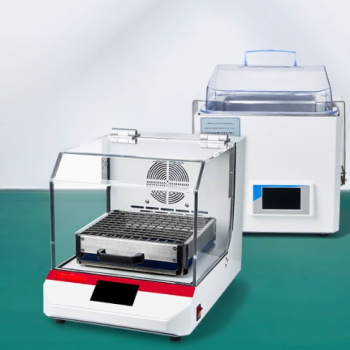
- Shaking Incubators for Diverse Laboratory Applications
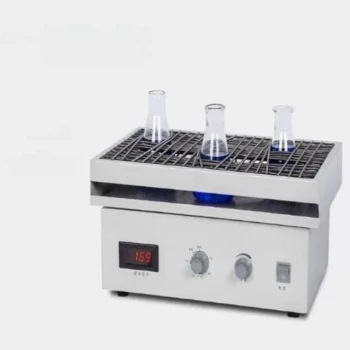
- Laboratory Multifunctional Small Speed-Adjustable Horizontal Mechanical Shaker for Lab
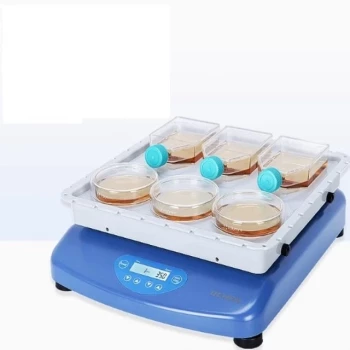
- Laboratory Oscillating Orbital Shaker
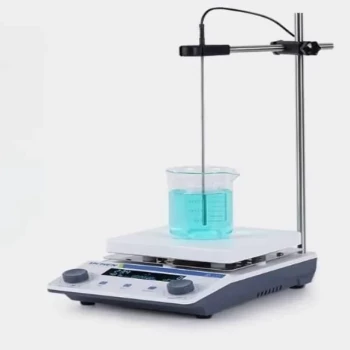
- Laboratory Small Constant Temperature Heated Magnetic Stirrer Heater and Stirrer
- 24T 30T 60T Heated Hydraulic Press Machine with Heated Plates for Laboratory Hot Press
People Also Ask
- What physical conditions does a shaking incubator provide for bioethanol fermentation? Optimize Yeast Productivity
- Why is the mechanical agitation provided by a shaking incubator necessary for the enzymatic hydrolysis of biomass?
- What critical reaction conditions does a shaking incubator provide? Optimize Cassava Cellulose Enzymatic Hydrolysis
- What are the primary functions of a shaking incubator? Optimize Biomass Fenton Pretreatment Efficiency
- What function does a laboratory shaking incubator serve for halophilic archaea? Optimize Your Seed Cultivation Today