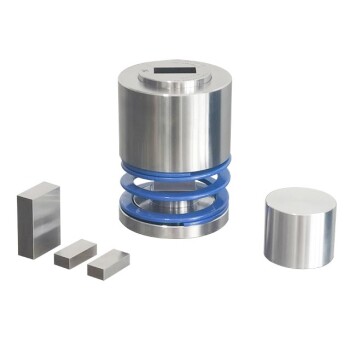
High-pressure synthesis equipment serves as the primary stabilizing force necessary to create layered 2D anti-perovskite materials like $\text{Li}_4\text{OBr}_2$. By applying extreme external pressure, these hydraulic presses and reactors force the formation of specific inverse Ruddlesden-Popper layered structures that are thermodynamically unstable and difficult to maintain under standard atmospheric conditions.
The utility of high pressure extends beyond simple synthesis; it acts as a precise lattice-tuning tool that compresses the crystal structure to optimize ion transport channels, a critical requirement for high-performance solid-state electrolytes.
The Mechanics of Structural Stabilization
Overcoming Thermodynamic Barriers
At atmospheric pressure, materials naturally settle into their lowest energy states. However, the desired layered structure of $\text{Li}_4\text{OBr}_2$ is often distinct from this natural state.
High-pressure equipment introduces massive external energy, forcing atoms to arrange themselves into inverse Ruddlesden-Popper phases. This allows researchers to access and stabilize crystal structures that would otherwise be impossible to form.
Enforcing Layered Configurations
The equipment applies uniform force to maintain the integrity of 2D layers. Without this pressure, the delicate stacking order of the anti-perovskite structure would likely collapse or revert to a bulk, non-layered phase.
Optimizing Electrochemical Performance
Compressing the Crystal Lattice
The primary reference highlights that high-pressure environments physically compress the crystal lattice. This reduction in volume brings ions closer together and alters the geometric parameters of the material's unit cell.
Tuning Ion Transport Channels
The ultimate goal of this synthesis is often the development of solid-state electrolytes.
By compressing the lattice, the equipment modifies the pathways—or channels—through which ions move. This optimization is essential for maximizing ionic conductivity, determining how effectively the material can function in a battery setting.
Understanding the Trade-offs
Synthesis Complexity
While high-pressure synthesis allows for the creation of exotic materials, it introduces significant complexity. The equipment requires precise calibration and safety protocols, making the process more resource-intensive than standard solid-state reactions.
Stability Challenges
A critical consideration is the "quenchability" of the material. You must ensure that the desired crystal phase remains stable once the external pressure is removed. If the lattice relaxes back to its atmospheric state immediately upon decompression, the functional benefits of the synthesis are lost.
Making the Right Choice for Your Goal
To leverage high-pressure synthesis effectively for materials like $\text{Li}_4\text{OBr}_2$, consider your specific objectives:
- If your primary focus is fundamental material discovery: Use high pressure to map out the stability windows of inverse Ruddlesden-Popper structures that do not exist in nature.
- If your primary focus is electrolyte performance: Utilize pressure specifically to tune the lattice dimensions, aiming to widen or optimize the specific channels required for rapid lithium-ion transport.
High-pressure synthesis is not just a method of fabrication; it is a method of structural engineering that dictates the final performance of the electrolyte.
Summary Table:
| Feature | Role of High-Pressure Synthesis | Impact on Li4OBr2 |
|---|---|---|
| Structural Stability | Forces formation of inverse Ruddlesden-Popper phases | Prevents lattice collapse; maintains 2D layering |
| Lattice Tuning | Compresses the unit cell volume | Optimizes pathways for faster lithium-ion transport |
| Thermodynamics | Overcomes ambient energy barriers | Stabilizes phases that are impossible at 1 atm |
| Performance | Enhances ionic conductivity | Creates high-performance solid-state electrolytes |
Elevate Your Material Research with KINTEK Precision
Unlock the full potential of your layered 2D anti-perovskite synthesis with KINTEK’s industry-leading high-pressure solutions. Whether you are mapping new material phases or optimizing ion transport for solid-state batteries, our advanced high-pressure high-pressure reactors, autoclaves, and hydraulic presses (pellet, hot, and isostatic) provide the extreme stability and lattice-tuning precision your research demands.
Why choose KINTEK?
- Comprehensive Laboratory Range: From high-temperature furnaces and crushing systems to essential consumables like crucibles and ceramics.
- Expertise in Energy Storage: Specialized tools for battery research, including electrolytic cells and electrodes.
- Built for Extremes: Engineered for safety and reliability in high-temperature, high-pressure environments.
Ready to engineer the next generation of solid-state electrolytes? Contact KINTEK today to discuss your equipment needs!
Related Products
- Customizable Laboratory High Temperature High Pressure Reactors for Diverse Scientific Applications
- Customizable High Pressure Reactors for Advanced Scientific and Industrial Applications
- Stainless High Pressure Autoclave Reactor Laboratory Pressure Reactor
- Visual High-Pressure Reactor for In-Situ Observation
- Mini SS High Pressure Autoclave Reactor for Laboratory Use
People Also Ask
- How do high-pressure and high-temperature reactors ensure the effective treatment of lignocellulosic wastewater in WAO?
- What equipment is required for high-pressure high-temperature reactions? Master Extreme Chemistry Safely
- How do you control high pressure in a reactor? A Guide to Safe & Stable Operation
- How does initial oxygen pressure affect the wet oxidation of pharmaceutical sludge? Master Your Oxidation Depth
- Why is argon better than nitrogen for inert atmosphere? Ensure Absolute Reactivity & Stability