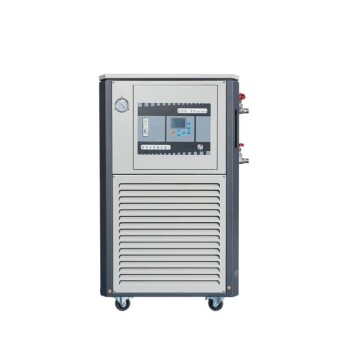
In the context of solar collector simulations, the heating unit acts as the primary simulator of solar energy absorption, while the jacketed system manages the critical exchange of that energy. Together, these components create a controlled environment where the heating unit mimics the heat source and the jacketed vessel facilitates the transfer of thermal energy from the nanofluid carrier to the target medium, usually water.
By coupling a controlled heat source with a jacketed exchange vessel, researchers can isolate variables to precisely measure convective heat transfer efficiency. This setup allows for the quantification of how effectively different nanofluid concentrations accelerate the heating process.
Mechanisms of Heat Transfer Simulation
To understand the simulation process, it is necessary to examine how the reactor separates energy generation from energy transfer.
Simulating Solar Absorption
The heating unit serves as the system's engine. Its primary role is to provide a controlled heat source that mimics the thermal energy absorption characteristics of a solar collector.
By generating a stable thermal input, this unit replicates the energy a collector would receive from the sun. This creates a baseline for testing how well that energy can be moved.
Facilitating Energy Exchange
The jacketed system functions as the thermal interface. It does not generate heat but rather facilitates the energy exchange between the heat carrier and the heated medium.
This system works in tandem with associated piping and pumps. It circulates the nanofluid heat carrier around the heated medium (water) to transfer the thermal energy generated by the heating unit.
Measuring Convective Efficiency
The ultimate goal of this configuration is performance verification. The system is designed to measure the specific time required to reach a target temperature, such as 50°C.
This metric provides a quantifiable standard. It verifies the efficiency of different nanofluid concentrations in enhancing convective heat transfer compared to base fluids.
Critical Considerations for Accuracy
While this system provides a robust simulation environment, it is important to recognize the dependencies involved in the setup.
Dependence on Auxiliary Components
The jacketed system cannot function in isolation. It relies heavily on the associated piping and pumps to maintain consistent flow.
If the pumping mechanism fails to maintain a steady flow rate, the rate of energy exchange will fluctuate. This can lead to inaccurate data regarding the time-to-temperature metrics.
Fluid Composition Sensitivity
The simulation is highly sensitive to the concentration of nanofluids. The setup is specifically engineered to detect changes in convective heat transfer caused by these fluids.
Therefore, the precision of the heating unit is paramount. Even slight deviations in the heat source can obscure the marginal efficiency gains provided by the nanofluid carrier.
Making the Right Choice for Your Simulation
When designing or analyzing a reactor for solar heat transfer, consider your specific experimental goals to maximize data integrity.
- If your primary focus is validating fluid chemistry: Ensure the jacketed system and pumps provide a flawlessly consistent flow rate to isolate the nanofluid's convective properties.
- If your primary focus is system speed: Focus on the heating unit's ability to maintain a consistent output to accurately measure the time required to reach the 50°C target.
By coordinating the heat source with the exchange vessel, you transform raw thermal data into actionable insights about collector performance.
Summary Table:
| Component | Role in Simulation | Function for Solar Research |
|---|---|---|
| Heating Unit | Solar Absorption Simulator | Provides stable thermal input mimicking solar energy absorption. |
| Jacketed System | Thermal Interface | Facilitates energy exchange between the nanofluid carrier and target medium. |
| Piping & Pumps | Flow Controller | Maintains consistent circulation to ensure accurate heat exchange data. |
| Nanofluid Carrier | Heat Transfer Medium | Enhances convective heat transfer efficiency within the reactor system. |
Advance Your Solar Thermal Research with KINTEK Precision
Maximize the accuracy of your heat transfer simulations with KINTEK’s industry-leading laboratory solutions. Whether you are analyzing nanofluid efficiency or measuring convective heat transfer, our high-performance high-temperature high-pressure reactors and autoclaves provide the stability and control your data demands.
From advanced jacketed reactor systems and crushing and milling systems to essential PTFE and ceramic consumables, KINTEK specializes in equipping researchers with the tools needed to transform complex thermal data into actionable insights.
Ready to elevate your laboratory capabilities? Contact us today to discover how our comprehensive range of equipment—including cooling solutions and battery research tools—can drive your project's success.
References
- Andreea Kufner .. DESIGN PARAMETERS TO OBTAIN AL2O3 NANOFLUID TO ENHANCE HEAT TRANSFER. DOI: 10.15623/ijret.2013.0209002
This article is also based on technical information from Kintek Solution Knowledge Base .
Related Products
- Multi Heating Zones CVD Tube Furnace Machine Chemical Vapor Deposition Chamber System Equipment
- High Temperature Constant Temperature Heating Circulator Water Bath Chiller Circulator for Reaction Bath
- Customer Made Versatile CVD Tube Furnace Chemical Vapor Deposition Chamber System Equipment
- Double-Layer Water Bath Electrolytic Electrochemical Cell
- 10L Heating Chilling Circulator Cooling Water Bath Circulator for High and Low Temperature Constant Temperature Reaction
People Also Ask
- What are the advantages of a multi-zone tube furnace for Sb2S3? Unlock Superior Semiconductor Thin Film Purity
- What are the advantages of using a Multi-zone Tube Furnace? Enhanced Thermal Uniformity for Diffusion Research
- What is a CVD tube furnace? A Complete Guide to Thin-Film Deposition
- What are the technical advantages of using a CVD tube furnace? Optimize Silicon-Carbon Battery Anodes
- What is the function of a high-temperature CVD tube furnace in 3D graphene foam prep? Master 3D Nanomaterial Growth