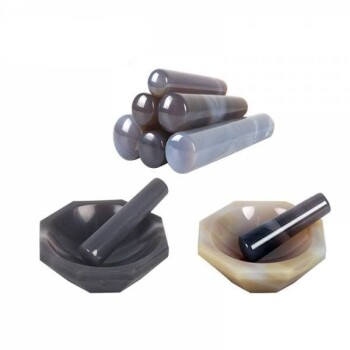
Agate grinding jars and balls are selected primarily for their high hardness and superior chemical inertness. When processing sensitive materials like silver vanadium oxide and solid electrolyte mixtures, these properties are essential to minimize wear-induced contamination. Unlike metal grinding media, agate prevents the introduction of conductive impurities that compromise battery safety and efficiency.
The Core Objective: The selection of agate media is a strategic choice to eliminate metallic impurities. Preserving the extreme purity of the mixture is critical to preventing internal short circuits and ensuring optimal electrochemical performance in all-solid-state batteries.
The Imperative of Contamination Control
Eliminating Metallic Impurities
The most significant risk in milling battery materials is the introduction of foreign particles from the grinding tools themselves.
Standard metallic media, such as stainless steel, can shed microscopic fragments during high-energy collisions.
Agate is a naturally hard, non-metallic mineral. Its use ensures that no conductive metal traces are introduced into the powder mixture, which is vital for the safety of the final cell.
Preventing Internal Short Circuits
The presence of even trace amounts of conductive metal can be catastrophic for a battery.
These impurities can act as bridges across the solid electrolyte, leading to internal short circuits.
By utilizing agate, you effectively remove the source of these conductive contaminants, ensuring the dielectric integrity of the electrolyte layer is maintained.
Optimizing Electrochemical Performance
Maintaining Chemical Inertness
Silver vanadium oxide and solid electrolytes are often chemically reactive or sensitive to catalytic changes.
Agate is chemically inert, meaning it does not react with the precursors or the active materials during the milling process.
This inertness ensures that the chemical composition of the mixture remains stable, preventing unwanted side reactions that could alter the material's properties.
Preventing Performance Degradation
Impurity contamination is a primary cause of electrochemical degradation over time.
Foreign particles can impede ion movement or degrade the active material structure during charge/discharge cycles.
Agate media preserves the high purity of the powder, which is directly linked to sustaining the long-term electrochemical performance and capacity of the battery.
Understanding the Trade-offs
The Inevitability of Wear
While agate is selected for its hardness, it is important to recognize that no grinding medium is completely wear-proof.
During prolonged or extremely high-energy milling, some abrasion of the agate jars and balls will occur.
However, the "contamination" resulting from agate (typically silica-based) is generally considered electrochemicaly benign or significantly less harmful compared to the fatal risks posed by metallic iron or chromium contamination.
Making the Right Choice for Your Goal
To ensure the success of your milling process, align your media selection with your specific performance targets:
- If your primary focus is Battery Safety: Select agate media to strictly eliminate conductive metallic debris that causes internal shorts.
- If your primary focus is Cycle Life: Rely on agate's chemical inertness to prevent impurities that degrade electrochemical stability over time.
Ultimately, selecting agate is about prioritizing the purity required to maintain the structural and electrical integrity of advanced energy storage systems.
Summary Table:
| Feature | Agate Media | Metallic Media (e.g., Steel) |
|---|---|---|
| Material Composition | Natural High-Purity Mineral | Stainless Steel / Iron Alloys |
| Contamination Risk | Non-conductive (benign) | Conductive (risk of short circuits) |
| Chemical Inertness | Superior (Non-reactive) | Moderate (Potential catalysis) |
| Hardness (Mohs) | 6.5 - 7 | ~5 - 6 (Depending on grade) |
| Primary Benefit | Preserves electrochemical integrity | Lower initial tool cost |
Elevate Your Battery Research with KINTEK Precision Milling Solutions
Contamination is the enemy of electrochemical performance. At KINTEK, we specialize in high-purity laboratory equipment designed for the rigorous demands of battery research and material science.
Our premium agate grinding jars and balls provide the hardness and chemical inertness required to process silver vanadium oxide and solid electrolytes without the risk of metallic impurities. Beyond milling, KINTEK offers a comprehensive range of crushing systems, hydraulic presses, high-temperature furnaces, and specialized battery research tools to streamline your workflow from powder preparation to cell testing.
Ready to safeguard your materials and prevent internal short circuits?
Contact KINTEK Today for a Custom Quote
Related Products
- Laboratory Jar Mill with Agate Grinding Jar and Balls
- Nature Agate Mortar and Pestle for Grinding and Mixing
- Laboratory Jar Ball Mill with Alumina Zirconia Grinding Jar and Balls
- Laboratory Ball Mill Jar Mill with Metal Alloy Grinding Jar and Balls
- Laboratory High Throughput Tissue Grinding Mill Grinder
People Also Ask
- What are the different types of laboratory mills? Choose the Right Grinder for Your Sample Material
- What is use for grinding in the laboratory? Select the Right Mill for Accurate Sample Prep
- What laboratory apparatus is used for grinding? Match the Right Mill to Your Sample Material
- What is the function of a laboratory grinding mill? Achieve Precise Sample Preparation for Accurate Results
- Why are agate milling jars and balls used for Mo-La2O3 powder mixing? Ensure High-Purity Material Dispersion