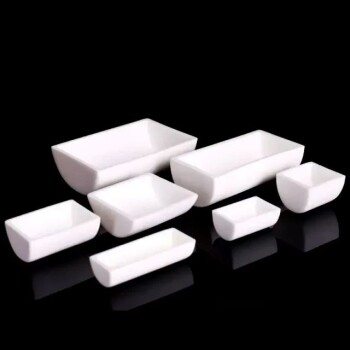
Alumina (corundum) boats are used for roasting Electric Arc Furnace (EAF) dust because they provide a chemically inert and thermally stable platform that prevents sample contamination and equipment damage. They maintain their structural integrity in harsh environments involving high temperatures and corrosive gases like hydrogen chloride (HCl), ensuring that heat and reaction gases act uniformly on the sample material.
Alumina boats serve as a critical barrier that ensures experimental purity and reactor longevity by leveraging high refractoriness and exceptional resistance to chemical erosion at temperatures exceeding 1000°C.
The Role of Refractoriness and Thermal Stability
Sustaining Structural Integrity at High Temperatures
EAF dust roasting often requires temperatures reaching up to 1300°C. Alumina ceramic boats possess high refractoriness, meaning they can withstand these extreme environments without physical deformation or melting.
Resistance to Thermal Shock
Roasting processes involve heating and cooling cycles that can cause inferior materials to crack. Alumina’s thermal shock resistance ensures the boat remains intact during the synthesis or activation process, protecting the sample from spills or furnace damage.
Maintaining a Stable Platform
The structural stability of corundum ensures that the sample remains in a consistent geometry throughout the reaction. This is vital for maintaining a stable vapor concentration gradient, which is essential for the formation of specific chemical structures or nanorods.
Chemical Inertness in Corrosive Environments
Resistance to Acidic and Reducing Gases
Roasting EAF dust often generates or utilizes aggressive gases such as hydrogen chloride (HCl) or reducing atmospheres like ammonia. Alumina is chemically inert to these substances, preventing the boat from being eaten away during the reaction.
Preventing Side Reactions with Additives
EAF dust samples frequently contain zinc oxide (ZnO), calcium oxide (CaO), or graphite additives. Alumina prevents unwanted side reactions between the container and these reactants, which would otherwise skew the analytical results of the roasted product.
Preservation of High Purity
Because alumina does not react with the sample or the atmosphere, it prevents the introduction of impurities. This ensures the chemical purity and structural integrity of the final product, whether it be recovered zinc or activated carbon.
Ensuring Experimental Precision and Safety
Protection of the Quartz Reactor
In many lab setups, the sample is placed inside a quartz reactor tube. The alumina boat prevents direct contact between the EAF dust and the quartz, which could otherwise lead to the sample fusing to the reactor or causing chemical etching of the glass.
Promoting Uniform Heating
The design of these boats, particularly flat-bottom versions, facilitates uniform heat distribution throughout the sample layer. This ensures that the entire sample undergoes the roasting reaction at the same rate, leading to more accurate and repeatable data.
Understanding the Trade-offs
Thermal Mass and Heating Rates
Alumina boats have a significant thermal mass, which can sometimes require a higher current or longer ramp times to reach the target temperature compared to thinner metallic sources. This must be accounted for in the furnace's power settings to ensure the sample reaches the desired thermal profile.
Fragility and Handling
While alumina is hard and heat-resistant, it is a ceramic and therefore brittle. It is susceptible to mechanical failure if dropped or handled with metal tongs too aggressively, requiring careful protocol during loading and unloading.
Cost vs. Longevity
While more expensive than some disposable options, the longevity of alumina boats makes them more cost-effective for repeated high-temperature cycles. However, if the sample contains aggressive alkaline agents at very high temperatures, even alumina may eventually suffer from gradual surface degradation.
Making the Right Choice for Your Goal
How to Apply This to Your Project
When selecting a sample holder for EAF dust roasting, your choice should be dictated by your specific experimental parameters:
- If your primary focus is analytical purity: Use a high-purity alumina (99%+) boat to ensure no trace elements from the container migrate into your EAF dust sample.
- If your primary focus is reactor longevity: Always utilize an alumina boat to prevent corrosive dust components from coming into direct contact with expensive quartz or ceramic furnace tubes.
- If your primary focus is uniform reaction kinetics: Select a flat-bottom alumina boat to maximize the surface area-to-volume ratio, ensuring even gas penetration and heat distribution.
By utilizing the chemical and thermal strengths of alumina, you ensure that your EAF dust roasting results are a product of the reaction itself, rather than a byproduct of container contamination.
Summary Table:
| Property | Benefit for EAF Dust Roasting |
|---|---|
| High Refractoriness | Withstands temperatures up to 1300°C without deformation. |
| Chemical Inertness | Resists corrosive HCl gases and avoids side reactions with ZnO or CaO. |
| Thermal Stability | Maintains sample geometry for consistent vapor concentration gradients. |
| Purity Protection | Prevents contamination and protects quartz furnace tubes from etching. |
| Uniform Heating | Flat-bottom design ensures even heat distribution across the sample. |
Elevate Your Thermal Processing Precision with KINTEK
Don't compromise your experimental accuracy with inferior sample holders. KINTEK specializes in high-performance laboratory equipment and consumables, offering premium alumina ceramics, crucibles, and boats designed to withstand the harshest roasting environments. Whether you are utilizing our advanced high-temperature muffle and tube furnaces or conducting complex material synthesis, our products ensure maximum purity and equipment longevity.
Ready to optimize your lab's workflow? Contact us today to explore our full range of ceramic solutions and thermal processing systems tailored for your research needs!
References
- D. I. Bludova, S. V. Mamyachenkov. Zinc extraction during recycling of electric arc furnace dust by chlorine-containing polymer wastes. DOI: 10.17580/nfm.2023.02.05
This article is also based on technical information from Kintek Solution Knowledge Base .
Related Products
- Aluminized Ceramic Evaporation Boat for Thin Film Deposition
- Ceramic Evaporation Boat Set Alumina Crucible for Laboratory Use
- Alumina Al2O3 Ceramic Crucible Semicircle Boat with Lid for Engineering Advanced Fine Ceramics
- Molybdenum Tungsten Tantalum Evaporation Boat for High Temperature Applications
- Tungsten Evaporation Boat for Thin Film Deposition
People Also Ask
- What is the source of evaporation for thin film? Choosing Between Thermal and E-Beam Methods
- Why are high-purity ceramic boats used for lignin activation? Ensure Purity & Thermal Stability
- Why is an alumina boat and Ti3AlC2 powder bed necessary for Ti2AlC sintering? Protect MAX Phase Purity
- Why use an alumina boat for high-temperature carbon activation? Ensure Maximum Material Purity & Thermal Stability
- Why is an alumina boat selected for catalyst precursors? Ensure Sample Purity at 1000 °C