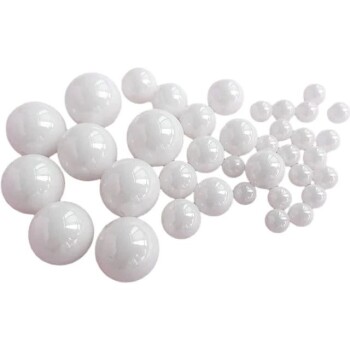
Zirconia grinding balls are the preferred media for milling c-LLZO materials because they combine the physical density required for high-energy pulverization with unique chemical compatibility. Since the c-LLZO precursor mixture already contains Zirconia (ZrO2), utilizing grinding media of the same material ensures that any inevitable wear debris does not introduce foreign impurities, thereby preserving the purity of the final solid electrolyte.
Core Insight: The selection of milling media is a strategic decision to align the hardness of the tool with the chemistry of the product. By using Zirconia to mill Zirconia-based precursors, you turn a common processing defect—media wear—into a benign addition that maintains the chemical integrity required for high-performance battery materials.
The Critical Role of Chemical Compatibility
Eliminating Foreign Contaminants
The primary driver for using Zirconia media is the strict requirement for purity in solid electrolytes.
In high-energy milling, media wear is unavoidable; the balls will degrade slightly over time.
Because c-LLZO precursors naturally contain Zirconia (ZrO2), wear debris from Zirconia balls simply adds more of a native ingredient rather than a foreign contaminant.
Preventing Performance Degradation
Alternative media, such as steel, introduces metallic impurities like iron during the grinding process.
These metallic contaminants can severely degrade the electrochemical stability and ionic conductivity of the final product.
Using chemically inert Zirconia prevents these adverse reactions, ensuring the material meets the rigorous standards for solid-state batteries.
Physical Properties and Milling Efficiency
High Density for Impact Force
Effective milling of hard oxide raw materials requires significant kinetic energy.
Zirconia is chosen for its high density, which translates to a higher impact force during planetary or ball milling.
This density allows the 2-3mm balls to effectively crush and pulverize the precursor materials into the requisite fine particle sizes.
Superior Hardness and Wear Resistance
Beyond density, the media must be harder than the material it is grinding to be effective.
Zirconia possesses extreme hardness and superior wear resistance compared to softer ceramics.
This ensures efficient particle refinement while minimizing the volume of media loss over long milling durations.
Understanding the Trade-offs
The Necessity of Matched Components
While Zirconia balls are effective, they must typically be paired with Zirconia grinding jars.
Using Zirconia balls in a softer jar (like plastic or lower-grade ceramic) can lead to rapid degradation of the jar walls, reintroducing contamination.
Cost vs. Purity
High-quality Zirconia media is generally more expensive than steel or alumina alternatives.
However, the cost is justified by the elimination of purification steps that would be required if foreign contaminants were introduced.
Making the Right Choice for Your Goal
When setting up your milling protocol for c-LLZO or similar solid electrolytes, consider the following principles:
- If your primary focus is Chemical Purity: Prioritize Zirconia media to ensure that any attrition (wear) results only in the addition of non-foreign ZrO2 to your mixture.
- If your primary focus is Milling Efficiency: Rely on Zirconia’s high density and hardness to generate the impact force necessary to pulverize hard oxide precursors effectively.
- If your primary focus is Electrochemical Performance: Avoid steel or non-inert media to prevent iron contamination that will hinder ionic conductivity.
By matching your grinding media to your precursor chemistry, you ensure that the physical processing does not compromise the chemical potential of your material.
Summary Table:
| Feature | Why Zirconia is Preferred for c-LLZO |
|---|---|
| Chemical Compatibility | Matches c-LLZO precursor (ZrO2); wear debris acts as a native ingredient rather than a contaminant. |
| Purity Preservation | Prevents metallic contamination (like iron from steel) that degrades ionic conductivity. |
| Milling Efficiency | High density provides the kinetic energy and impact force needed for hard oxide pulverization. |
| Durability | Extreme hardness and wear resistance ensure long-term performance and consistent particle size refinement. |
| System Synergy | Best paired with Zirconia grinding jars to eliminate secondary contamination from jar walls. |
Elevate Your Solid-State Battery Research with KINTEK
Precise milling is the foundation of high-performance electrolytes. KINTEK specializes in premium laboratory equipment and consumables designed for the most demanding materials science applications.
Whether you are processing c-LLZO or advanced ceramics, our high-density Zirconia grinding media and matching jars ensure your samples remain free from foreign contaminants while achieving optimal particle size refinement. Beyond milling, KINTEK offers a comprehensive range of solutions including:
- Crushing & Milling Systems: Planetary ball mills and high-wear-resistance media.
- High-Temperature Furnaces: Muffle, tube, and vacuum furnaces for precise sintering.
- Battery Research Tools: Specialized tools and consumables for next-generation energy storage.
- Advanced Processing: Hydraulic presses, high-pressure reactors, and autoclaves.
Don't let impurities compromise your electrochemical performance. Contact KINTEK today to discover how our high-purity consumables and precision equipment can streamline your laboratory workflow and enhance your material integrity.
Related Products
- Laboratory Jar Ball Mill with Alumina Zirconia Grinding Jar and Balls
- Precision Machined Zirconia Ceramic Ball for Engineering Advanced Fine Ceramics
- Laboratory Jar Mill with Agate Grinding Jar and Balls
- Laboratory Ball Mill Jar Mill with Metal Alloy Grinding Jar and Balls
- Laboratory Micro Tissue Grinding Mill Grinder
People Also Ask
- What are the primary functions of using a ball mill for BZCY72 powder? Achieve High Purity and Enhanced Sintering
- In what way does a laboratory ball mill affect material properties when modifying PHBV/pulp fiber composites?
- Why is a laboratory ball mill required for ultra-fine fly ash? Unlock Nano-Scale Adsorption Power
- What is the function of a laboratory ball mill in the preparation of AMMCs? Optimize Dispersion & Grain Refinement
- What is the function of a laboratory ball mill in the pretreatment of waste tire char (WTC)? Optimize Material Reactivity