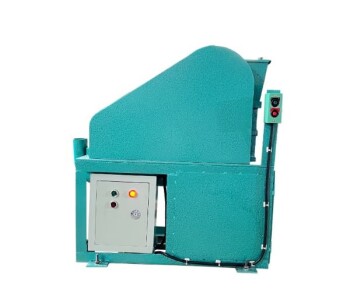
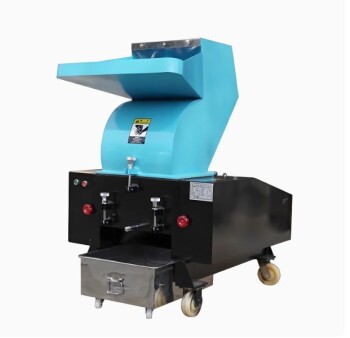
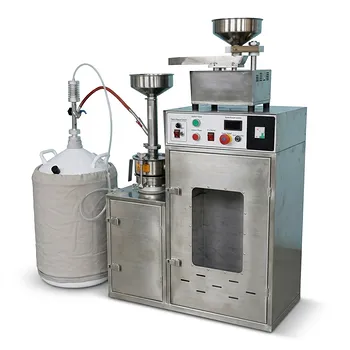
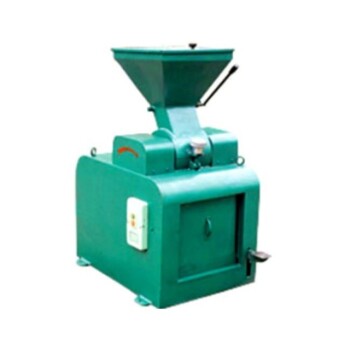
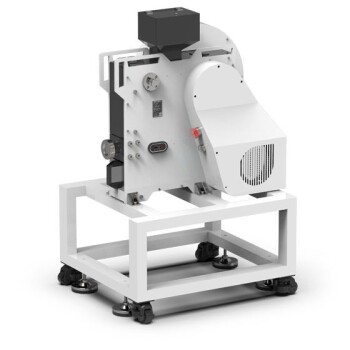
Effective chemical activation begins with precise physical preparation. High-energy crushing and milling systems are required to transform bulky African star apple seed shells into a refined powder with a specific particle size, typically ranging from -6 mesh down to 125–150μm. This mechanical reduction is essential because it exponentially increases the material's specific surface area, allowing chemical activating agents to penetrate the internal biomass structure deeply and uniformly.
High-energy milling serves as the critical bridge between raw biomass and high-performance activated carbon. By maximizing the available surface area, these systems ensure that activating agents can fully saturate the material, which is the fundamental requirement for developing a sophisticated and effective internal pore structure.
Maximizing Chemical Reactivity Through Surface Area
Overcoming the Natural Diffusion Barrier
Biomass materials like African star apple seed shells possess a dense, protective natural structure designed to resist external penetration.
High-energy milling shatters these physical barriers, creating a vast network of entry points for chemical agents such as phosphoric acid.
Without this initial reduction, the activating agent would only react with the outer crust, leaving the core of the material unrefined and inert.
Ensuring Uniform Internal Saturation
Reducing particles to a consistent range, such as 125–150μm, allows the chemical agent to reach the center of every grain via capillary action and diffusion.
This deep saturation ensures that the chemical reaction occurs simultaneously throughout the entire volume of the material during the heating phase.
Uniform saturation is the only way to prevent "raw spots" in the final product, ensuring that every milligram of the precursor contributes to the final porosity.
Optimizing the Pore Development Process
The Role of Pre-Carbonization Refinement
The ultimate goal of processing these seed shells is to create a high-porosity carbon matrix capable of adsorption.
Proper milling ensures that when the material is subjected to carbonization, the chemical agent is already in place to facilitate pore formation.
This leads to a more developed and interconnected network of micropores and mesopores, which directly determines the quality and grade of the activated carbon.
Enhancing Material Homogeneity
High-energy methods, such as planetary ball milling, are often employed to ensure the sample is completely homogenized.
Eliminating variations in particle size prevents analysis errors and ensures that the final product behaves predictably in industrial applications.
A homogeneous precursor results in a final product with consistent chemical and physical properties, which is vital for technical and commercial viability.
Understanding the Trade-offs and Challenges
Energy Consumption vs. Particle Size
While finer particles generally lead to better activation, high-energy milling is an energy-intensive process that increases operational costs.
Over-processing can also produce "fines"—excessively small dust particles—that may be lost during the carbonization process or cause clogging in downstream filtration equipment.
Finding the "sweet spot" between particle fineness and processing cost is a critical engineering challenge for large-scale production.
Thermal Management During Milling
High-energy systems generate significant friction and heat, which can potentially trigger premature chemical changes in the biomass.
If the seed shells overheat during milling, they may begin to lose volatile components or undergo surface oxidation before the activation stage.
Managing the temperature through intermittent milling or cooling systems is often necessary to preserve the chemical integrity of the raw material.
Strategic Implementation for Material Processing
Applying These Principles to Your Project
- If your primary focus is maximizing adsorption capacity: Prioritize milling the shells to the finer 125–150μm range to ensure the most thorough chemical penetration and pore development.
- If your primary focus is operational throughput: Aim for the coarser -6 to +40 mesh range to balance processing speed with a sufficient increase in surface area for standard activation.
- If your primary focus is product consistency: Utilize high-energy planetary milling to eliminate particle size variations and ensure a uniform reaction across the entire batch.
Precise mechanical refinement is the invisible foundation upon which high-performance activated carbon is built.
Summary Table:
| Feature | Targeted Range/Detail | Primary Benefit |
|---|---|---|
| Particle Size | 125–150μm | Ensures uniform chemical saturation |
| Specific Surface Area | High-energy reduction | Overcomes natural diffusion barriers |
| Homogeneity | Planetary milling | Eliminates analysis errors and variations |
| Thermal Control | Intermittent cooling | Preserves chemical integrity of biomass |
| Pore Development | Pre-carbonization refinement | Maximizes adsorption capacity and quality |
Elevate Your Material Preparation with KINTEK
Transform your raw biomass into high-performance activated carbon with KINTEK’s industry-leading precision equipment. We specialize in high-energy crushing and milling systems designed to achieve the perfect particle size, alongside a comprehensive range of high-temperature furnaces (muffle, vacuum, and atmosphere) for subsequent carbonization and activation.
Whether you are conducting laboratory-scale research or optimizing industrial throughput, KINTEK provides the expertise and tools—including planetary mills, ceramic crucibles, and cooling solutions—to ensure your process is efficient and your results are consistent.
Ready to optimize your activation process? Contact our technical experts today to find the perfect equipment solution for your laboratory's needs!
References
- Patrick Isicheli, Peter Muwarure. Pyrolytic conversion of waste plastics using African apple seed-based activated carbon catalyst. DOI: 10.30574/gjeta.2023.16.3.0199
This article is also based on technical information from Kintek Solution Knowledge Base .
Related Products
- High-Energy Omnidirectional Planetary Ball Mill Milling Machine for Laboratory
- High Energy Planetary Ball Mill Milling Machine for Laboratory
- High Energy Planetary Ball Mill Milling Machine for Laboratory
- High Energy Vibratory Laboratory Ball Mill Grinding Mill Single Tank Type
- High-Energy Omnidirectional Planetary Ball Mill Machine for Laboratory
People Also Ask
- How does a planetary ball mill solve mixing challenges with PEO? Unlock solid-state synthesis for insoluble dopants
- What is the role of a planetary ball mill in preparing doped high-nickel cathode materials? Enhance Battery Stability
- Why is a planetary ball mill used for LNMO precursor powders? Optimize Particle Uniformity & Battery Performance
- What is the function of a planetary ball mill in the solid-state synthesis of LiTa2PO8? Achieve High-Purity Electrolytes
- What is the critical role of a planetary ball mill in the processing of inorganic fillers? Enhance Battery Performance