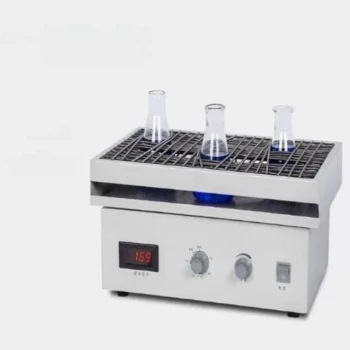
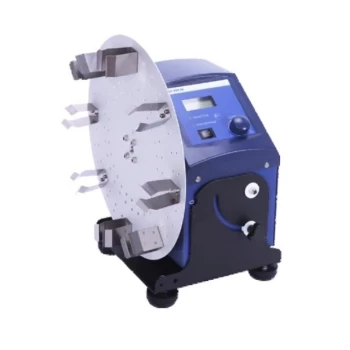
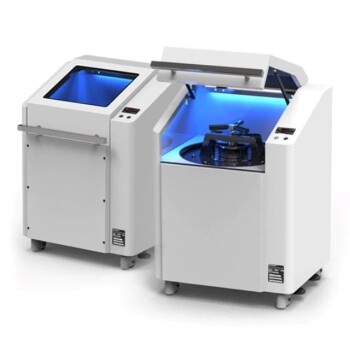
A high-performance laboratory magnetic stirrer is essential because it provides the consistent power required to maintain granular titanium dioxide in a continuous, uniform suspension throughout the reaction. Without this robust agitation, the catalyst would rapidly settle at the bottom of the reactor, rendering the active surface area inaccessible to the dye solution and compromising the experiment's validity.
Success in photocatalytic degradation relies on maximizing contact between the pollutant and the catalyst. A high-performance stirrer acts as the engine of the experiment, eliminating mass transfer limitations and preventing concentration gradients that distort efficiency data.
The Mechanics of Catalyst Suspension
To understand the necessity of high-performance stirring, one must look at the physical behavior of granular catalysts in a liquid medium.
Overcoming Gravity and Density
Granular titanium dioxide is significantly denser than the aqueous dye solutions typically used in these experiments. A standard stirrer often lacks the torque to prevent sedimentation, leading to a pile of catalyst on the reactor floor.
Creating Forced Convection
A high-performance unit provides consistent power output to generate forced convection. This fluid movement ensures the catalyst particles are not just moving, but are evenly distributed in a three-dimensional suspension.
Optimizing Reaction Kinetics
The primary goal of the experiment is to measure how effectively the catalyst degrades the dye. The stirring mechanism directly influences the chemical kinetics.
Maximizing Collision Frequency
Photocatalysis creates a reaction only when a dye molecule physically touches an active site on the titanium dioxide surface. Vigorous stirring increases the collision frequency between these molecules and the catalyst, driving the oxidation process.
Eliminating Concentration Gradients
In a poorly stirred reactor, "dead zones" of untreated solution can form while the solution near the catalyst becomes fully treated. High-performance stirring homogenizes the mixture, eliminating concentration gradients and ensuring the dye concentration is uniform throughout the vessel.
Removing Mass Transfer Limitations
By keeping the solution in constant motion, the stirrer removes mass transfer limitations. This ensures that the rate of reaction is limited only by the chemical activity of the catalyst, not by how slowly the dye diffuses through the liquid.
Common Pitfalls to Avoid
While high-performance stirring is necessary, it introduces variables that must be managed to maintain data integrity.
Catalyst Attrition
Excessive agitation speed can cause granular materials to grind against each other or the stir bar. This attrition breaks granules into finer particles, unintentionally increasing the surface area and skewing results mid-experiment.
Thermal Interference
High-performance motors can generate significant heat during long experiments. If the stirrer transfers this heat to the solution, it may alter the reaction rate, as temperature is a critical variable in chemical kinetics.
Ensuring Experimental Accuracy
To achieve reliable data, you must match your stirring capabilities to the physical properties of your catalyst and the goals of your experiment.
- If your primary focus is data reproducibility: Select a stirrer with feedback control to maintain a constant RPM, ensuring the suspension state remains identical across multiple trials.
- If your primary focus is kinetic analysis: Verify that your stirring speed is high enough that increasing it further does not change the reaction rate, confirming you have eliminated mass transfer limitations.
Proper agitation turns a static mixture into a dynamic reaction environment, ensuring your degradation efficiency metrics are both accurate and repeatable.
Summary Table:
| Key Feature | Impact on Photocatalytic Degradation | Benefit for Researcher |
|---|---|---|
| Consistent Torque | Prevents catalyst sedimentation & settling | Ensures maximum active surface area exposure |
| Forced Convection | Eliminates concentration gradients | Guarantees uniform dye-catalyst interaction |
| Mass Transfer Control | Reduces diffusion limitations | Ensures reaction rate reflects catalyst activity |
| RPM Stability | Maintains reproducible suspension states | Provides reliable, repeatable experimental data |
| Thermal Management | Prevents unintended solution heating | Protects the integrity of temperature-sensitive kinetics |
Elevate Your Research Precision with KINTEK
Achieving consistent photocatalytic degradation requires more than just chemistry—it requires the right laboratory environment. KINTEK specializes in high-performance laboratory equipment designed to eliminate variables and maximize efficiency. From robust magnetic stirrers and homogenizers that ensure perfect catalyst suspension to our specialized high-temperature reactors, electrolytic cells, and precision crushing systems, we provide the tools necessary for rigorous material science and battery research.
Don't let mass transfer limitations or inconsistent agitation skew your data. Partner with KINTEK for reliable equipment and essential consumables like PTFE products, ceramics, and crucibles tailored to your specific experimental needs.
Ready to optimize your lab's performance? Contact KINTEK today for a customized solution!
References
- Şahin Giray Atalı, Bilgehan Cem Turan. Granular titanium dioxide and silicon‐doped titanium dioxide as reusable photocatalysts for dye removal. DOI: 10.1111/ijac.14603
This article is also based on technical information from Kintek Solution Knowledge Base .
Related Products
- Laboratory Small Constant Temperature Heated Magnetic Stirrer Heater and Stirrer
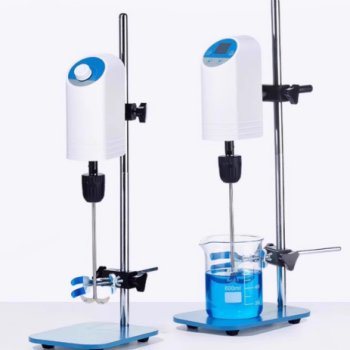
- High Performance Laboratory Stirrers for Diverse Applications
- Custom PTFE Teflon Parts Manufacturer for Magnetic Stirring Bar
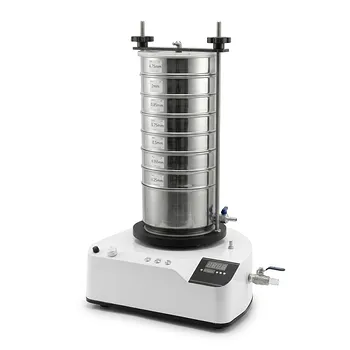
- Laboratory Vibratory Sieve Shaker Machine for Dry and Wet Three-Dimensional Sieving
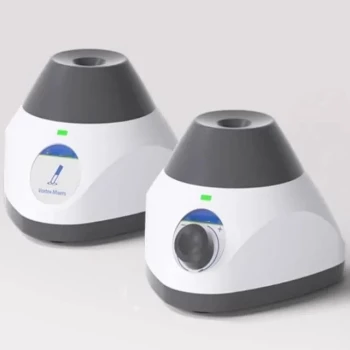
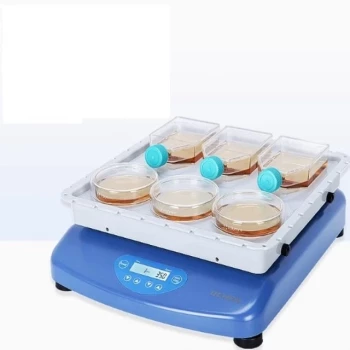
- Laboratory Vortex Mixer Orbital Shaker Multifunctional Rotation Oscillation Mixer
People Also Ask
- What role does a magnetic stirrer with heating play in ZnO nanoparticle synthesis? Precision Control for Quality Results
- What role does a constant temperature heating magnetic stirrer play in MFC-HAp synthesis? Achieve Material Homogeneity
- What is the function of a laboratory magnetic stirrer in Ni–Cr–P electrodeposition? Optimize Ion Transport & Coating
- Why is a laboratory magnetic stirrer required for benzoic acid esters? Boost Reaction Speed & Yield with High RPM
- What role does a laboratory magnetic stirrer play in TiO2 and TiO2-Ag sol preparation? Master Chemical Kinetics