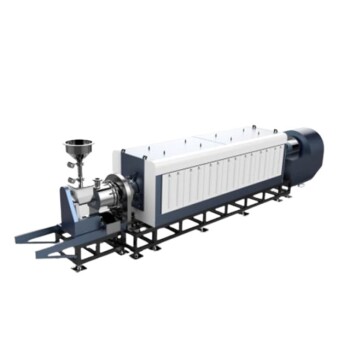
Precision control over phase and reaction kinetics. A high-temperature and high-pressure hydrothermal reactor is strictly necessary to achieve a temperature of 300°C while maintaining saturated steam pressure. This specific environment is required to degrade straw into reducing intermediates within a liquid phase, facilitating the simultaneous dissolution of aluminum and the reduction of hematite to high-purity magnetite.
Core Takeaway Standard atmospheric heating cannot support the complex chemistry required for this process. The reactor creates a closed, subcritical environment where water remains liquid at high temperatures, allowing the straw to function effectively as a reducing agent for iron while an alkaline medium dissolves aluminum.
Creating the Critical Thermodynamic Environment
Achieving the 300°C Threshold
The conversion of hematite (iron ore) to magnetite using biomass requires significant thermal energy. According to the primary technical data, this specific reduction process necessitates a temperature of 300°C.
Standard open-air vessels cannot reach this temperature without the liquid medium evaporating entirely. The hydrothermal reactor allows the system to reach this high thermal setpoint, which provides the thermodynamic conditions necessary to drive the reduction reaction forward.
Maintaining the Liquid Phase via Pressure
Temperature alone is not enough; the state of the solvent matters. At 300°C, water would normally exist only as superheated steam.
The reactor utilizes high pressure (saturated steam pressure) to force water to remain in a liquid or subcritical state. This liquid phase is essential because it acts as the transport medium that brings the reactants—the straw and the red mud—into intimate contact.
Enhancing Solvent Properties
Under these high-pressure, subcritical conditions, the physicochemical properties of water change. As noted in broader hydrothermal applications, the density and ion product of water increase.
This creates an environment where the water itself acts as a more effective solvent and catalyst. It penetrates the solid structures of the straw and the red mud more effectively than water at standard ambient conditions.
Facilitating Chemical Transformations
Straw Degradation and Reducing Intermediates
The primary function of the straw in this process is to act as a reducing agent. However, raw straw does not react efficiently with iron oxides.
The high-temperature, high-pressure liquid environment degrades the straw's complex lignocellulosic structure. This breakdown generates reducing intermediates—active chemical species derived from the biomass. These intermediates are what physically reduce the iron from hematite to magnetite.
Simultaneous Element Recovery
The reactor enables a dual-recovery process that would otherwise require separate steps.
- Aluminum Dissolution: The alkaline liquid environment promotes the dissolution of aluminum from the red mud into the solution.
- Iron Reduction: Simultaneously, the reducing intermediates from the straw convert the remaining iron solids into magnetite.
The closed reactor ensures that the volatile reducing agents generated by the straw are kept within the system long enough to react with the iron, rather than escaping as gas.
Understanding the Trade-offs
Equipment Complexity and Cost
Operating at 300°C and corresponding saturation pressures requires robust, specialized vessels. These reactors must be constructed from materials capable of withstanding both high mechanical stress and the corrosive nature of the alkaline red mud slurry. This significantly increases initial capital expenditure compared to atmospheric leaching tanks.
Energy Consumption
Reaching and maintaining 300°C consumes substantial energy. While the process is effective for element recovery, the energy cost must be weighed against the value of the recovered aluminum and magnetite.
Safety Considerations
Handling pressurized vessels at high temperatures introduces operational risks. Strict safety protocols and pressure relief systems are mandatory, adding a layer of operational complexity that does not exist in low-pressure hydrometallurgy.
Making the Right Choice for Your Goal
When evaluating the implementation of this hydrothermal method, consider your specific recovery targets:
- If your primary focus is High-Purity Magnetite: The high-pressure reactor is non-negotiable, as the specific reducing intermediates required for phase transformation are only generated effectively under these subcritical conditions.
- If your primary focus is Aluminum Recovery alone: You may be able to use lower-temperature atmospheric digestion, but you will sacrifice the ability to simultaneously upgrade the iron residue into valuable magnetite.
The high-pressure hydrothermal reactor is not just a vessel; it is a catalyst that enables the synergistic recovery of two valuable metals from waste in a single step.
Summary Table:
| Feature | Requirement for Red Mud & Straw Process | Role of the Hydrothermal Reactor |
|---|---|---|
| Temperature | 300°C Threshold | Provides thermal energy to drive hematite reduction and straw degradation. |
| Pressure | Saturated Steam Pressure | Keeps water in a subcritical liquid state to act as a transport medium. |
| Chemistry | Reducing Intermediates | Prevents volatile reducing agents from escaping, ensuring iron phase transformation. |
| Solvent State | High Density/Ion Product | Enhances penetration into solid red mud structures for efficient element recovery. |
Maximize Your Material Recovery with KINTEK Precision
Transitioning red mud waste into valuable magnetite and aluminum requires uncompromising equipment. KINTEK specializes in advanced laboratory solutions, providing the high-temperature high-pressure reactors and autoclaves necessary to maintain the 300°C subcritical environment required for complex hydrothermal chemistry.
From robust crushing and milling systems for feedstock preparation to specialized reactors that withstand corrosive alkaline slurries, KINTEK offers the complete toolset for battery research, metallurgical recovery, and material science.
Ready to elevate your lab's performance? Contact our technical experts today to find the perfect reactor configuration for your research goals.
References
- Xiaofei Li, Song Wang. Summary of Research Progress on Metallurgical Utilization Technology of Red Mud. DOI: 10.3390/min13060737
This article is also based on technical information from Kintek Solution Knowledge Base .
Related Products
- Customizable Laboratory High Temperature High Pressure Reactors for Diverse Scientific Applications
- High Pressure Laboratory Autoclave Reactor for Hydrothermal Synthesis
- Automatic High Temperature Heated Hydraulic Press Machine with Heated Plates for Lab
- Manual High Temperature Heated Hydraulic Press Machine with Heated Plates for Lab
- Customizable High Pressure Reactors for Advanced Scientific and Industrial Applications
People Also Ask
- How do high-pressure and high-temperature reactors ensure the effective treatment of lignocellulosic wastewater in WAO?
- What equipment is required for high-pressure high-temperature reactions? Master Extreme Chemistry Safely
- How do you control high pressure in a reactor? A Guide to Safe & Stable Operation
- Why is argon better than nitrogen for inert atmosphere? Ensure Absolute Reactivity & Stability
- How does initial oxygen pressure affect the wet oxidation of pharmaceutical sludge? Master Your Oxidation Depth