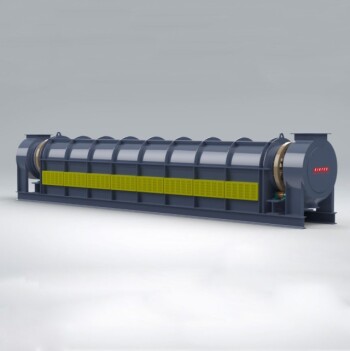
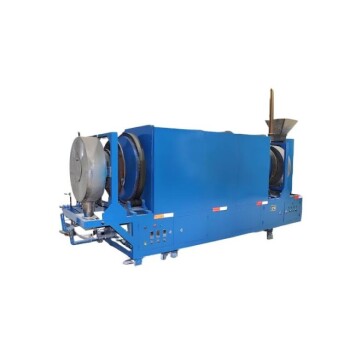
The primary function of operating a high-temperature calcination furnace at 900°C in an oxygen-rich atmosphere is to guarantee the complete destruction of residual organic matter found in pyrolysis products. This specific combination of intense heat and oxygen drives a total oxidation process, converting the waste into a purely inorganic ash.
Core Takeaway The ultimate goal of this thermal treatment is not just volume reduction, but chemical purification. By eliminating organic contaminants, the process prevents chemical interference with the downstream geopolymer solidification matrix, thereby ensuring the structural stability of the final radioactive waste form.
The Mechanism of Purification
Achieving Complete Oxidation
The 900°C operating temperature provides the thermal energy necessary to break down complex organic structures. When coupled with an oxygen-rich atmosphere, this environment creates ideal conditions for rapid and thorough oxidation. This ensures that no carbon-based residue survives the treatment.
Yielding Specific Inorganic Compounds
The successful removal of organics transforms the chemical profile of the waste. The process yields a clean, inorganic ash. This resulting residue is characteristically rich in calcium, zinc, and alumino-silicates, which are chemically stable.
Ensuring Long-Term Stability
Preparing for Geopolymer Solidification
The treated ash is not the end product; it is a raw material for the next stage: the geopolymer solidification matrix. This matrix is a specific chemical environment designed to encapsulate radioactive materials.
Preventing Chemical Incompatibility
Eliminating organic components is essential for the success of this encapsulation. If organic matter remains, it creates chemical incompatibility within the geopolymer matrix. These impurities can disrupt the chemical bonding required to turn the ash into a solid block.
Enhancing Structural Integrity
The physical strength of the final waste form relies on a pure starting material. By removing the organics, the process ensures the geopolymer can cure correctly. This results in a solidified waste form with superior structural stability, which is critical for safe handling and storage.
Risks of Incomplete Treatment
The Threat of Residual Organics
If the furnace temperature drops below 900°C or oxygen levels are insufficient, oxidation will be incomplete. This failure allows organic matter to pass through into the solidification stage.
Compromised Matrix Stability
The presence of unoxidized organics is a direct threat to the waste form's integrity. These residues interfere with the geopolymer chemistry, leading to a weaker final product that may not meet the rigorous stability standards required for radioactive waste disposal.
Making the Right Choice for Your Process
Depending on your specific operational goals, prioritize the following parameters:
- If your primary focus is Waste Form Quality: Prioritize the verification of organic removal, as this is the single biggest factor in the structural stability of the final solidified product.
- If your primary focus is Process Optimization: Monitor the furnace atmosphere carefully; maintaining high oxygen levels is just as critical as temperature for ensuring the ash is rich in the necessary calcium and alumino-silicates.
Ultimately, the rigorous control of temperature and atmosphere is the safeguard that ensures chemical compatibility and long-term structural safety.
Summary Table:
| Parameter | Operating Condition | Purpose in Waste Treatment |
|---|---|---|
| Temperature | 900°C | Complete thermal breakdown of organic structures |
| Atmosphere | Oxygen-Rich | Rapid oxidation & conversion to inorganic ash |
| Ash Profile | Calcium & Alumino-silicate rich | Ensures chemical compatibility with geopolymer matrix |
| End Goal | Total Purification | Prevents matrix interference for structural stability |
Maximize the Stability of Your Radioactive Waste Treatment
At KINTEK, we understand that precision is non-negotiable in nuclear waste processing. Our advanced high-temperature furnaces, including muffle, tube, and atmosphere-controlled systems, are engineered to maintain the rigorous 900°C environments and oxygen-rich atmospheres necessary for complete organic destruction.
Whether you are processing radioactive ash or developing advanced geopolymer solidification matrices, KINTEK provides the high-performance tools your lab requires—from crushing and milling systems to high-pressure reactors and specialized ceramics.
Ready to enhance your process safety and structural integrity? Contact our laboratory equipment experts today to find the perfect furnace solution for your specific application.
References
- Andrea Santi, Mario Mariani. Design of sustainable geopolymeric matrices for encapsulation of treated radioactive solid organic waste. DOI: 10.3389/fmats.2022.1005864
This article is also based on technical information from Kintek Solution Knowledge Base .
Related Products
- Vacuum Heat Treat and Pressure Sintering Furnace for High Temperature Applications
- High Temperature Muffle Oven Furnace for Laboratory Debinding and Pre Sintering
- 1700℃ Laboratory High Temperature Tube Furnace with Alumina Tube
- 1700℃ Controlled Atmosphere Furnace Nitrogen Inert Atmosphere Furnace
- 1400℃ Laboratory High Temperature Tube Furnace with Alumina Tube
People Also Ask
- What is the purpose of the heat treatment (sintering) step? Engineering Robust Electroactive Membranes
- What is a vacuum sintering furnace? Unlock Purity and Performance in Advanced Materials
- What are some alternative atmospheres to pure hydrogen for powder metallurgy sintering processes? Top Sintering Solutions
- How does the vacuum environment impact sintering of diamond-copper composites? Protect Against Thermal Damage
- Why must green bodies produced via binder jetting undergo treatment in a vacuum sintering furnace?