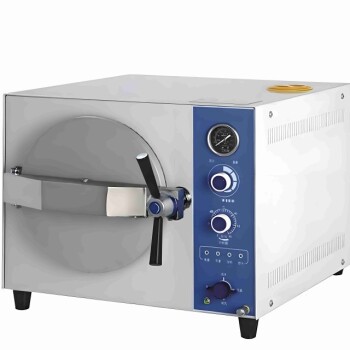
A laboratory high-pressure autoclave acts as a critical accelerant for biomass pretreatment by creating a controlled environment that significantly enhances chemical efficacy. By sustaining a stable temperature of approximately 121°C under elevated pressure, it forces alkaline solutions like sodium hydroxide deep into the plant's cellular structure much more rapidly than atmospheric soaking would allow.
Core Takeaway While alkaline chemicals provide the mechanism for breaking down biomass, the autoclave provides the necessary force. Its high-pressure environment drives chemical agents past stubborn physical barriers, ensuring thorough lignin degradation and maximizing the release of fermentable sugars.
The Mechanics of Thermal-Chemical Treatment
Creating a Stable Reaction Environment
The primary function of the autoclave in this context is stability. It maintains a precise thermal environment, typically around 121°C, which is the standard sterilization temperature but used here to kineticize chemical reactions.
This stability ensures that the pretreatment process is consistent and reproducible. Without this controlled heat, the reaction rates of the alkaline solution would be unpredictable and likely too slow for practical laboratory research.
Accelerating Chemical Penetration
Biomass, specifically lignocellulose, is naturally resistant to chemical attack due to its dense structure. The autoclave utilizes high pressure to overcome this resistance.
The pressure physically forces the alkaline solution (such as sodium hydroxide) into the pores of the biomass. This ensures that the chemical agents reach the internal structure of the material rather than just reacting with the surface.
Breaking Down the Biomass Structure
Degrading the Lignin Barrier
The ultimate goal of using the autoclave is to target lignin, the rigid polymer that protects cellulose. The combination of heat, pressure, and alkalinity promotes the degradation and dissolution of lignin fragments.
By breaking down the lignin, the autoclave effectively unlocks the biomass. This exposes the valuable cellulose fibers that are otherwise trapped inside the rigid plant cell walls.
Increasing Cellulose Recovery
Once the lignin structure is compromised, the recovery of cellulose becomes significantly easier. The thermal treatment ensures that a higher percentage of cellulose is preserved and made accessible for downstream processing.
This accessibility is directly linked to the final output of the process. A more thorough pretreatment leads to a higher final sugar yield during subsequent hydrolysis steps.
Critical Operational Considerations
The Necessity of Synergistic Treatments
While the autoclave is powerful, the primary reference suggests it works best as part of a multi-step approach. The text explicitly highlights the benefits of combining thermal treatment with cavitation treatments.
Relying on the autoclave alone may not achieve the theoretical maximum yield. The synergy between the thermal/chemical breakdown (autoclave) and physical disruption (cavitation) is often required to reach the highest levels of cellulose recovery.
Managing Lignocellulose Complexity
Not all biomass responds to thermal treatment exactly the same way. The specific penetration rate of the alkaline solution depends heavily on maintaining the target 121°C temperature.
Any fluctuation in the autoclave’s performance can result in incomplete lignin degradation. This leads to "stubborn" biomass fractions that lower the overall efficiency of the sugar conversion process.
Making the Right Choice for Your Goal
To maximize the effectiveness of your biomass pretreatment, consider your specific objectives:
- If your primary focus is Speed: Utilize the autoclave to drastically shorten the reaction time required for sodium hydroxide to penetrate the lignocellulose structure.
- If your primary focus is Maximum Yield: Do not rely on the autoclave in isolation; combine the thermal treatment with cavitation to physically and chemically disassemble the lignin matrix.
By leveraging the high-pressure environment of an autoclave, you transform a slow chemical soak into a rapid, high-efficiency degradation process.
Summary Table:
| Feature | Role in Biomass Pretreatment | Impact on Results |
|---|---|---|
| High Pressure | Forces alkaline agents deep into cellular structures | Rapid chemical penetration |
| Thermal Stability | Maintains a consistent 121°C environment | Reproducible reaction kinetics |
| Lignin Degradation | Breaks down the rigid protective polymer | Unlocks trapped cellulose fibers |
| Process Synergy | Combines thermal and cavitation treatments | Maximizes fermentable sugar yield |
Revolutionize Your Biomass Research with KINTEK
Maximize your cellulose recovery and streamline your laboratory workflows with KINTEK’s industry-leading thermal solutions. Whether you are performing complex lignocellulose degradation or standard material sterilization, our high-temperature high-pressure reactors and autoclaves provide the precision and durability needed to achieve superior results.
At KINTEK, we specialize in comprehensive laboratory equipment—from crushing and milling systems to high-temperature furnaces and vacuum solutions—tailored for target customers in renewable energy, chemical engineering, and advanced materials science.
Ready to enhance your lab’s efficiency and sugar yield? Contact us today to find the perfect autoclave for your research!
References
- Federico Verdini, Giancarlo Cravotto. Cellulose Recovery from Agri-Food Residues by Effective Cavitational Treatments. DOI: 10.3390/app11104693
This article is also based on technical information from Kintek Solution Knowledge Base .
Related Products
- Mini SS High Pressure Autoclave Reactor for Laboratory Use
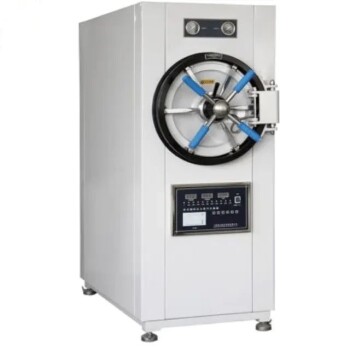
- Laboratory High Pressure Horizontal Autoclave Steam Sterilizer for Lab Use
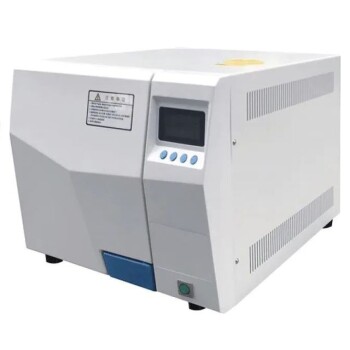
- Desktop Fast High Pressure Laboratory Autoclave Sterilizer 16L 24L for Lab Use
- Stainless High Pressure Autoclave Reactor Laboratory Pressure Reactor
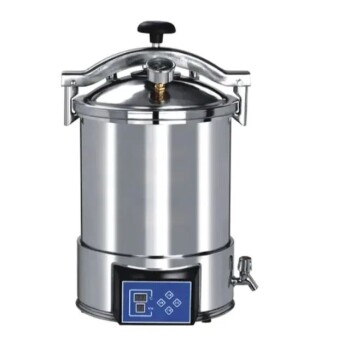
- Portable High Pressure Laboratory Autoclave Steam Sterilizer for Lab Use
People Also Ask
- Why use high-pressure reactors for molecular sieve synthesis? Unlock Superior Crystallinity and Framework Control
- What is the function of a high-pressure reactor autoclave? Enhancing Cu/N Co-Doped Carbon Catalyst Synthesis
- What are the advantages of using a high-pressure reactor like an autoclave? Maximize Liquefaction Speed & Yield
- Why are high-pressure reactors or autoclaves necessary for the synthesis of new functional materials? Unlock Precision.
- How are high-pressure reactors used to prepare metaphosphate electrocatalysts? Master In-Situ Precursor Growth