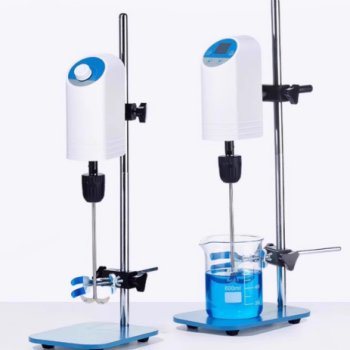
Precision stirring is the mechanical mechanism that enforces chemical uniformity. A reaction vessel equipped with this device typically maintains a rotation speed of approximately 1000 rpm to generate high-intensity shear forces. This creates a uniform hydrodynamic environment, which is essential for preventing the disordered precipitation of fast-reacting elements like aluminum and ensuring the successful formation of a continuous concentration gradient.
The precision stirring device acts as a physical regulator against chaotic chemical reactions. By eliminating local concentration deviations, it prevents rapid aluminum hydrolysis and forces the material to grow in a controlled, layer-by-layer structure.
Controlling the Hydrodynamic Environment
The Necessity of High-Intensity Shear
To synthesize a gradient precursor, simple mixing is insufficient. The stirring device must operate at speeds around 1000 rpm to produce high-intensity shear force.
This mechanical force rigorously disrupts the fluid dynamics within the vessel. It ensures that the incoming reactants are dispersed instantly, preventing them from pooling in specific areas.
Eliminating Local Concentration Deviations
Without precision stirring, reactants can create pockets of high concentration, known as local deviations.
These deviations alter the reaction kinetics in unpredictable ways. The stirring device ensures the chemical environment is identical throughout the entire vessel, forcing the reaction to proceed exactly as designed across the entire batch.
Managing Aluminum Nucleation
Preventing Disordered Hydrolysis
Aluminum is particularly sensitive in this process due to its tendency toward rapid hydrolysis.
If the hydrodynamic environment is not uniform, aluminum ions will nucleate in a disordered, chaotic fashion. This results in random precipitates rather than the desired structure, compromising the integrity of the material.
Enabling Layer-by-Layer Growth
The ultimate goal of this synthesis is to create a structure where the aluminum concentration changes gradually.
The uniform environment created by the stirring device allows aluminum elements to grow layer-by-layer onto the nickel hydroxide core. This precise physical control is what facilitates the formation of a continuous, pre-designed gradient distribution.
Understanding the Trade-offs
The Reliance on Constant Velocity
The effectiveness of this process is entirely dependent on the stability of the rotation speed.
If the stirring speed fluctuates significantly below the optimal 1000 rpm, shear forces drop, and local deviations return. Conversely, excessive speed could potentially disrupt the secondary particle formation, making the precision of the device—not just its power—the critical factor.
Making the Right Choice for Your Goal
To achieve a high-quality Ni-rich gradient precursor, the stirring mechanism must be viewed as a tool for structural engineering, not just homogenization.
- If your primary focus is Gradient Continuity: Ensure your stirring device creates sufficient shear force to prevent independent aluminum nucleation, forcing it to bond with the nickel core.
- If your primary focus is Particle Uniformity: Prioritize a stirring system that eliminates all local concentration deviations to ensure every particle experiences the exact same hydrodynamic conditions.
Precision stirring transforms a chaotic chemical reaction into a predictable manufacturing process.
Summary Table:
| Feature | Function in Co-Precipitation | Benefit for Ni-Rich Precursors |
|---|---|---|
| High Shear (1000 rpm) | Disrupts fluid dynamics & disperses reactants | Prevents independent aluminum nucleation |
| Hydrodynamic Control | Eliminates local concentration deviations | Ensures identical reaction kinetics throughout vessel |
| Structural Regulation | Facilitates layer-by-layer growth | Enables continuous, pre-designed concentration gradients |
| Velocity Stability | Maintains constant mechanical mechanism | Prevents chaotic reactions and ensures particle uniformity |
Elevate Your Precursor Synthesis with KINTEK Precision Solutions
Precision in chemical synthesis requires more than just mixing; it demands the mechanical excellence of KINTEK’s reaction vessels and precision stirring systems. Whether you are developing next-generation Ni-rich gradient materials or optimizing complex co-precipitation processes, our high-performance equipment provides the stability and shear force necessary for structural engineering at the molecular level.
Beyond our specialized reactors, KINTEK offers a comprehensive ecosystem for battery research and material science, including:
- High-Temperature High-Pressure Reactors & Autoclaves for advanced material synthesis.
- Crushing, Milling & Sieving Systems for precise particle size control.
- Battery Research Tools & Electrolytic Cells to test and validate your materials.
- PTFE, Ceramics & Crucibles designed for high-purity chemical environments.
Ready to transform chaotic reactions into predictable manufacturing outcomes? Contact KINTEK today to consult with our experts on the ideal equipment configuration for your laboratory needs.
References
- Xinwei Jiao, Jung‐Hyun Kim. Development of diverse aluminium concentration gradient profiles in Ni-rich layered cathodes for enhanced electrochemical and thermal performances. DOI: 10.1039/d4ta00433g
This article is also based on technical information from Kintek Solution Knowledge Base .
Related Products
- Custom PTFE Teflon Parts Manufacturer for F4 PTFE Volumetric Bottle
- High Performance Laboratory Stirrers for Diverse Applications
- High Purity Pure Graphite Crucible for Evaporation
- Customizable High Pressure Reactors for Advanced Scientific and Industrial Applications
People Also Ask
- What makes PTFE bottles suitable for static leaching? Ensure Zero-Contamination for Glass Testing
- What are the primary reasons for selecting PTFE as a matrix? Enhance Composites with Carbon Nanotube Reinforcement
- Why Use PTFE Sample Bottles for Coal Demineralization? Ensure Chemical Stability and Data Integrity
- What are the specific applications of PTFE in micro-batch slug flow systems? Enhance Your Microfluidic Reaction Purity
- How is PTFE utilized for insulation in Alloy 22 corrosion setups? Ensure Signal Purity & Accuracy