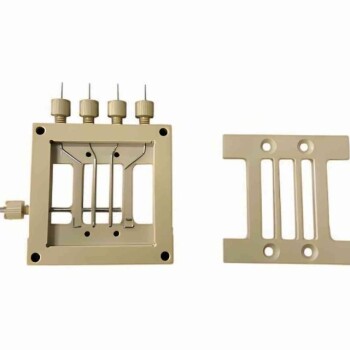
A three-electrode electrolytic cell system is the critical standard for ensuring the scientific validity of Stress Corrosion Cracking (SCC) tests on 316LN stainless steel. This configuration isolates the voltage measurement from the current flow, effectively eliminating polarization errors that would otherwise distort the data. Without this separation, accurate assessment of the steel's corrosion potential in complex environments becomes impossible.
The three-electrode setup serves one primary function: it decouples the reference point from the current path. By using a specific auxiliary electrode to carry the current, the system ensures that the potential measured at the 316LN surface is a true reflection of the material's behavior, free from external interference.
The Architecture of Accuracy
The Working Electrode (The Subject)
The 316LN stainless steel specimen acts as the working electrode. This is the material under investigation, where the electrochemical reactions and stress corrosion cracking phenomena are observed.
The Auxiliary Electrode (The Current Carrier)
Usually a graphite rod, the auxiliary (or counter) electrode completes the electrical circuit. Its sole purpose is to allow current to pass through the electrolyte without participating in the potential measurement.
The Reference Electrode (The Standard)
A saturated calomel electrode (SCE) is typically used as the reference. It provides a stable, known potential against which the working electrode is measured, acting as the system's "voltage yardstick."
The Core Problem: Polarization Interference
Why Two Electrodes Fail
In a simple two-electrode system, the reference electrode would also have to carry the cell current. Passing current through a reference electrode changes its chemical equilibrium, causing its potential to shift.
The Consequence of Interference
This shift is known as polarization. If the reference electrode polarizes, the "yardstick" changes length during the test, making it impossible to distinguish between changes in the 316LN steel and errors in the reference itself.
The Solution: Decoupling Current and Potential
The three-electrode system solves this by routing all current between the working electrode (316LN) and the auxiliary electrode (graphite). The reference electrode is connected to a high-impedance circuit that draws almost no current, ensuring its potential remains perfectly stable.
Critical Benefits for 316LN Testing
Precision in Alkaline Environments
316LN stainless steel is often tested in high-pH alkaline environments, such as simulated concrete pore solutions (e.g., 1 N KOH). In these conditions, achieving accurate polarization resistance values is difficult without a stable reference.
Eliminating Counter-Electrode Noise
The three-electrode setup specifically eliminates the influence of counter-electrode polarization on the measurement results. This ensures that the data reflects only the surface activity of the 316LN steel.
Ensuring Repeatability
For valid SCC analysis, you must be able to reproduce anodic polarization curves accurately. This system captures subtle changes in the dissolution current of different precipitated phases, providing the high-precision data required for reliable analysis.
Understanding the Trade-offs
Operational Complexity
While superior in accuracy, a three-electrode system introduces more physical components to the test cell. This requires careful alignment of electrodes to minimize uncompensated resistance (IR drop) in the solution.
Maintenance of the Reference
The accuracy of the entire system hinges on the health of the reference electrode (SCE). If the SCE is contaminated or the salt bridge is blocked, the stability benefits are lost, regardless of the three-electrode configuration.
Making the Right Choice for Your Goal
To achieve valid results in electrochemical SCC testing, the three-electrode system is not optional—it is a requirement.
- If your primary focus is Research-Grade Accuracy: You must use this system to eliminate polarization interference and ensure your polarization resistance values are publishable and precise.
- If your primary focus is Comparative Analysis: You need this setup to ensure that differences in anodic polarization curves are due to material changes, not fluctuations in the test equipment.
The three-electrode system transforms a noisy, unreliable electrical circuit into a precise analytical instrument capable of characterizing complex corrosion mechanisms.
Summary Table:
| Electrode Type | Material Used | Primary Function in SCC Testing |
|---|---|---|
| Working Electrode | 316LN Stainless Steel | The subject material where corrosion and stress reactions occur. |
| Auxiliary Electrode | Graphite Rod | Completes the circuit and carries current to prevent measurement interference. |
| Reference Electrode | Saturated Calomel (SCE) | Provides a stable, known potential for precise voltage measurement. |
Elevate Your Electrochemical Research with KINTEK Precision
Don’t let polarization noise compromise your SCC analysis. KINTEK specializes in high-performance laboratory equipment designed for the rigorous demands of materials science. From advanced electrolytic cells and electrodes specifically engineered for 316LN stainless steel testing to our comprehensive range of high-temperature high-pressure reactors and autoclaves, we provide the tools you need for reproducible, research-grade results.
Why choose KINTEK?
- Precision Engineering: Minimize IR drop and uncompensated resistance with our optimized cell designs.
- Complete Solutions: We supply everything from PTFE products and ceramics to high-precision potentiostat-compatible electrodes.
- Expert Support: Our team understands the complexities of alkaline environment testing and anodic polarization curves.
Ready to ensure the scientific validity of your next study? Contact us today to find the perfect configuration for your lab!
References
- Ulises Martin, David M. Bastidas. Pit-to-crack mechanisms of 316LN stainless steel reinforcement in alkaline solution influenced by strain induced martensite. DOI: 10.1038/s41529-023-00406-w
This article is also based on technical information from Kintek Solution Knowledge Base .
Related Products
- Electrolytic Electrochemical Cell for Coating Evaluation
- Super Sealed Electrolytic Electrochemical Cell
- PTFE Electrolytic Cell Electrochemical Cell Corrosion-Resistant Sealed and Non-Sealed
- Thin-Layer Spectral Electrolysis Electrochemical Cell
- Flat Corrosion Electrolytic Electrochemical Cell
People Also Ask
- What is the volume range of the coating evaluation electrolytic cell? A Guide to Choosing the Right Size
- How does the design of an electrochemical electrolytic cell influence the coating uniformity? Optimize Your Catalysts
- What is the correct shutdown and disassembly procedure after an experiment? Ensure Safety and Protect Your Equipment
- How do the electrochemical cell and three-electrode testing system collaborate? Optimize Zinc Anode Deposition Control
- What is the difference between a voltaic cell and an electrochemical cell? Understand the Two Types of Energy Conversion