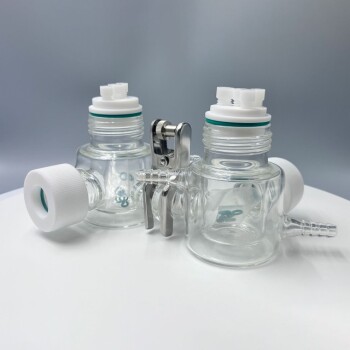
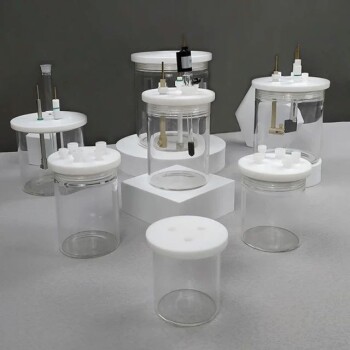
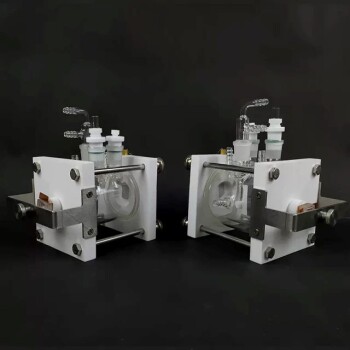
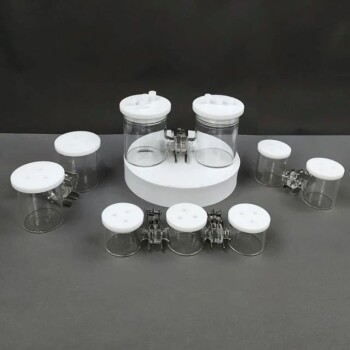
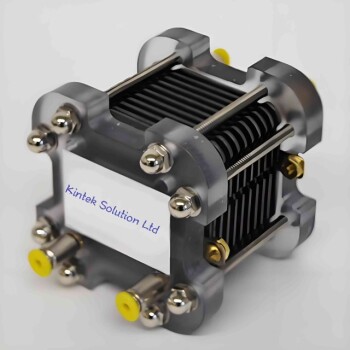
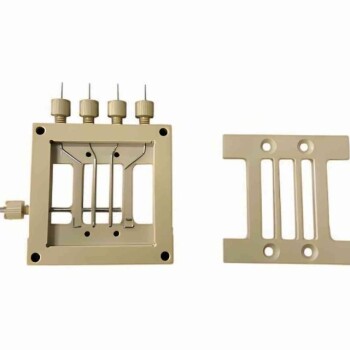
The distinct preference for a two-compartment cell arises from its ability to physically isolate the reaction environments using an ion exchange membrane. This separation prevents the valuable products generated at the anode from migrating to the cathode, where they would otherwise undergo destructive secondary reactions. Additionally, it stabilizes the significant pH shifts distinct to each electrode, ensuring the process remains chemically efficient.
A two-compartment design solves the fundamental incompatibility between the anode and cathode environments during Kolbe electrolysis. By preventing product crossover and managing extreme pH gradients, this configuration significantly increases the coulombic efficiency of target hydrocarbons like n-decane.
Preventing Product Degradation
The Risk of Secondary Reactions
In a single-compartment cell, the electrolyte circulates freely between electrodes. This allows products formed at the anode to migrate toward the cathode. Once there, these target molecules interact with the reducing environment and undergo secondary reactions, effectively destroying the product you intended to create.
The Barrier Function of the Membrane
A two-compartment cell utilizes an ion exchange membrane to separate the anode and cathode chambers. This membrane acts as a selective barrier. It prevents the anodic products from physically reaching the cathode surface, preserving the integrity of the synthesized molecules.
Managing Chemical Stability
Divergent pH Environments
Kolbe electrolysis induces severe pH changes during operation. The process naturally causes acidification at the anode and alkalization at the cathode. In a single vessel, these opposing shifts mix, leading to a chemically unstable bulk solution.
Stabilizing the Reaction Chambers
By isolating the two chambers, the two-compartment cell allows each electrode to maintain its required pH environment. The anolyte remains acidic while the catholyte remains basic, without them neutralizing or interfering with one another.
Impact on Coulombic Efficiency
This environmental stability is directly linked to performance. Maintaining separate, stable conditions significantly increases the coulombic efficiency of the reaction. This is particularly critical for synthesizing specific target products, such as n-decane, which require precise conditions to form efficiently.
Understanding the Trade-offs
Complexity vs. Efficiency
While the two-compartment cell is technically superior for yield, it introduces mechanical complexity. It requires an ion exchange membrane and typically necessitates separate circulation loops for the anolyte and catholyte.
The Cost of Simplicity
A single-compartment cell is simpler to design and operate but suffers from the chemical interference described above. The "cost" of this simplicity is a lower yield and lower efficiency due to product loss at the counter-electrode.
Making the Right Choice for Your Goal
To maximize the success of your Kolbe electrolysis project, align your cell design with your production metrics.
- If your primary focus is maximum product yield: Utilize a two-compartment cell to protect your anodic products from cathodic degradation.
- If your primary focus is process efficiency: Choose the two-compartment configuration to manage pH gradients and maximize coulombic efficiency for targets like n-decane.
Isolating your reaction environments is the most effective engineering control for ensuring high-purity synthesis in medium-chain carboxylic acid electrolysis.
Summary Table:
| Feature | Single-Compartment Cell | Two-Compartment Cell |
|---|---|---|
| Product Protection | High risk of cathodic degradation | Products isolated via membrane |
| pH Management | Unstable; neutralizes in bulk | Stable; isolated acidic/basic zones |
| Coulombic Efficiency | Lower due to secondary reactions | Higher (critical for n-decane) |
| System Complexity | Low (simple design) | Higher (requires membrane & loops) |
| Best Use Case | Basic testing/Simple reactions | High-purity synthesis of MCCAs |
Elevate Your Electrochemical Synthesis with KINTEK
Maximize your laboratory's productivity and research accuracy with KINTEK’s premium electrolytic cells and electrodes. Whether you are performing Kolbe electrolysis on medium-chain carboxylic acids or developing next-generation battery technologies, our specialized equipment is designed to handle extreme pH gradients and provide the precise isolation needed for high coulombic efficiency.
Why choose KINTEK?
- Comprehensive Range: From advanced electrolytic cells to high-temperature furnaces and hydraulic presses.
- Precision Engineering: Durable ceramics, PTFE consumables, and specialized reactors for demanding environments.
- Tailored Solutions: Supporting everything from crushing and milling to sophisticated CVD/PECVD processes.
Don't let secondary reactions compromise your yields. Contact KINTEK today to find the perfect cell configuration for your research goals!
References
- Katharina Neubert, Falk Harnisch. Platinized Titanium as Alternative Cost‐Effective Anode for Efficient Kolbe Electrolysis in Aqueous Electrolyte Solutions. DOI: 10.1002/cssc.202100854
This article is also based on technical information from Kintek Solution Knowledge Base .
Related Products
- Double-Layer Water Bath Electrolytic Electrochemical Cell
- Double Layer Five-Port Water Bath Electrolytic Electrochemical Cell
- H-Type Double-Layer Optical Electrolytic Electrochemical Cell with Water Bath
- Electrolytic Electrochemical Cell with Five-Port
- Customizable PEM Electrolysis Cells for Diverse Research Applications
People Also Ask
- What does the routine maintenance of a double-layer water-bath electrolytic cell involve? A Guide to Ensuring Precision and Longevity
- What is the typical experimental system used with a double-layer water-bath electrolytic cell? Achieve Precise Electrochemical Control
- What are the procedures for after using a double-layer water-bath electrolytic cell? Ensure Equipment Longevity and Data Accuracy
- When is professional repair required for a double-layer water-bath electrolytic cell? Protect Your Lab's Precision and Safety
- What are the key features of a double-layer water-bath electrolytic cell? Achieve Precise Temperature Control for Your Experiments