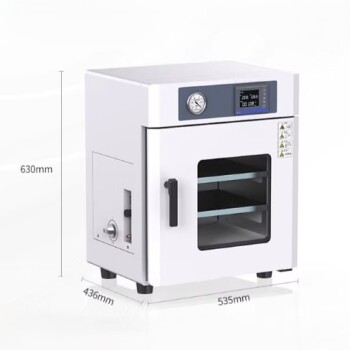
A vacuum drying oven is a mandatory requirement in the preparation of Silicon Carbide whisker (SiCw) reinforced aluminum matrix composites to prevent the oxidation of highly reactive aluminum powder. It creates a controlled, low-pressure environment that allows for the rapid removal of solvents—typically anhydrous ethanol—at low temperatures, isolating the mixture from atmospheric oxygen to ensure the chemical purity necessary for high-quality sintering.
The core function of the vacuum drying oven is to decouple drying speed from high temperature. By lowering the ambient pressure, solvents evaporate quickly without thermal stress, preventing the formation of oxide layers that would compromise the structural integrity of the final composite.
The Critical Mechanisms of Vacuum Drying
Preventing Aluminum Oxidation
The primary danger during the drying phase is the reactivity of the aluminum matrix. Aluminum powder has a high affinity for oxygen and will rapidly form an oxide layer if exposed to air, especially when heated.
A vacuum drying oven effectively isolates the powder mixture from ambient air. By removing oxygen from the environment, it ensures that the aluminum surfaces remain metallic and pure. This purity is vital for creating a strong interfacial bond between the aluminum matrix and the Silicon Carbide whiskers during the subsequent sintering phase.
Efficient Low-Temperature Solvent Removal
The preparation process often involves mixing powders in a solvent, such as anhydrous ethanol, to ensure uniform dispersion. Removing this solvent is necessary, but high heat can induce particle growth or oxidation.
Vacuum drying significantly lowers the boiling point of the solvent. This allows the ethanol to evaporate rapidly and completely at much lower temperatures than would be required at atmospheric pressure. This "gentle" drying process protects the microstructure of the composite materials.
Preventing Agglomeration
Drying ultra-fine powders in standard conditions can lead to the formation of hard clumps or "agglomerates." These clumps create inconsistencies in the material density.
The vacuum drying process facilitates the creation of a loose, dry composite powder. By preventing hard agglomeration, the oven ensures the powder maintains excellent flowability. This is essential for uniform mold filling and achieving high density in the final solidified component.
Understanding the Risks of Improper Drying
Using a standard convection oven or air drying for this specific application introduces significant defects that cannot be corrected later.
The Oxide Barrier
If the aluminum oxidizes during drying, these oxide impurities act as a brittle barrier between powder particles. During sintering, these barriers prevent proper fusion, leading to a composite with poor mechanical strength and reduced ductility.
Porosity and Gas Defects
Incomplete removal of solvents due to inefficient drying can lead to trapped volatiles. When the material is later heated for sintering, these residual solvents vaporize, creating gas pores and voids within the composite. Vacuum drying eliminates this risk by ensuring thorough solvent extraction.
Making the Right Choice for Your Goal
To ensure the success of your SiCw reinforced aluminum matrix composite, apply the following principles based on your specific processing targets:
- If your primary focus is mechanical strength: Prioritize high vacuum levels to minimize oxygen partial pressure, as this directly reduces oxide inclusions that weaken the material.
- If your primary focus is powder uniformity: Monitor the drying temperature carefully; it should be high enough to facilitate evaporation under vacuum but low enough to prevent thermal stress or particle coarsening.
Ultimatley, the vacuum drying oven is not merely a drying tool; it is a protective processing environment that preserves the chemical potential of your raw materials.
Summary Table:
| Feature | Benefit for SiCw/Al Composites | Importance |
|---|---|---|
| Oxygen Removal | Prevents Al oxidation & brittle oxide barriers | Critical for mechanical strength |
| Low-Pressure Drying | Rapid ethanol evaporation at low temperatures | Protects microstructure & chemistry |
| Clump Prevention | Minimizes powder agglomeration | Ensures uniform density & flowability |
| Volatile Extraction | Eliminates residual solvents | Prevents gas pores & voids during sintering |
Elevate Your Advanced Material Research with KINTEK
Precision in preparation determines the performance of your final composite. KINTEK specializes in high-performance laboratory equipment designed to protect your most reactive materials. From advanced vacuum drying ovens that prevent oxidation to our industry-leading crushing and milling systems, hydraulic presses (pellet, hot, isostatic), and high-temperature furnaces, we provide the tools necessary for superior material synthesis.
Whether you are working on metal matrix composites, battery research, or advanced ceramics, our comprehensive portfolio—including PTFE consumables, autoclaves, and cooling solutions—ensures your lab achieves consistent, high-purity results.
Ready to optimize your composite powder preparation? Contact KINTEK experts today to find the perfect equipment solution for your specific research goals.
Related Products
- 56L Vertical Laboratory Vacuum Drying Oven
- 23L Laboratory Vacuum Drying Oven
- Laboratory Scientific Electric Heating Blast Drying Oven
- Benchtop Laboratory Vacuum Freeze Dryer
- Vacuum Heat Treat Sintering Brazing Furnace
People Also Ask
- Why is a laboratory vacuum drying oven recommended for rice straw residues? Protect Your Biomass Integrity
- What role does a laboratory vacuum drying oven play in the preparation of modified multi-walled carbon nanotubes?
- What is the importance of using a laboratory vacuum drying oven? Preserving Slow-Release Microcapsule Integrity
- Why is a Laboratory Vacuum Drying Oven recommended for PBAT microspheres? Protect Sensitive Polymer Integrity
- What role does a laboratory vacuum drying oven play in processing nanoparticle powder samples? Protect Sample Integrity