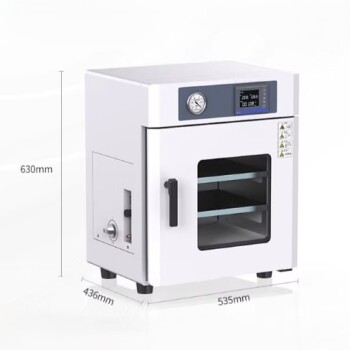
A laboratory constant temperature drying oven serves as a critical intermediate stage in the synthesis of Zinc Oxide precipitates by maintaining a stable 120°C environment for a duration of four hours. This controlled thermal processing is essential for removing residual moisture and volatile impurities from the filtered material before it is subjected to high-temperature calcination.
By prioritizing a steady, moderate heat over rapid evaporation, the drying oven prevents the formation of hard particle agglomerates. This ensures the Zinc Oxide powder retains the necessary fineness and dispersibility required for high-quality final processing.
The Mechanics of Controlled Dehydration
Precise Moisture Removal
After Zinc Oxide precipitates are filtered, they remain saturated with solvents and water. The drying oven operates at a constant 120°C, a temperature specifically selected to evaporate these liquids effectively without inducing thermal shock.
Establishing Chemical Stability
This four-hour drying phase is not merely about drying; it is about stabilizing the chemical composition. By eliminating volatile impurities at this stage, the oven prepares the raw precipitate for the much higher temperatures of calcination.
Preserving Particle Morphology
Preventing Hard Agglomeration
One of the primary risks in powder synthesis is the fusing of particles, known as agglomeration. If moisture evaporates too rapidly—as it would in a high-heat furnace—the surface tension changes can pull particles together into hard clumps.
Ensuring Uniform Dispersibility
The constant temperature oven facilitates gentle evaporation. This slow removal of the liquid phase allows the Zinc Oxide particles to remain distinct and well-dispersed, rather than fusing into large, irregular masses that are difficult to process later.
Understanding the Trade-offs
Process Efficiency vs. Material Quality
The primary drawback of this method is the time investment; a four-hour cycle creates a bottleneck compared to rapid flash-drying methods. However, this time is the "cost" of ensuring particle integrity.
Energy Consumption
Maintained heating at 120°C for extended periods consumes continuous energy. While necessary for high-grade Zinc Oxide, it requires valid consideration regarding the overall energy efficiency of the production line.
Making the Right Choice for Your Goal
To optimize your Zinc Oxide processing, consider your specific end-product requirements:
- If your primary focus is Particle Size Uniformity: Adhere strictly to the 120°C, 4-hour cycle to minimize the risk of hard agglomeration and ensure a fine powder structure.
- If your primary focus is Production Throughput: You must carefully evaluate if the potential for increased particle clumping is an acceptable trade-off for reducing the drying duration.
Consistent thermal processing is the invisible guardian of powder quality, turning a raw precipitate into a viable precursor for advanced applications.
Summary Table:
| Parameter | Specification | Purpose in ZnO Processing |
|---|---|---|
| Drying Temperature | 120°C (Constant) | Removes solvents/water without thermal shock |
| Process Duration | 4 Hours | Ensures complete stabilization and chemical consistency |
| Target Outcome | Fine Powder Dispersibility | Prevents the formation of hard particle agglomerates |
| Key Component | Laboratory Drying Oven | Provides steady, uniform heating for material integrity |
Elevate Your Powder Synthesis with KINTEK Precision
High-quality Zinc Oxide production demands uncompromising thermal accuracy. At KINTEK, we specialize in providing advanced laboratory constant temperature drying ovens and high-performance calcination furnaces designed to maintain the precise environmental conditions your materials require.
Whether you are focusing on particle size uniformity or optimizing throughput, our comprehensive range of laboratory equipment—from crushing and milling systems to high-temperature furnaces—ensures your research and production meet the highest standards.
Ready to optimize your lab's drying and calcination workflows? Contact KINTEK today to speak with our technical experts about our tailored solutions for advanced materials research.
References
- I. Othman, Mohamed M. El-Molla. Synthesis of zinc oxide and silver/ zinc oxide nano composite for production of antimicrobial textiles. DOI: 10.21608/ejchem.2019.17392.2083
This article is also based on technical information from Kintek Solution Knowledge Base .
Related Products
- Laboratory Scientific Electric Heating Blast Drying Oven
- 23L Laboratory Vacuum Drying Oven
- 56L Vertical Laboratory Vacuum Drying Oven
- High Temperature Muffle Oven Furnace for Laboratory Debinding and Pre Sintering
People Also Ask
- How does a laboratory electric drying oven contribute to the formation of the initial coating? Expert Insights
- What role does a precision laboratory drying oven play in the synthesis of GO-PANI nanocomposites? Protect Material Integrity
- What role does a laboratory drying oven play in the preparation of zinc oxide nanoparticle precursors?
- What is the necessity of using a laboratory drying oven when processing MoO3/GO composite nanopowders? Find out here.
- What is the role of a laboratory drying oven in cellulose citrate production? Ensure Material Stability & Purity