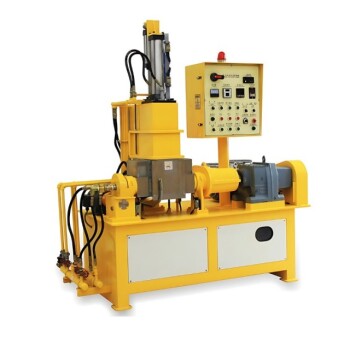
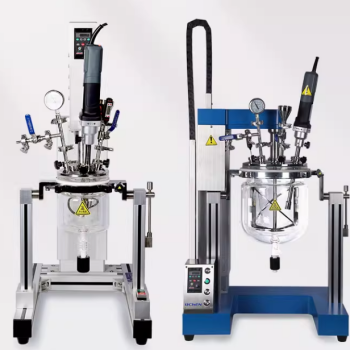
The use of a vibrating mixer is essential for preserving the delicate structural components of the composite mixture. This method employs high-frequency reciprocal oscillation to generate relatively weak shear forces, which allows alloy powders to uniformly coat the surfaces of Ti-coated diamonds and PMMA particles. By avoiding the aggressive mechanical impacts of ball milling, the process ensures the titanium coating remains intact and the PMMA particles retain their spherical geometry, both of which are vital for the final material's performance.
The central advantage of a vibrating mixer lies in its ability to achieve uniform distribution through low-shear force. This approach prioritizes the structural integrity of sensitive coatings and space-holding agents over the aggressive particle size reduction typical of high-energy milling.
The Mechanics of Structural Preservation
Protecting the Titanium-Diamond Interface
The titanium coating on diamond particles is a critical functional layer that facilitates interfacial bonding between the diamond and the alloy matrix.
A vibrating mixer provides a gentle environment where the alloy powder can adhere to the diamond surface without scratching or stripping this thin metallic film.
Preserving this coating is necessary to ensure that the final composite achieves the required interfacial bonding strength and thermal conductivity.
Maintaining the Integrity of PMMA Space-Holders
PMMA particles act as "space-holders" that define the pore shape and size in the final porous material.
The high-frequency oscillation of a vibrating mixer ensures these particles are evenly distributed throughout the powder bed without compromising their spherical integrity.
If these spheres are deformed or broken during mixing, the resulting pore architecture becomes irregular, negatively impacting the mechanical properties of the finished product.
The Limitations of High-Energy Ball Milling
The Impact of Grinding Media
High-energy ball milling utilizes heavy grinding media, such as tungsten carbide or zirconia balls, to force-mix materials through intense impact and friction.
While this is effective for mechanical alloying, these impacts are often too violent for coated or polymer-based particles.
The abrasive nature of the balls can easily fracture the Ti-coating or crush the PMMA particles, leading to a loss of structural control.
Mechanical Alloying vs. Surface Coating
Ball milling is designed to reduce particle size and embed reinforcements within the metal powder to increase surface energy and reactivity.
In this specific application, the goal is not to embed the diamond or PMMA within the alloy, but to coat them uniformly.
High-energy milling creates "ultra-fine-grained" structures that, while strong, sacrifice the precise geometric arrangement required for high-performance porous alloys.
Understanding the Trade-offs
Precision vs. Reactivity
The primary trade-off when choosing a vibrating mixer is the sacrifice of mechanical alloying for the sake of geometric precision.
Vibrating mixers do not significantly reduce the particle size of the alloy powder or increase its reactivity to the same degree as high-energy milling.
However, in composites where the pore shape and coating integrity are the dominant factors in performance, the lack of aggressive particle deformation is an intentional benefit rather than a drawback.
Processing Time and Uniformity
While a vibrating mixer is gentler, it requires careful calibration of frequency and duration to ensure a truly homogeneous distribution.
Without the aggressive "forced-mixing" of grinding media, achieving a uniform coating on all surfaces depends entirely on the fluidization of the powder bed.
Failure to optimize these parameters can result in clusters of alloy powder or uneven coating thickness across the diamond and PMMA particles.
How to Apply This to Your Project
When selecting a mixing strategy for advanced composite powders, your choice should be dictated by the sensitivity of your reinforcement phase.
- If your primary focus is preserving functional coatings (like Ti or Ni): Use a vibrating mixer to ensure low-shear distribution and prevent the stripping of the coating from the substrate.
- If your primary focus is defining precise pore architecture: Opt for a vibrating mixer to protect the spherical integrity of your space-holding agents like PMMA.
- If your primary focus is creating an ultra-fine-grained matrix: Utilize high-energy ball milling, but only if your reinforcements can withstand high-impact grinding media without losing their functional properties.
Selecting the correct mixing energy is the most critical step in ensuring that the microstructural design of your material translates successfully to the final fabricated part.
Summary Table:
| Feature | Vibrating Mixer | High-Energy Ball Milling |
|---|---|---|
| Mixing Mechanism | High-frequency reciprocal oscillation | High-impact grinding media (balls) |
| Shear Force | Low (Gentle) | High (Aggressive) |
| Coating Protection | Preserves Ti-coating integrity | Often fractures or strips coatings |
| Particle Shape | Maintains spherical PMMA geometry | Deforms or crushes space-holders |
| Primary Goal | Uniform coating & distribution | Particle size reduction & alloying |
Optimize Your Material Synthesis with KINTEK
Precision in material science starts with the right processing tools. At KINTEK, we specialize in providing high-performance laboratory equipment tailored to your specific research needs. Whether you require gentle vibrating mixers to preserve delicate coatings or robust crushing and milling systems for mechanical alloying, our portfolio is built for excellence.
Beyond mixing, we offer a comprehensive range of solutions, including:
- High-Temperature Furnaces: Muffle, tube, vacuum, and CVD systems for precise sintering.
- Hydraulic Presses: Pellet and isostatic presses for superior sample preparation.
- Material Analysis: Sieving equipment and high-pressure reactors for advanced research.
Ensure the structural integrity and performance of your advanced composites with KINTEK’s reliable technology. Contact our technical experts today to find the ideal equipment for your laboratory and take your material performance to the next level!
References
- Bisma Parveez, Muneer Baig. Microstructure and Strengthening Effect of Coated Diamond Particles on the Porous Aluminum Composites. DOI: 10.3390/ma16083240
This article is also based on technical information from Kintek Solution Knowledge Base .
Related Products
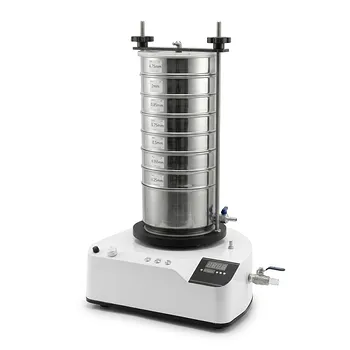
- Laboratory Vibratory Sieve Shaker Machine Slap Vibrating Sieve
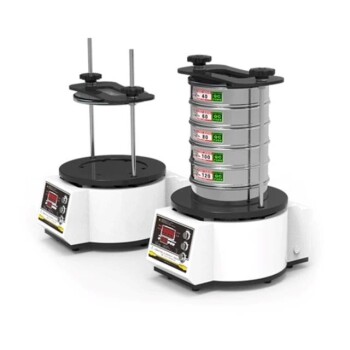
- Laboratory Vibratory Sieve Shaker Machine for Dry and Wet Three-Dimensional Sieving
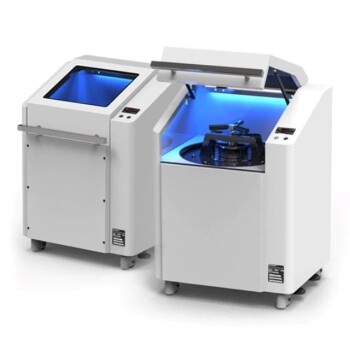
- Laboratory Wet Three-Dimensional Vibratory Sieve Shaker Machine
- Vibrating Disc Mill Small Laboratory Grinding Machine
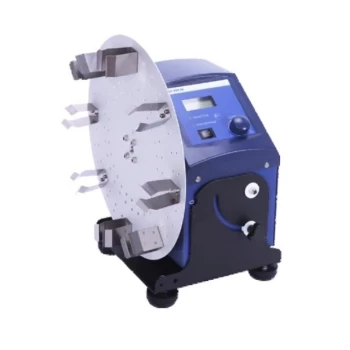
- Lab Vibration Mill
People Also Ask
- How does a laboratory vibratory sieve shaker facilitate the microstructural study of gas-atomized alloy powders?
- What role does a laboratory vibrating sieve shaker play in the LiFePO4 powder processing workflow? Ensure Batch Quality
- What are laboratory sieves used for? Measure Particle Size for Quality Control & R&D
- What are the uses of sieve in laboratory? Essential Guide to Particle Size Analysis
- What are the sieve used in laboratory? A Guide to Choosing the Right Sieve for Accurate Particle Analysis