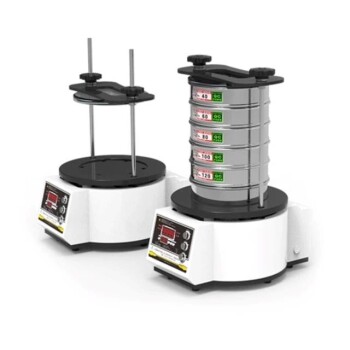
Standardizing corncob powder through a specific 40 to 80 mesh sieving system is the primary method for ensuring biomass particle uniformity prior to experimentation. This mechanical separation controls the particle size distribution, effectively maximizing the specific surface area of the raw material. By establishing this baseline, you eliminate variables that could otherwise skew experimental data or reduce processing efficiency.
Uniform particle size is the prerequisite for consistent thermodynamics; without strict mesh controls, heat and moisture transfer become unpredictable, compromising the repeatability of the entire hydrothermal process.
The Mechanics of Biomass Preparation
Achieving Particle Uniformity
The primary function of the sieving system is to isolate a specific fraction of crushed powder. By restricting particles to the 40 to 80 mesh range, you remove both overly coarse chunks and excessively fine dust. This ensures that every unit of biomass introduced to the reaction chamber has similar physical dimensions.
Maximizing Specific Surface Area
Processing corncob within this specific mesh range significantly increases the specific surface area of the material. A larger surface area ensures that more of the biomass is physically exposed to the reaction environment. This exposure is critical for initiating chemical changes efficiently.
Optimizing Reaction Conditions
Ensuring Uniform Heat Transfer
In subsequent hydrothermal reactions, thermal consistency is paramount. Particles within the 40-80 mesh range allow for uniform heat transfer throughout the biomass. This prevents the formation of "hot spots" or "cold zones" that often occur with irregular particle sizes.
Facilitating Moisture Penetration
The sieving process directly impacts how fluids interact with the solid biomass. The controlled particle size ensures that moisture penetrates the corncob powder at a consistent rate. Uniform saturation is essential for the hydrolysis or degradation processes often targeted in these experiments.
Improving Experimental Repeatability
The ultimate goal of this preparation step is scientific reliability. By standardizing heat and moisture interactions, you stabilize the reaction kinetics. This leads to high experimental repeatability, allowing you to attribute results to your variables rather than inconsistent raw materials.
Risks of Improper Sizing
The Cost of Inconsistency
If the sieving step is skipped or the mesh range is ignored, the resulting particle size distribution becomes random. Large particles may not react fully in the allotted time, while fines may over-react or degrade too quickly. This variance creates noise in your data, making it nearly impossible to replicate results or scale the process efficiently.
Making the Right Choice for Your Goal
To ensure your biomass preparation supports your ultimate objectives, consider the following recommendations:
- If your primary focus is experimental accuracy: Strictly adhere to the 40-80 mesh standard to guarantee that heat transfer and moisture penetration remain constant across all trials.
- If your primary focus is process efficiency: Use this sieving range to maximize specific surface area, which ensures the fastest and most complete reaction kinetics during hydrothermal processing.
Control your inputs to control your outcomes; precision in the sieving stage is the foundation of a successful reaction.
Summary Table:
| Particle Parameter | Benefit of 40-80 Mesh Range | Impact on Process |
|---|---|---|
| Uniformity | Eliminates coarse chunks and fine dust | Ensures consistent thermodynamics |
| Surface Area | Maximizes specific surface area | Increases chemical reaction efficiency |
| Heat Transfer | Prevents hot spots and cold zones | Guarantees stable reaction kinetics |
| Moisture Flow | Enables consistent fluid penetration | Stabilizes hydrolysis & degradation |
| Reliability | Minimizes experimental noise | Enhances high repeatability |
Maximize Your Research Precision with KINTEK
Don't let inconsistent particle sizes compromise your biomass data. KINTEK specializes in high-performance laboratory equipment, including precision crushing and milling systems and professional sieving equipment designed to deliver the exact particle distribution your hydrothermal processes demand.
Whether you are preparing corncob powder or advanced biomass samples, our comprehensive range—from high-temperature furnaces and isostatic presses to PTFE consumables—ensures your lab maintains the highest standards of accuracy.
Ready to standardize your results? Contact our experts today to find the perfect sieving and preparation solution for your facility!
References
- Tang-sheng Sun, Feng Xu. Hydrothermal Treatment and Enzymatic Saccharification of Corncobs. DOI: 10.15376/biores.9.2.3000-3013
This article is also based on technical information from Kintek Solution Knowledge Base .
Related Products
- Three-dimensional electromagnetic sieving instrument
- Laboratory Vibratory Sieve Shaker Machine for Dry and Wet Three-Dimensional Sieving
- Laboratory Test Sieves and Sieving Machines
- Laboratory Wet Three-Dimensional Vibratory Sieve Shaker Machine
- Vibratory Sieve Shaker Machine Dry Three-Dimensional Vibrating Sieve
People Also Ask
- Why is sieving equipment essential for the classification of processed bio-activated carbon? Optimize Performance
- What are the limitations of sieving? Understanding the Constraints of Particle Size Analysis
- What are advantages and disadvantages of sieving method? A Guide to Reliable & Cost-Effective Particle Sizing
- How is sieving important? The Critical Role of Particle Size Analysis in Quality Control
- What is sieving and how does it work? A Guide to Accurate Particle Size Analysis