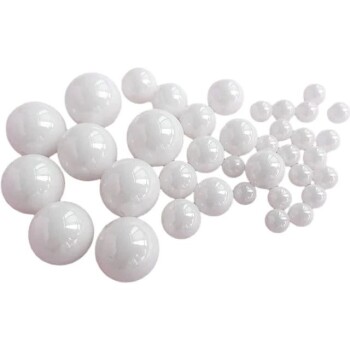
The necessity of zirconia grinding media lies in its ability to maintain absolute material purity. Specifically, using zirconia components prevents the introduction of metallic impurities—such as iron fragments—into the electrolyte powder during high-energy milling. Avoiding these contaminants is the only way to preserve the electrolyte's ionic conductivity and electrochemical stability.
The combination of extreme hardness and chemical inertness allows zirconia to transfer mechanical energy efficiently without contaminating the sensitive halide structure, ensuring the final material retains a wide electrochemical window and optimal performance.
The Critical Role of Purity in Electrolytes
Preventing Metallic Contamination
Halide solid-state electrolytes are highly sensitive to foreign materials. Standard grinding media, such as stainless steel, can shed microscopic metal fragments during the violent milling process. Zirconia eliminates this risk, preventing iron or other metals from mixing with the powder.
Preserving Electrochemical Stability
The presence of impurities does more than just dilute the material; it fundamentally alters its performance. Metallic contaminants can severely narrow the electrochemical window, limiting the voltage range in which the battery can operate safely. Furthermore, these impurities often lead to a direct decrease in ionic conductivity, rendering the solid electrolyte less effective.
Avoiding Unwanted Side Reactions
Chemical inertness is a defining feature of zirconia. Unlike reactive metals, zirconia ensures that no unwanted side reactions occur between the grinding media and the electrolyte precursors. This stability is vital for preventing the degradation of the material during synthesis.
Mechanical Efficiency and Energy Transfer
Harnessing High Density for Kinetic Energy
Zirconia is not just hard; it is dense. This high density provides the powerful kinetic energy required for efficient powder refinement and mechanical alloying. The media effectively transfers the impact energy needed to drive solid-phase reactions among precursors.
Withstanding Prolonged High-Energy Milling
Synthesis processes often require long-duration milling (e.g., over 13 hours) at high speeds. Zirconia’s superior wear resistance ensures it can withstand this stress without degrading. This durability allows for the consistent application of energy needed to reach the desired particle fineness and uniformity.
The Risks of Alternative Materials
The "Iron Fragment" Trap
If you opt for softer or metallic grinding media, you introduce a fatal flaw into the process: wear debris. The primary reference explicitly notes that metallic impurities, such as iron fragments, are a direct consequence of using inferior media.
Compromised Ion Transport
Even trace amounts of wear debris can form impurity phases within the electrolyte. These phases can physically or chemically block the ion transport channels. Once these channels are compromised, the fundamental utility of the solid-state electrolyte is lost.
Making the Right Choice for Your Goal
To achieve a high-performance solid-state battery, your choice of milling media must align with your synthesis requirements.
- If your primary focus is Maximizing Ionic Conductivity: Select zirconia to eliminate metallic impurities that block ion transport channels and degrade performance.
- If your primary focus is Synthesis Efficiency: Rely on the high density of zirconia to generate the kinetic energy necessary for rapid and uniform mechanical alloying.
By choosing zirconia, you ensure that the mechanical rigor of processing does not compromise the chemical integrity of your final product.
Summary Table:
| Feature | Benefit of Zirconia Media | Impact on Halide Electrolytes |
|---|---|---|
| Material Purity | Zero metallic debris (iron-free) | Maintains wide electrochemical window |
| Chemical Inertness | Non-reactive with precursors | Prevents unwanted side reactions during synthesis |
| High Density | Efficient kinetic energy transfer | Promotes rapid and uniform mechanical alloying |
| Wear Resistance | Long-duration durability | Ensures consistent particle fineness without degradation |
Elevate Your Battery Research with KINTEK Precision
Don't let metallic contamination compromise your solid-state electrolyte performance. KINTEK specializes in high-performance laboratory equipment, providing the advanced crushing and milling systems your research demands. Our premium zirconia grinding jars and balls are engineered to protect the ionic conductivity and electrochemical stability of your sensitive halide materials.
From high-speed planetary ball mills to specialized consumables like PTFE and ceramic crucibles, KINTEK offers a comprehensive range of solutions for battery research, including high-temperature furnaces, hydraulic pellet presses, and electrolytic cells.
Ready to optimize your material synthesis? Contact our technical experts today to find the perfect equipment configuration for your lab's success!
Related Products
- Laboratory Jar Ball Mill with Alumina Zirconia Grinding Jar and Balls
- Laboratory Jar Mill with Agate Grinding Jar and Balls
- Laboratory Ball Mill Jar Mill with Metal Alloy Grinding Jar and Balls
- Precision Machined Zirconia Ceramic Ball for Engineering Advanced Fine Ceramics
- Nature Agate Mortar and Pestle for Grinding and Mixing
People Also Ask
- What are the primary functions of using a ball mill for BZCY72 powder? Achieve High Purity and Enhanced Sintering
- In what way does a laboratory ball mill affect material properties when modifying PHBV/pulp fiber composites?
- Why is a laboratory ball mill required for ultra-fine fly ash? Unlock Nano-Scale Adsorption Power
- What is the function of a laboratory ball mill in the preparation of AMMCs? Optimize Dispersion & Grain Refinement
- What is the function of a laboratory ball mill in the pretreatment of waste tire char (WTC)? Optimize Material Reactivity