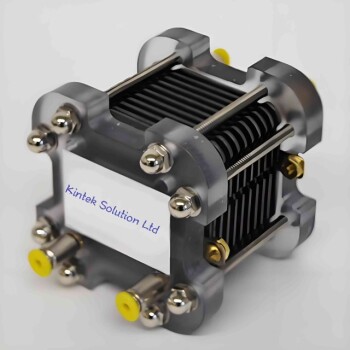
Polyetheretherketone (PEEK) is the material of choice for electrochemical cell bodies primarily due to its ability to withstand aggressive environments without degrading. Its selection is driven by a unique combination of exceptional chemical resistance to acidic electrolytes and high mechanical strength, which allows for the precise fabrication required in sensitive X-ray absorption spectroscopy (XAS) experiments.
Core Takeaway: Success in operando XAS requires a cell body that is both chemically inert and mechanically rigid. PEEK is utilized because it prevents contamination from dissolved cell materials and ensures a leak-proof seal, protecting both the electrolyte stability and the integrity of the vacuum or detector environment.
Critical Requirements for XAS Cell Materials
Chemical Inertness in Aggressive Media
The primary driver for selecting PEEK is its exceptional chemical resistance.
In low-energy XAS experiments, the electrochemical environment often involves aggressive acidic electrolytes, such as sulfuric acid.
PEEK remains stable in these conditions, ensuring that the cell body does not react with the electrolyte, which prevents sample contamination and preserves experimental accuracy.
High Mechanical Strength
Beyond chemical properties, the physical robustness of the material is paramount.
PEEK provides high mechanical strength, which is necessary to maintain the structural shape of the cell under experimental stresses.
This rigidity ensures that the cell components do not deform over time, maintaining the precise geometry required for consistent X-ray path lengths.
Precision Machinability
The complexity of operando XAS cells requires intricate designs to accommodate electrodes and windows.
PEEK offers excellent machinability, allowing engineers to fabricate complex cell bodies with tight tolerances.
This capability is essential for creating custom geometries that optimize the interface between the X-ray beam, the electrode, and the electrolyte.
Ensuring Experimental Integrity
Guaranteeing Leak-Proof Sealing
One of the most critical challenges in liquid-environment X-ray experiments is containment.
The mechanical stability of PEEK ensures leak-proof sealing.
Because the material does not deform easily under clamping pressure, it maintains a tight barrier, preventing hazardous electrolyte leakage during operation.
Stability for Operando Experiments
Operando experiments require the system to remain stable while active data collection occurs.
PEEK ensures structural integrity throughout the duration of the experiment.
By resisting both chemical attack and mechanical creep, PEEK provides the reliability needed for long-duration, stable measurements.
Common Pitfalls in Material Selection
The Risk of Chemical Degradation
A common failure mode in XAS cell design is the use of materials that cannot survive the electrolyte.
If a material lacks the chemical resistance of PEEK, it may degrade or dissolve when exposed to sulfuric acid.
This degradation can alter the concentration of the electrolyte or introduce foreign elements into the spectral data, rendering the experiment invalid.
Compromising the Seal
Choosing a material with lower mechanical strength can lead to containment failure.
Softer materials may distort under the pressure required to seal the cell, leading to electrolyte leakage.
In an XAS setup, a leak can damage sensitive detectors or compromise the vacuum environment (if applicable), making the structural rigidity of PEEK a non-negotiable factor for safety.
Making the Right Choice for Your Goal
To ensure the success of your low-energy XAS experiment, align your material selection with your specific operational parameters.
- If your primary focus is working with acidic electrolytes: Choose PEEK to utilize its exceptional resistance against aggressive media like sulfuric acid.
- If your primary focus is complex cell design: Choose PEEK for its excellent machinability, ensuring precise fabrication and leak-proof sealing.
By leveraging PEEK, you establish a robust, chemically neutral foundation that allows you to focus on the electrochemistry rather than the hardware.
Summary Table:
| Feature | Advantage of PEEK in XAS Experiments | Benefit to Researcher |
|---|---|---|
| Chemical Resistance | Withstands aggressive acidic electrolytes (e.g., sulfuric acid) | Prevents sample contamination and cell degradation |
| Mechanical Strength | High rigidity under clamping pressure | Ensures leak-proof sealing and maintains precise geometry |
| Machinability | Allows for intricate, high-tolerance fabrication | Accommodates complex electrode and window configurations |
| Structural Stability | Resists deformation and mechanical creep | Provides reliability for long-duration operando measurements |
Elevate Your XAS Research with KINTEK Precision Solutions
Don't let material degradation or leaks compromise your sensitive electrochemical data. KINTEK specializes in high-performance laboratory equipment and consumables designed for the most demanding scientific applications.
Whether you need specialized electrolytic cells and electrodes, precision-machined PTFE or PEEK components, or advanced high-temperature reactors, we provide the durability and precision your research demands. Our team understands the critical requirements of operando spectroscopy and offers a comprehensive range of laboratory tools—from crushing and milling systems to vacuum furnaces and cooling solutions.
Ready to optimize your experimental setup? Contact KINTEK today to discover how our high-quality materials and expert engineering can ensure the integrity of your next experiment!
References
- Hebe M. Villullas, Flávio C. Vicentin. A novel electrochemical cell for operando X-ray absorption measurements at low energies: Probing electrochemically induced electronic changes in palladium. DOI: 10.1016/j.elecom.2018.07.023
This article is also based on technical information from Kintek Solution Knowledge Base .
Related Products
- Electrolytic Electrochemical Cell for Coating Evaluation
- Side Window Optical Electrolytic Electrochemical Cell
- Thin-Layer Spectral Electrolysis Electrochemical Cell
- Electrolytic Electrochemical Cell with Five-Port
- Optical Water Bath Electrolytic Electrochemical Cell
People Also Ask
- What is the volume range of the coating evaluation electrolytic cell? A Guide to Choosing the Right Size
- How does the design of an electrochemical electrolytic cell influence the coating uniformity? Optimize Your Catalysts
- What is the correct shutdown and disassembly procedure after an experiment? Ensure Safety and Protect Your Equipment
- How do the electrochemical cell and three-electrode testing system collaborate? Optimize Zinc Anode Deposition Control
- What is the difference between a voltaic cell and an electrochemical cell? Understand the Two Types of Energy Conversion