In the demanding environment of a laboratory, material choice is a critical factor that directly impacts the validity and success of an experiment. Quartz is used for laboratory ware because of its superior ability to withstand extreme and rapid temperature changes (thermal shock), its exceptional chemical purity, and its unique transparency to a wide range of light, including ultraviolet (UV). These properties make it indispensable for applications where standard glass would fail.
While standard borosilicate glass is sufficient for many routine lab tasks, quartz is the material of choice when experiments involve extreme temperatures, high purity requirements, or UV light. Its use is a direct solution to the physical and chemical limits of other types of glass.
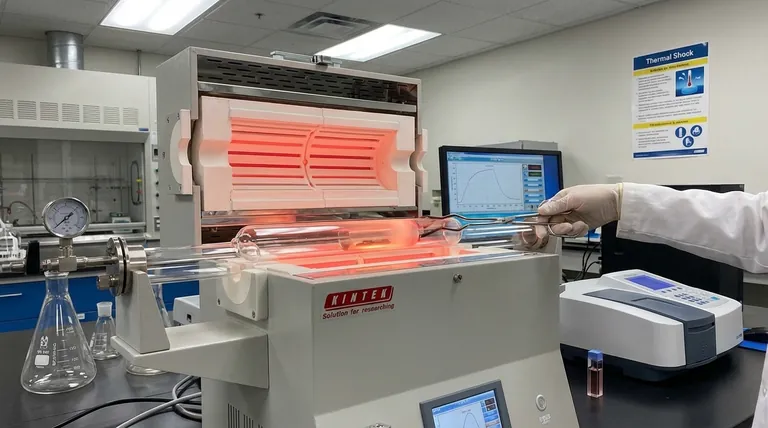
The Core Properties Defining Quartz Labware
The decision to use quartz over more common materials like borosilicate glass (e.g., Pyrex®) is driven by three fundamental properties that make it uniquely suited for extreme conditions.
Exceptional Thermal Performance
The primary advantage of quartz is its remarkably low coefficient of thermal expansion. This means it barely expands or contracts when heated or cooled.
This property gives it incredible resistance to thermal shock. You can take a red-hot quartz crucible and plunge it into cold water without it cracking, a treatment that would shatter conventional glass.
Furthermore, fused quartz has a softening point of approximately 1650°C (3000°F), significantly higher than the roughly 820°C (1500°F) for borosilicate glass. This makes it the only viable choice for very high-temperature applications like furnace tubes and crucibles for ashing samples.
Unmatched Chemical Purity and Inertness
Most laboratory quartzware is fused quartz, which is simply high-purity silicon dioxide (SiO₂). It is not formulated with other chemicals, unlike other glasses.
Borosilicate glass, by contrast, contains other oxides like boron, sodium, and aluminum. In highly sensitive experiments, these elements can leach from the glass into the sample, causing contamination.
This high purity makes quartz essential for applications in trace-element analysis, semiconductor manufacturing, and any research where maintaining sample integrity at the parts-per-million (or billion) level is critical.
Superior Optical Transparency
Quartz is transparent across a much broader spectrum of light than other glasses.
Crucially, it allows ultraviolet (UV) light to pass through it, whereas borosilicate glass absorbs most UV radiation.
This property is why quartz is the required material for cuvettes used in UV-Vis spectrophotometry, for UV lamps, and for reaction vessels in photochemical experiments.
Understanding the Trade-offs: Quartz vs. Borosilicate Glass
While superior in many ways, quartz is not always the best choice. Its selection involves clear trade-offs that every researcher must consider.
The Cost Factor
The most significant drawback of quartz is its cost. It is substantially more expensive than borosilicate glass.
This is because melting and forming pure SiO₂ requires much higher temperatures and more energy than processing standard glass formulations, making its manufacturing process more difficult and costly.
Workability and Brittleness
Due to its extremely high melting point, quartz is more difficult for glassblowers to shape into complex apparatus. This can increase the cost of custom pieces or limit design possibilities.
While very strong under thermal stress, it can be more brittle and susceptible to mechanical shock (i.e., being dropped) than borosilicate glass.
Chemical Resistance Nuances
While exceptionally inert, quartz is not completely immune to all chemicals. It can be attacked and dissolved by hydrofluoric acid (HF) and hot, strong alkaline solutions like sodium hydroxide (NaOH).
Making the Right Choice for Your Goal
Selecting the correct glassware is fundamental to good science. Use these guidelines to make an informed decision between quartz and standard borosilicate glass.
- If your primary focus is high-temperature work (>500°C): Quartz is the only reliable choice due to its high softening point and resistance to thermal shock.
- If your primary focus is trace analysis or high-purity applications: Choose quartz to avoid the chemical leaching of contaminants that is possible with other types of glass.
- If your primary focus involves UV light (e.g., spectroscopy, photoreactions): Quartz's transparency to UV radiation makes it essential, as borosilicate glass is opaque to most UV wavelengths.
- If your primary focus is general benchtop chemistry below 500°C: Standard borosilicate glass offers the best balance of performance and cost-effectiveness for most routine applications.
Ultimately, selecting quartz is a strategic decision to overcome the specific thermal, chemical, or optical limitations of conventional laboratory glass.
Summary Table:
| Property | Quartz | Borosilicate Glass |
|---|---|---|
| Max Working Temperature | ~1100-1650°C | ~500°C |
| Thermal Shock Resistance | Extremely High | Good |
| UV Light Transparency | Excellent | Poor |
| Chemical Purity | Very High (Fused SiO₂) | Good (contains additives) |
| Relative Cost | High | Cost-Effective |
Need the right labware for extreme conditions? KINTEK specializes in high-performance quartz and borosilicate glassware for laboratories. Our quartz products are designed for superior thermal stability, unmatched chemical purity, and critical UV transparency, ensuring your most demanding experiments succeed. Contact our experts today to find the perfect solution for your specific application and elevate your lab's capabilities.
Visual Guide

Related Products
- Laboratory Rapid Thermal Processing (RTP) Quartz Tube Furnace
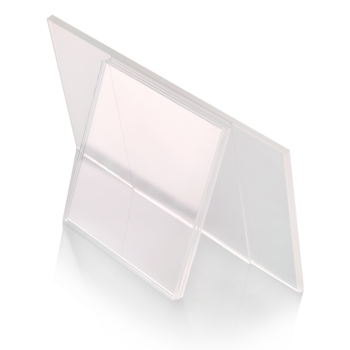
- Optical Window Glass Substrate Wafer Quartz Plate JGS1 JGS2 JGS3
- 1200℃ Split Tube Furnace with Quartz Tube Laboratory Tubular Furnace
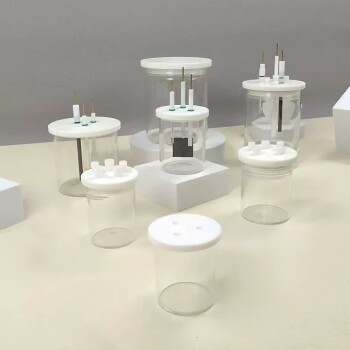
- Quartz Electrolytic Electrochemical Cell for Electrochemical Experiments
- Laboratory Ball Mill Jar Mill with Metal Alloy Grinding Jar and Balls
People Also Ask
- How does a laboratory tube furnace provide precise temperature control? Expert Simulation for Steam Cracking
- How does a quartz tube furnace facilitate the synthesis of rGO? Optimize Your Cathode Matrix with Precise Pyrolysis
- What are the advantages of using an electric heating furnace with a quartz tube for liquid bismuth corrosion control?
- What is the temperature of RTP? Achieving Precise Thermal Control for Semiconductor Fabrication
- What role does a quartz tube furnace play in hBN synthesis? Optimize Your Chemical Vapor Deposition Results