The Invisible Noise
In electrochemistry, contamination is not just dirt. It is noise.
It is a rogue peak on a cyclic voltammogram. It is a baseline that drifts when it should be steady. It is the invisible variable that turns a week of data into nonsense.
We often treat cleaning as a chore—a janitorial task performed before the "real science" begins. This is a mistake.
The preparation of a five-port water bath electrolytic cell is not a preliminary step. It is the foundation of the experiment itself. As Atul Gawande might observe in a surgical suite, the outcome is determined long before the incision is made. In the lab, the quality of your data is determined the moment you touch the soap.
The challenge is that "clean" is a relative term. To a mechanic, a wiped-down wrench is clean. To an electrochemist, a surface with a monolayer of adsorbed organics is a catastrophe.
Here is how to engineer a system of absolute purity.
The Environment as a Vector
Entropy is always trying to enter your system.
Your five-port cell does not exist in a vacuum (unless, of course, that is your specific variable). It exists in a room filled with dust, aerosols, and vibrations.
The first pillar of defense is environmental isolation.
If you are weighing powders or scrubbing equipment on the same bench where you assemble your cell, you are fighting a losing battle. Particulates settle.
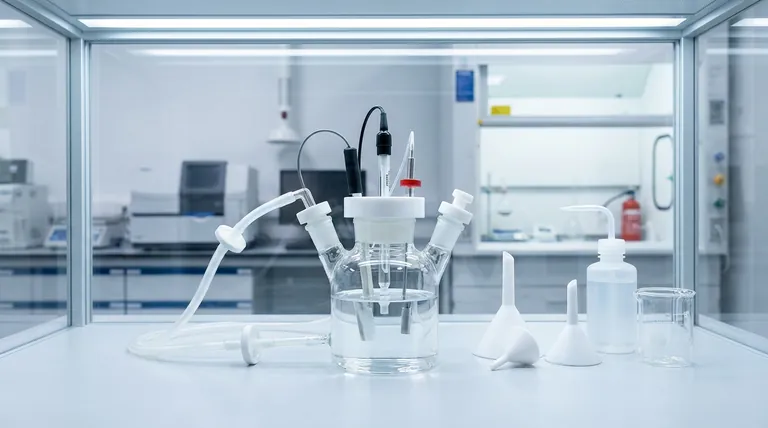
For high-sensitivity trace analysis, the air itself is a contaminant. The cell should be assembled in a laminar flow hood or a glove box. You are not just blocking dirt; you are creating a perimeter.
The Material Paradox: Glass vs. PTFE
The most common failure mode in electrolytic cell preparation is a misunderstanding of materials.
We tend to want a "universal" cleaning protocol. We want to throw everything into the autoclave and blast it with heat until it is sterile.
This works beautifully for glass. It is catastrophic for PTFE (Polytetrafluoroethylene).
The Glass Body
The glass body of your cell is resilient. It craves heat. For biological or organic-sensitive work, autoclaving at 121°C is the gold standard. It resets the surface.
The PTFE Components
The lids, stoppers, and seal rings are different. PTFE flows. It has a memory.
If you autoclave a PTFE lid, it expands. When it cools, it does not return to its original micron-perfect dimensions. It deforms.
A deformed lid creates a compromised seal. You may clean the bacterial contamination, but you invite atmospheric contamination because the lid no longer fits.
The Rule:
- Glass: Autoclave allowed. Acid wash allowed.
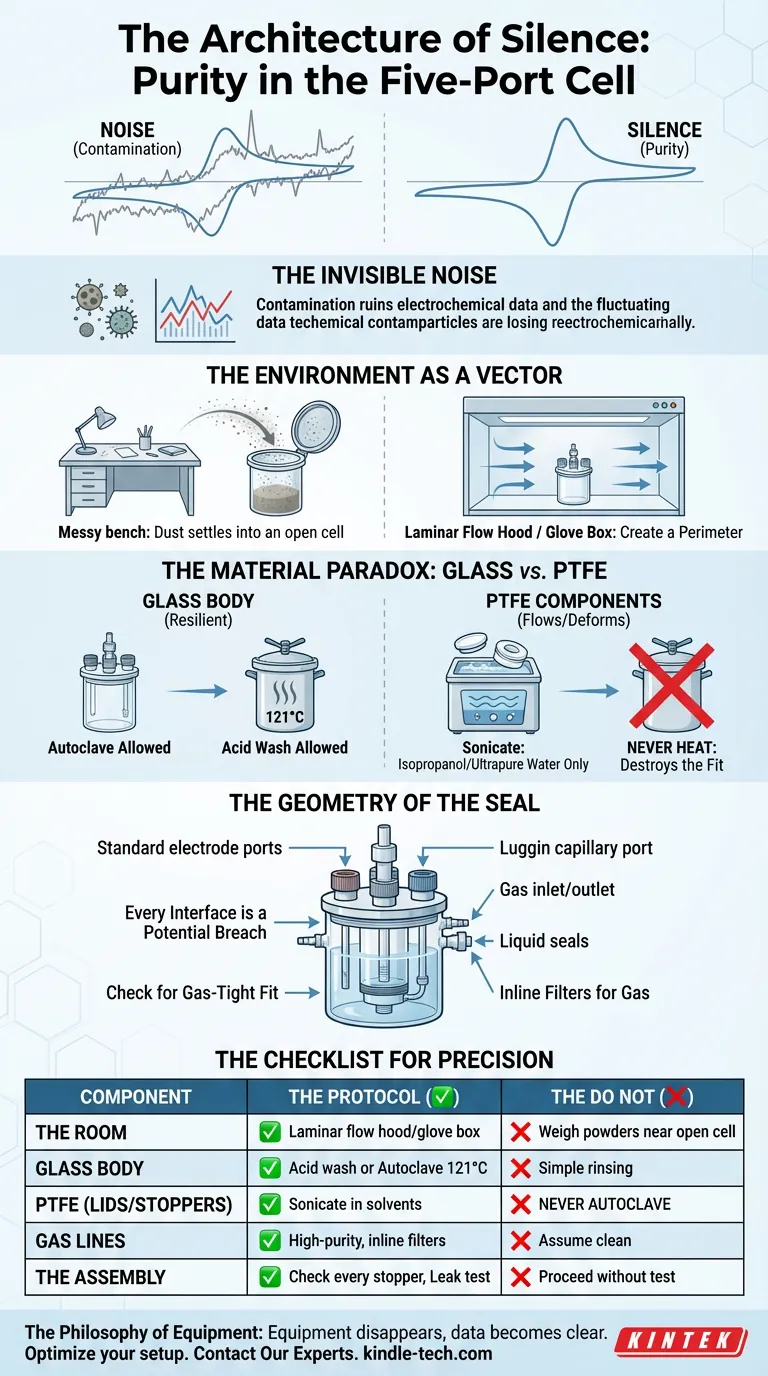
- PTFE: Solvents (isopropanol/ultrapure water) and sonication only. Never heat.
The Geometry of the Seal
A clean cell is useless if it leaks.
Once the components are prepped, the challenge shifts to system integrity. The five-port cell is complex by design. It usually houses:
- Two electrode ports (6.2mm standard).
- A Luggin capillary port.
- Gas inlet/outlet ports.
Every interface is a potential breach.
The "liquid seal" device is particularly elegant and particularly vulnerable. It is designed to prevent gas exchange while balancing pressure. If this is dry, or filled with dirty liquid, the outside world rushes in.
If you are using a gas inlet for sparging, you must ask: Is the gas clean? Pumping high-purity nitrogen through a dirty tube is simply an efficient way to inject contaminants into your electrolyte. Inline filters are not a luxury; they are a requirement.
The Checklist for Precision
Complexity requires checklists. To ensure reproducibility, we must standardize the variables we can control.
Below is the protocol for maintaining the sanctity of the electrochemical environment:
| Component / Vector | The Protocol | The "Do Not" |
|---|---|---|
| The Room | Assemble in a laminar flow hood or glove box. | Do not weigh powders near the open cell. |
| Glass Body | Acid wash or Autoclave (121°C). | Do not rely on simple rinsing for trace analysis. |
| PTFE (Lids/Stoppers) | Sonicate in Isopropanol/Ultrapure water. | NEVER AUTOCLAVE. Heat destroys the fit. |
| Gas Lines | Use high-purity sources with inline filters. | Do not assume tubing is clean out of the box. |
| The Assembly | Check every stopper for a gas-tight mechanical fit. | Do not proceed without a leak test. |
The Philosophy of Equipment
There is a certain romance in a perfectly set up electrolytic cell.
When the glass is pristine, the PTFE seals are tight, and the electrolyte is pure, the equipment disappears. It stops being a collection of jars and tubes and becomes a transparent medium for the reaction.
That silence—that lack of noise—is what allows you to see the data clearly.
At KINTEK, we understand that your equipment is the partner to your intellect. From high-grade borosilicate glass to precision-machined PTFE components that hold their seal, we build tools that respect the sensitivity of your science.
Do not let contamination be the variable that defines your work.
Let us help you optimize your setup. Contact Our Experts for a consultation tailored to your specific electrochemical needs.
Visual Guide
Related Products
- Electrolytic Electrochemical Cell with Five-Port
- Double Layer Five-Port Water Bath Electrolytic Electrochemical Cell
- Side Window Optical Electrolytic Electrochemical Cell
- Customizable PEM Electrolysis Cells for Diverse Research Applications
- FS Electrochemical Hydrogen Fuel Cells for Diverse Applications
Related Articles
- The Architecture of Control: Decoding the Five-Port Electrolytic Cell
- The Fragile Vessel of Truth: A Maintenance Manifesto for Electrolytic Cells
- The Symphony of Coefficients: Why Your Electrolytic Cell Cannot Be a Monolith
- The Fragility of Precision: Mastering the Integrity of Five-Port Electrolytic Cells
- The Art of the Sealed System: Mastering the Five-Port Electrolytic Cell