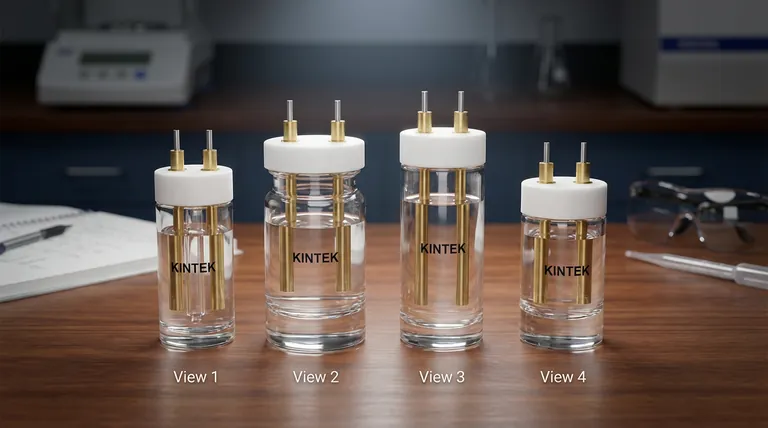
Blog The Transparency Paradox: Mastering the Fragile Art of Electrolytic Cells
The Transparency Paradox: Mastering the Fragile Art of Electrolytic Cells

The Transparency Paradox: Mastering the Fragile Art of Electrolytic Cells

6 days ago

The Illusion of Strength

In the laboratory, we spend most of our time looking through glass, not at it.

This transparency is its greatest asset, allowing us to witness chemical reactions in real-time. However, it is also a psychological trap. Because the barrier is invisible, we often forget it is there—until it shatters.

The electrolytic cell is not merely a vessel; it is a critical scientific instrument. It is the only thing separating a controlled electrochemical environment from chaotic failure.

When we handle the glass body of a cell, we are managing a risk equation. The glass is brittle. It does not forgive mistakes. It does not bend to accommodate our impatience.

The Physics of Catastrophe

Glass possesses a material property that engineers respect and operators often fear: brittleness.

Unlike metals or polymers, which might deform or dent under stress, glass maintains its shape until it reaches a catastrophic breaking point. There is no warning. There is no yielding.

When an electrolytic cell fractures, the cost is rarely just the replacement of the glass. The true costs are:

  • Data corruption: The closed system is breached, invalidating the experiment.
  • Resource loss: Valuable reagents and electrolytes are spilled.
  • Safety hazards: Chemical exposure and sharp debris create an immediate danger zone.

A Protocol for Preservation

To protect the integrity of the experiment, we must adopt a deliberate system of handling. This requires shifting from a mindset of "moving equipment" to "transporting instruments."

The Mechanics of Movement

Gravity and friction are the enemies of glass. To mitigate these forces:

  • Support the Base: Never lift a cell by its neck or rim. Always cup the base. The structural center of gravity is lower than you think.
  • Lift, Don't Slide: Sliding a cell across a benchtop creates microscopic vibrations. If the glass catches on an imperfection in the surface, the resulting torque can cause an immediate fracture.
  • Controlled Descent: When placing the cell down, the motion should be slow and deliberate.

The Art of Assembly

The most dangerous moment for an electrolytic cell is often during assembly—inserting electrodes or connecting gas lines.

The rule is simple: Zero Force.

If a component does not fit easily, something is wrong. Applying pressure to force a fit creates stress concentrations. These invisible tension points turn the glass into a time bomb, waiting for a slight temperature shift or vibration to shatter.

The Psychology of the Break

Why do accidents happen? Rarely is it a lack of skill. Usually, it is a lack of focus.

We rush. We try to carry two things at once. We operate in a cluttered workspace where the cell has to fight for space against beakers and notebooks.

Accidents are the result of systems that allow for error. To prevent breakage, we must engineer our environment and our behavior.

The "Safe Zone" Checklist:

  1. Clear the Bench: The cell requires a stable, vibration-free surface.
  2. Isolate the Task: Handle the cell individually. Never stack it with other glassware.
  3. Inspect First: A hairline crack is a fracture waiting to expand. Check before you pour.

Summary: The Rules of Engagement

The following framework outlines the difference between casual handling and professional preservation.

Operational Phase The Professional Approach The Failure Point
Transport Lift vertically with a secure grip on the base. Sliding horizontally or gripping by the rim.
Assembly Gentle insertion; respect tolerances. Forcing components; uneven pressure.
Environment Dedicated, clear, stable surface. Cluttered, high-traffic bench space.
Maintenance Individual cleaning; separate storage. Washing in batches; crowded storage.

The KINTEK Standard

The fragility of glass is a constraint, but it is also a sign of quality. It implies purity, transparency, and chemical inertness—qualities essential for high-precision electrochemistry.

At KINTEK, we understand that your equipment is the foundation of your research. We specialize in lab equipment and consumables designed to withstand the rigors of serious science while delivering the precision your data demands.

We build instruments for those who understand that the details matter.

Contact Our Experts to discuss how our high-quality electrolytic cells can improve the safety and reliability of your laboratory workflow.

Visual Guide
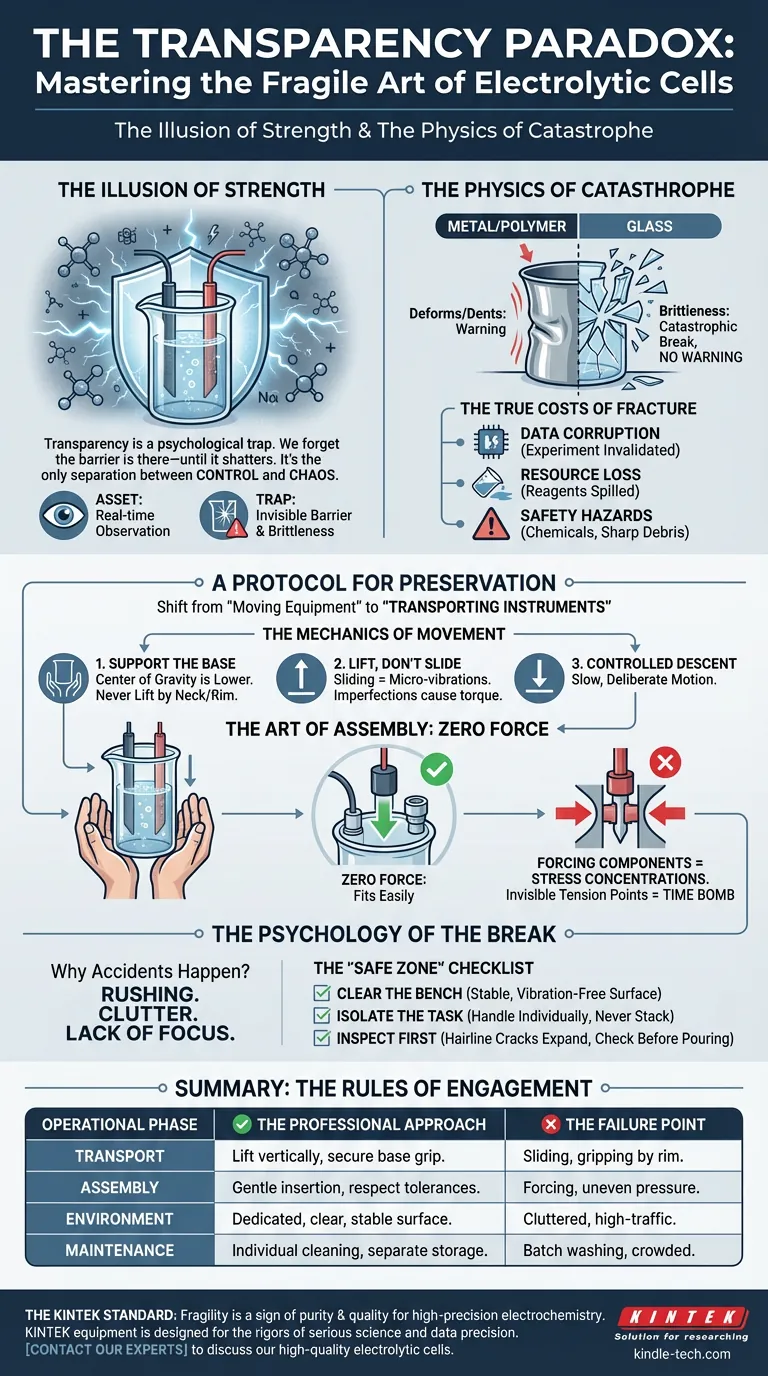
The Transparency Paradox: Mastering the Fragile Art of Electrolytic Cells Visual Guide

Related Products

Related Articles

Related Products

Electrolytic Electrochemical Cell with Five-Port

Electrolytic Electrochemical Cell with Five-Port

Streamline your laboratory consumables with Kintek's Electrolytic Cell with five-port design. Choose from sealed and non-sealed options with customizable electrodes. Order now.

Super Sealed Electrolytic Electrochemical Cell

Super Sealed Electrolytic Electrochemical Cell

Super-sealed electrolytic cell offers enhanced sealing capabilities, making it ideal for experiments that require high airtightness.

Double-Layer Water Bath Electrolytic Electrochemical Cell

Double-Layer Water Bath Electrolytic Electrochemical Cell

Discover the temperature-controllable electrolytic cell with a double-layer water bath, corrosion resistance, and customization options. Complete specifications included.

Electrolytic Electrochemical Cell for Coating Evaluation

Electrolytic Electrochemical Cell for Coating Evaluation

Looking for corrosion-resistant coating evaluation electrolytic cells for electrochemical experiments? Our cells boast complete specifications, good sealing, high-quality materials, safety, and durability. Plus, they're easily customizable to meet your needs.

Optical Water Bath Electrolytic Electrochemical Cell

Optical Water Bath Electrolytic Electrochemical Cell

Upgrade your electrolytic experiments with our Optical Water Bath. With controllable temperature and excellent corrosion resistance, it's customizable for your specific needs. Discover our complete specifications today.

Quartz Electrolytic Electrochemical Cell for Electrochemical Experiments

Quartz Electrolytic Electrochemical Cell for Electrochemical Experiments

Looking for a reliable quartz electrochemical cell? Our product boasts excellent corrosion resistance and complete specifications. With high-quality materials and good sealing, it's both safe and durable. Customize to meet your needs.

Side Window Optical Electrolytic Electrochemical Cell

Side Window Optical Electrolytic Electrochemical Cell

Experience reliable and efficient electrochemical experiments with a side window optical electrolytic cell. Boasting corrosion resistance and complete specifications, this cell is customizable and built to last.

Double Layer Five-Port Water Bath Electrolytic Electrochemical Cell

Double Layer Five-Port Water Bath Electrolytic Electrochemical Cell

Experience optimal performance with our Water Bath Electrolytic Cell. Our double-layer, five-port design boasts corrosion resistance and longevity. Customizable to fit your specific needs. View specs now.

H-Type Double-Layer Optical Electrolytic Electrochemical Cell with Water Bath

H-Type Double-Layer Optical Electrolytic Electrochemical Cell with Water Bath

Double-layer H-type optical water bath electrolytic cells, with excellent corrosion resistance and a wide range of specifications available. Customization options are also available.

H Type Electrolytic Cell Triple Electrochemical Cell

H Type Electrolytic Cell Triple Electrochemical Cell

Experience versatile electrochemical performance with our H-type Electrolytic Cell. Choose from membrane or non-membrane sealing, 2-3 hybrid configurations. Learn more now.

Electrolytic Electrochemical Cell Gas Diffusion Liquid Flow Reaction Cell

Electrolytic Electrochemical Cell Gas Diffusion Liquid Flow Reaction Cell

Looking for a high-quality gas diffusion electrolysis cell? Our liquid flow reaction cell boasts exceptional corrosion resistance and complete specifications, with customizable options available to suit your needs. Contact us today!

PTFE Electrolytic Cell Electrochemical Cell Corrosion-Resistant Sealed and Non-Sealed

PTFE Electrolytic Cell Electrochemical Cell Corrosion-Resistant Sealed and Non-Sealed

Choose our PTFE Electrolytic Cell for reliable, corrosion-resistant performance. Customize specifications with optional sealing. Explore now.

Customizable PEM Electrolysis Cells for Diverse Research Applications

Customizable PEM Electrolysis Cells for Diverse Research Applications

Custom PEM test cell for electrochemical research. Durable, versatile, for fuel cells & CO2 reduction. Fully customizable. Get a quote!

Flat Corrosion Electrolytic Electrochemical Cell

Flat Corrosion Electrolytic Electrochemical Cell

Discover our flat corrosion electrolytic cell for electrochemical experiments. With exceptional corrosion resistance and complete specifications, our cell guarantees optimal performance. Our high-quality materials and good sealing ensure a safe and durable product, and customization options are available.

Thin-Layer Spectral Electrolysis Electrochemical Cell

Thin-Layer Spectral Electrolysis Electrochemical Cell

Discover the benefits of our thin-layer spectral electrolysis cell. Corrosion-resistant, complete specifications, and customizable for your needs.

Customizable Swagelok Type Test Cells for Advanced Battery Research Electrochemical Analysis

Customizable Swagelok Type Test Cells for Advanced Battery Research Electrochemical Analysis

The KINTEK Swagelok-type test cell is a modular, T-shaped device constructed from high-quality, chemically inert materials.

FS Electrochemical Hydrogen Fuel Cells for Diverse Applications

FS Electrochemical Hydrogen Fuel Cells for Diverse Applications

KINTEK's FS Electrochemical Cell: Modular PEM fuel cell stack for R&D and training. Acid-resistant, scalable, and customizable for reliable performance.

Customizable CO2 Reduction Flow Cell for NRR ORR and CO2RR Research

Customizable CO2 Reduction Flow Cell for NRR ORR and CO2RR Research

The cell is meticulously crafted from high-quality materials to ensure chemical stability and experimental accuracy.

Button Battery Disassembly and Sealing Mold for Lab Use

Button Battery Disassembly and Sealing Mold for Lab Use

The simple sealing and disassembly mold can be directly used on ordinary tablet presses, which can save costs, is convenient and fast, and can be used to encapsulate and disassemble button batteries. Other specifications can be customized.

Laboratory manual slicer

Laboratory manual slicer

Manual microtome is a high-precision cutting device designed for laboratories, industry and medical fields. It is suitable for the preparation of thin slices of various materials such as paraffin samples, biological tissues, battery materials, food, etc.


Leave Your Message