Blog The Art of the Finish: Why the Most Critical Moment Happens After the Data is Collected
The Art of the Finish: Why the Most Critical Moment Happens After the Data is Collected

The Art of the Finish: Why the Most Critical Moment Happens After the Data is Collected

3 hours ago

The Invisible Accumulation of Error

There is a moment in every laboratory, usually around 6:00 PM, that determines the future success of a scientist more than their hypothesis does.

The data is collected. The graphs look promising. The fatigue sets in. The temptation is biological and overwhelming: leave the cleanup for tomorrow morning.

This is the most dangerous moment in the lifecycle of a side-window optical electrolytic cell.

We often view equipment maintenance as a chore—a tax we pay for doing science. But in reality, the shutdown protocol is not separate from the experiment. It is the experiment. It is the variable that defines whether your next reading is a breakthrough or a ghost artifact caused by a microscopic salt crystal left behind three days ago.

Residue compounds. Scratches accumulate. Precision erodes slowly, then all at once.

Here is how to master the art of the shutdown, preserving both your equipment and your data integrity.

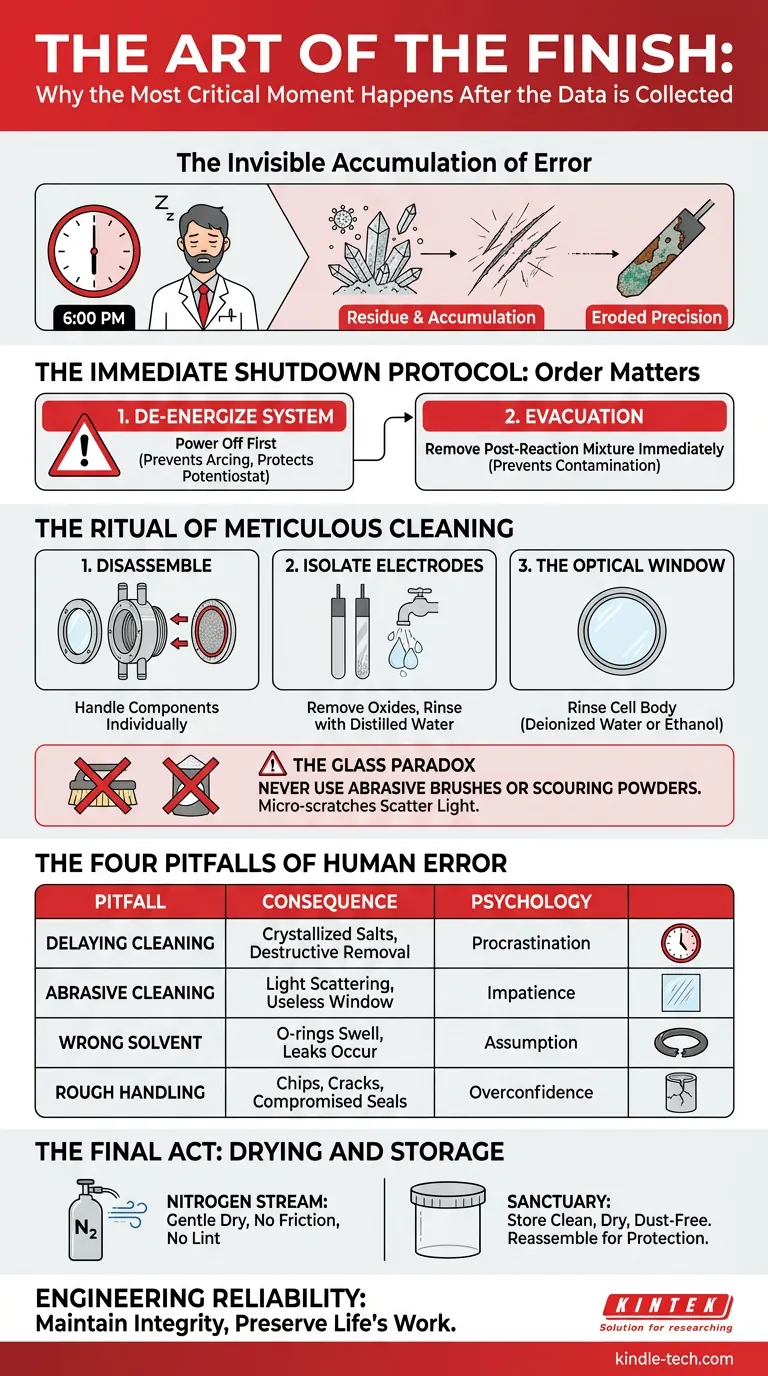
The Immediate Shutdown Protocol: Order Matters

Safety is not just about avoiding injury; it is about control. When an electrochemical system is active, it is a live environment. The order in which you dismantle that environment dictates safety.

The Arc and The Spark

The first step is binary. De-energize the system.

You must turn off the power source before touching any electrical leads. This seems obvious, yet it is frequently violated in moments of haste. Disconnecting a live lead can create an electric arc.

An arc does two things:

  1. It endangers the operator.
  2. It damages the potentiostat and electrode connections.

Only once the silence of the machine is absolute should you proceed.

Evacuation

Once the energy is gone, the chemistry must follow. Remove the post-reaction mixture immediately.

If the product is valuable, transfer it to storage. If it is waste, dispose of it according to environmental regulations. The goal is an empty vessel. The longer liquid sits, the more likely it is to interact with the cell walls or seals.

The Ritual of Meticulous Cleaning

Cleaning is an exercise in deconstruction. You cannot clean a complex system while it is assembled.

Step 1: Disassemble. Take the cell apart. Remove the working, counter, and reference electrodes. Handling each component individually is the only way to ensure they are truly clean.

Step 2: Isolate the Electrodes. Electrodes have memories. If you don't scrub that memory away, it contaminates the future. Clean them based on their specific material requirements. Remove oxides and dirt. Rinse with distilled water.

Step 3: The Optical Window. This is the heart of the "optical" electrolytic cell. It is a lens into the truth of your reaction.

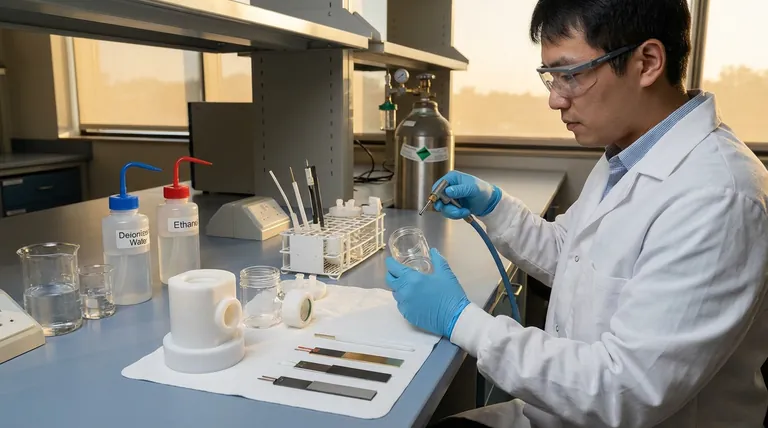
Rinse the cell body repeatedly with deionized water. If the residue is stubborn, use an organic solvent like ethanol. But here, you must exercise what engineers call "material empathy."

The Glass Paradox

The optical window is strong enough to hold chemical reactions but fragile enough to be ruined by a paper towel.

Never use abrasive brushes. Never use scouring powders.

A single micro-scratch on the window scatters light. Once light scatters, your optical measurements become noise. The window must remain invisible to be useful.

The Four Pitfalls of Human Error

In our experience at KINTEK, equipment failure is rarely caused by the equipment itself. It is caused by a deviation from protocol.

The Pitfall The Consequence The Psychology
Delaying Cleaning Salts crystallize and harden. Removal becomes destructive. "I'll do it tomorrow." (Procrastination)
Abrasive Cleaning Light scattering renders the window useless. "I need to get this stain off fast." (Impatience)
Wrong Solvent O-rings swell; PTFE degrades; leaks occur. "This solvent should work." (Assumption)
Rough Handling Chips or cracks in the glass body; compromised seals. "It feels sturdy enough." (Overconfidence)

The Final Act: Drying and Storage

You have cleaned the past away. Now you must protect the future.

The Nitrogen Stream Do not rub the components dry. Use a gentle stream of dry nitrogen gas. It is the gold standard for removing moisture without introducing lint or friction.

If nitrogen is unavailable, air drying in a dust-free environment is acceptable. The enemy here is moisture. A single drop of water left in a crevice is a breeding ground for corrosion or a contaminant for tomorrow's anhydrous reaction.

Sanctuary Store the components in a clean, dry, dust-free location. Reassembling the cell for storage is often the best way to protect the delicate optical window from accidental impact or ambient dust.

Engineering Reliability

Your protocol reflects your priorities.

  • For Safety: Power off first. Always.
  • For Reproducibility: Clean immediately.
  • For Longevity: Store properly.

At KINTEK, we believe that the tools of science should be as resilient as the scientists using them. We specialize in high-quality lab equipment and consumables designed to withstand the rigors of serious research—provided they are treated with the respect they deserve.

When you care for your equipment, you are not just maintaining a machine; you are maintaining the integrity of your life's work.

Ready to upgrade your laboratory's capabilities? Contact Our Experts to discuss how KINTEK can support your research with precision equipment and compatible consumables.

Visual Guide
The Art of the Finish: Why the Most Critical Moment Happens After the Data is Collected Visual Guide

Related Products

Related Articles

Related Products

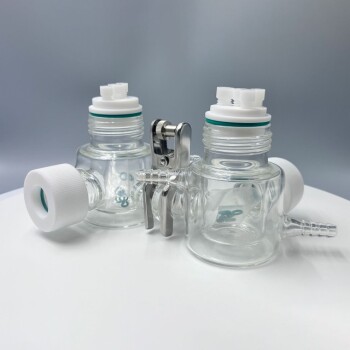
Side Window Optical Electrolytic Electrochemical Cell

Side Window Optical Electrolytic Electrochemical Cell

Experience reliable and efficient electrochemical experiments with a side window optical electrolytic cell. Boasting corrosion resistance and complete specifications, this cell is customizable and built to last.

Super Sealed Electrolytic Electrochemical Cell

Super Sealed Electrolytic Electrochemical Cell

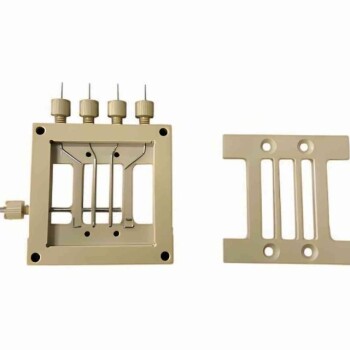
Super-sealed electrolytic cell offers enhanced sealing capabilities, making it ideal for experiments that require high airtightness.

Electrolytic Electrochemical Cell for Coating Evaluation

Electrolytic Electrochemical Cell for Coating Evaluation

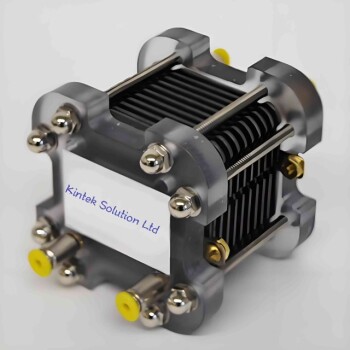
Looking for corrosion-resistant coating evaluation electrolytic cells for electrochemical experiments? Our cells boast complete specifications, good sealing, high-quality materials, safety, and durability. Plus, they're easily customizable to meet your needs.

Multifunctional Electrolytic Electrochemical Cell Water Bath Single Layer Double Layer

Multifunctional Electrolytic Electrochemical Cell Water Bath Single Layer Double Layer

Discover our high-quality Multifunctional Electrolytic Cell Water Baths. Choose from single or double-layer options with superior corrosion resistance. Available in 30ml to 1000ml sizes.

Glassy Carbon Sheet RVC for Electrochemical Experiments

Glassy Carbon Sheet RVC for Electrochemical Experiments

Discover our Glassy Carbon Sheet - RVC. Perfect for your experiments, this high-quality material will elevate your research to the next level.

High Performance Laboratory Stirrers for Diverse Applications

High Performance Laboratory Stirrers for Diverse Applications

Precise laboratory overhead stirrers for high-viscosity mixing. Durable, customizable, and ideal for research. Explore models now!

Custom PTFE Teflon Parts Manufacturer Laboratory High Temperature Mixing Paddle Mixer

Custom PTFE Teflon Parts Manufacturer Laboratory High Temperature Mixing Paddle Mixer

The PTFE mixing paddle mixer is a versatile and robust tool designed for laboratory use, particularly in environments requiring high resistance to chemicals and extreme temperatures. Crafted from high-quality PTFE, this mixer boasts several key features that enhance its functionality and durability.

Laboratory Vortex Mixer Orbital Shaker Multifunctional Rotation Oscillation Mixer

Laboratory Vortex Mixer Orbital Shaker Multifunctional Rotation Oscillation Mixer

The inching mixer is small in size, mixes quickly and thoroughly, and the liquid is in a vortex shape, which can mix all the test solutions attached to the tube wall.

Custom PTFE Teflon Parts Manufacturer for Culture Dish and Evaporation Dish

Custom PTFE Teflon Parts Manufacturer for Culture Dish and Evaporation Dish

The PTFE culture dish evaporating dish is a versatile laboratory tool known for its chemical resistance and high-temperature stability. PTFE, a fluoropolymer, offers exceptional non-stick properties and durability, making it ideal for various applications in research and industry, including filtration, pyrolysis, and membrane technology.

Laboratory manual slicer

Laboratory manual slicer

Manual microtome is a high-precision cutting device designed for laboratories, industry and medical fields. It is suitable for the preparation of thin slices of various materials such as paraffin samples, biological tissues, battery materials, food, etc.

Laboratory Oscillating Orbital Shaker

Laboratory Oscillating Orbital Shaker

Mixer-OT orbital shaker uses brushless motor, which can run for a long time. It is suitable for vibration tasks of culture dishes, flasks and beakers.

Laboratory Disc Rotary Mixer for Efficient Sample Mixing and Homogenization

Laboratory Disc Rotary Mixer for Efficient Sample Mixing and Homogenization

Efficient Laboratory Disc Rotary Mixer for Precise Sample Mixing, Versatile for Various Applications, DC Motor and Microcomputer Control, Adjustable Speed and Angle.

Custom PTFE Teflon Parts Manufacturer for PTFE Mesh F4 Sieve

Custom PTFE Teflon Parts Manufacturer for PTFE Mesh F4 Sieve

PTFE mesh sieve is a specialized test sieve designed for particle analysis in various industries, featuring a non-metallic mesh woven from PTFE filament. This synthetic mesh is ideal for applications where metal contamination is a concern . PTFE sieves are crucial for maintaining the integrity of samples in sensitive environments, ensuring accurate and reliable results in particle size distribution analysis.

Twin Screw Extruder Plastic Granulation Machine

Twin Screw Extruder Plastic Granulation Machine

Twin screw extruder plastic granulation machine is designed for the mixing and processing experiments of engineering plastics, modified plastics, waste plastics and masterbatches.

Optical Ultra-Clear Glass Sheet for Laboratory K9 B270 BK7

Optical Ultra-Clear Glass Sheet for Laboratory K9 B270 BK7

Optical glass, while sharing many characteristics with other types of glass, is manufactured using specific chemicals that enhance properties crucial for optics applications.

Custom PTFE Teflon Parts Manufacturer for PTFE Measuring Cylinder 10/50/100ml

Custom PTFE Teflon Parts Manufacturer for PTFE Measuring Cylinder 10/50/100ml

PTFE measuring cylinder are a rugged alternative to traditional glass cylinders. They are chemically inert over a wide temperature range (up to 260º C), have excellent corrosion resistance and maintain a low coefficient of friction, ensuring ease of use and cleaning.

Custom PTFE Teflon Parts Manufacturer for Acid and Alkali Resistant Chemical Powder Material Scoops

Custom PTFE Teflon Parts Manufacturer for Acid and Alkali Resistant Chemical Powder Material Scoops

Known for its excellent thermal stability, chemical resistance and electrical insulating properties, PTFE is a versatile thermoplastic material.

Rubber Vulcanizer Vulcanizing Machine Plate Vulcanizing Press for Lab

Rubber Vulcanizer Vulcanizing Machine Plate Vulcanizing Press for Lab

The Plate vulcanizing press is a kind of equipment used in the production of rubber products, mainly used for the vulcanization of rubber products. Vulcanization is a key step in rubber processing.

Vacuum Hot Press Furnace Machine for Lamination and Heating

Vacuum Hot Press Furnace Machine for Lamination and Heating

Experience clean and precise lamination with Vacuum Lamination Press. Perfect for wafer bonding, thin-film transformations, and LCP lamination. Order now!


Leave Your Message