The Psychology of "Done"
There is a dangerous moment in every laboratory. It happens right after the data is captured.
The curve has been plotted. The reaction is complete. The dopamine hit of discovery—or the frustration of failure—is washing over you. In your mind, the work is finished.
But in the physical world, the work is at its most critical juncture.
The way you handle the next fifteen minutes determines the validity of your work six months from now.
Reliability in electrochemistry is not just about the quality of the reaction; it is about the "memory" of the equipment. A double-layer water-bath electrolytic cell is a precision instrument. If treated like a dirty coffee mug, it will eventually lie to you.
The most effective scientists understand a simple truth: Maintenance is not a chore. It is the first step of the next experiment.
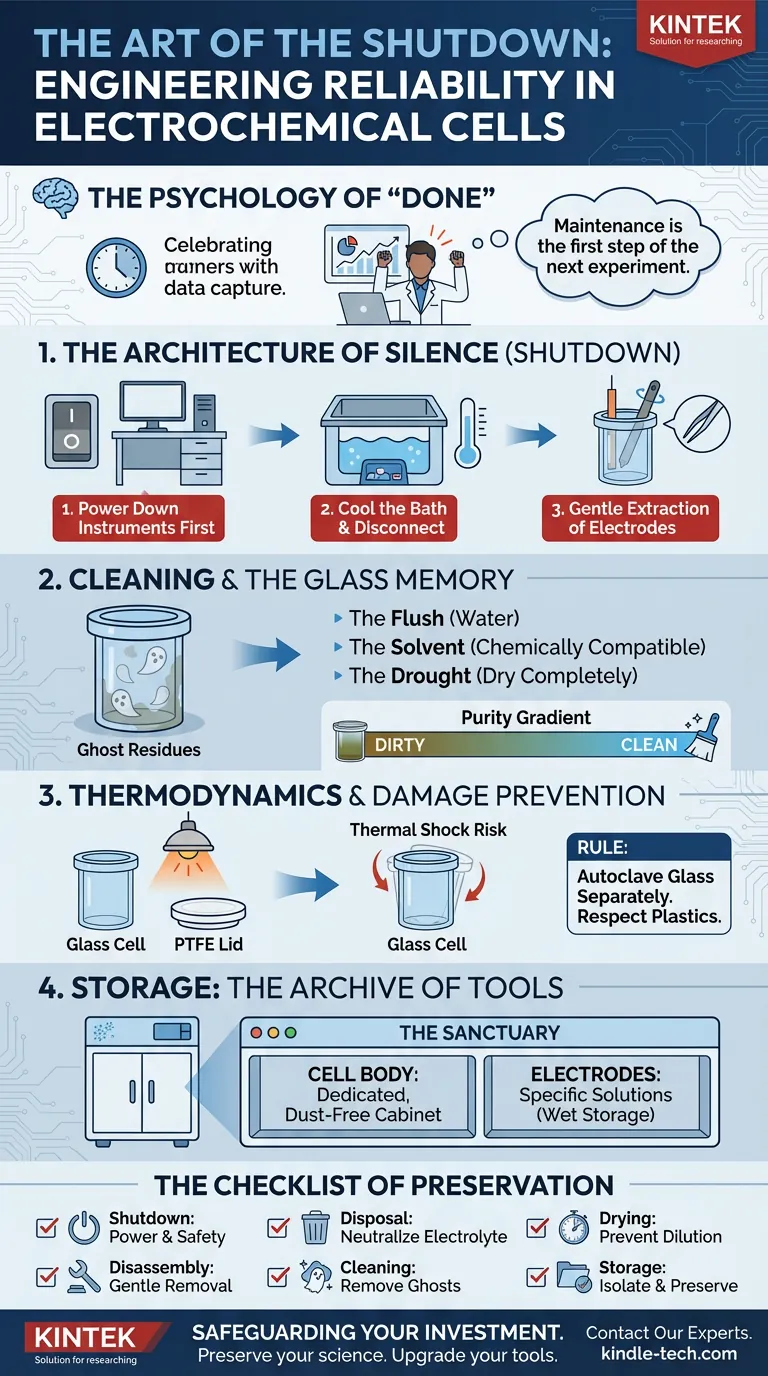
The Architecture of Silence
When the hum of the lab fades, the shutdown protocol begins. This is a systematic de-escalation of energy.
The goal is to return the system to a state of neutrality without inflicting thermal or mechanical shock.
1. The Energy Vacuum
Before matter is moved, energy must cease. The sequence is non-negotiable.
- Silence the Workstation: Cut the power to the electrochemical workstation first.
- Cool the Bath: Turn off the constant temperature water bath.
- Disconnect: Only when the energy is zero do you remove the wiring.
Touching a live circuit in a wet environment is an amateur mistake with professional consequences.
2. The Extraction
Electrodes are the nerves of your system. They are sensitive, expensive, and fragile.
Removing them requires the steady hand of a surgeon. A working electrode bumped against a glass wall can develop microscopic scratches that alter surface area calculations.
Once removed, the electrolyte—now a chemical waste product—must be purged. Neutralize it. Recycle it. Dispose of it. Do not let it sit. The longer it remains, the more it interacts with the cell seals.
Glass Has a Memory
We like to think of glass as inert. In the short term, it is. In the long term, glass has a memory.
If you leave a trace of residue—a phantom of the previous reaction—the glass "remembers" it. When you introduce new electrolytes next week, that residue releases, turning your pure experiment into a chaotic mixture.
Cleaning is the exorcism of these ghosts.
The Gradient of Purity
Cleaning is not a binary state (clean/dirty); it is a gradient.
- The Flush: Immediate rinsing with distilled or deionized water removes the bulk material.
- The Solvent: For stubborn organics, water is insufficient. Ethanol, acetone, or dilute acids may be required.
- Engineer’s Note: Verify chemical compatibility. A solvent that cleans the glass might dissolve the seal.
- The Drought: Dry the cell completely. A drop of residual water is a contaminant that changes the concentration of your next solution.
The Thermodynamics of Destruction
Most equipment damage is not caused by wear and tear. It is caused by thermal shock and impatience.
A common tragedy involves the PTFE (Teflon) lid. In a rush to sterilize, a researcher might throw the entire assembly into high heat.
Glass expands. PTFE expands. But they expand at different rates.
When heated excessively, the PTFE lid deforms. It loses its geometric fidelity. When it cools, it no longer fits. The seal is broken, and the cell is useless.
** The Rule:** Autoclave glass if you must, but do so separately. Treat plastics with the thermal respect they demand.
Storage: The Archive of Tools
Where do you put a tool when you aren't using it?
If you throw it in a drawer, you are inviting dust—the silent enemy of electrochemistry. Dust particles are essentially random noise added to your data.
The Sanctuary
- The Cell Body: Store in a dedicated, dust-free cabinet. It should be dry and isolated from volatile chemicals.
- The Electrodes: These are living components. Reference electrodes often need to be stored in specific solutions to maintain potential stability. A dry reference electrode is often a dead reference electrode.
The Checklist of Preservation
Discipline outperforms motivation. Do not rely on "trying hard" to keep your equipment safe. Rely on a system.
| Phase | Action | The "Why" (The Engineering Logic) |
|---|---|---|
| Shutdown | Power down instruments first. | Prevents electrical shorts and ensures user safety. |
| Disassembly | Remove electrodes gently. | Protects the most expensive sensors from mechanical impact. |
| Disposal | Remove electrolyte immediately. | Prevents chemical etching of seals and glass. |
| Cleaning | Rinse (Water) $\rightarrow$ Clean (Solvent). | Removes "ghost" residues that alter future data. |
| Drying | Air dry completely. | Prevents dilution errors in the next run. |
| Storage | Isolate components. | Prevents dust contamination and physical breakage. |
Safeguarding Your Investment
There is a romance to the pristine lab bench. It signifies a mind that is clear, ordered, and ready for discovery.
But we know that entropy is the natural state of the lab. Things break. Things get dirty. Things degrade.
At KINTEK, we understand the tension between the chaos of experimentation and the need for precision. We build our lab equipment—from our robust electrolytic cells to our consumables—to withstand the rigors of real-world research.
However, even the best equipment relies on the discipline of the user.
If you treat your tools with the respect they deserve, they will return the favor with data you can trust. If you need equipment that is worthy of that respect, or if you need to replace components lost to the entropy of the lab, we are here.
Preserve your science. Upgrade your tools.
Visual Guide
Related Products
- Double-Layer Water Bath Electrolytic Electrochemical Cell
- H-Type Double-Layer Optical Electrolytic Electrochemical Cell with Water Bath
- Double Layer Five-Port Water Bath Electrolytic Electrochemical Cell
- Multifunctional Electrolytic Electrochemical Cell Water Bath Single Layer Double Layer
- PTFE Electrolytic Cell Electrochemical Cell Corrosion-Resistant Sealed and Non-Sealed
Related Articles
- The Architecture of Control: Why Thermal Stability Defines Electrolysis Success
- The Thermodynamic Paradox: Balancing Precision and Safety in Electrolytic Cells
- The Silent Deformation: Why Good Intentions Break Precision Glassware
- The Quiet Discipline: Mastering the Post-Use Protocol for Five-Port Electrolytic Cells
- The Thermodynamics of Consistency: Mastering the Invisible Variable in Electrolysis