The Illusion of Solidity
We have a deep, instinctual trust in solid objects. We assume a metal part, a ceramic component, or a block of pressed powder is uniformly strong throughout.
This assumption is often wrong.
In many manufacturing processes, the very act of creation introduces hidden flaws. Like a fault line deep underground, these invisible inconsistencies in density are the starting points for future failure—cracks, warping, and inconsistent performance. This isn't a failure of material, but a failure of a fundamental force: pressure.
The Tyranny of Uniaxial Force
Traditional powder compaction uses a simple, intuitive method: a powerful press drives a punch into a rigid die. This is known as uniaxial (or biaxial) pressing. It is fast, efficient, and excellent for producing simple shapes in high volumes.
But it has a hidden physical sin: friction.
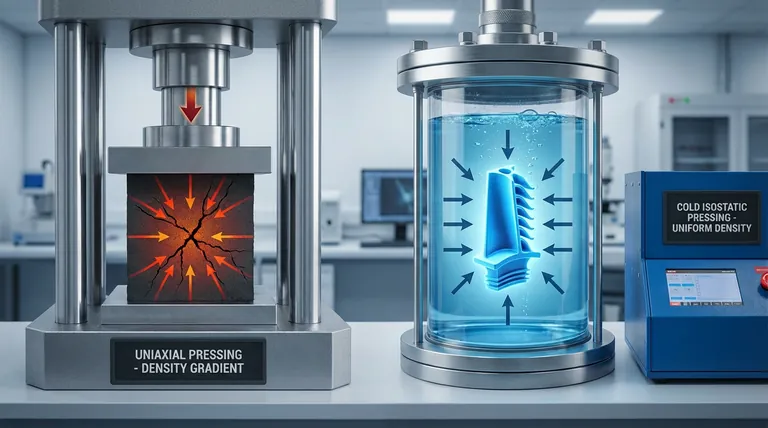
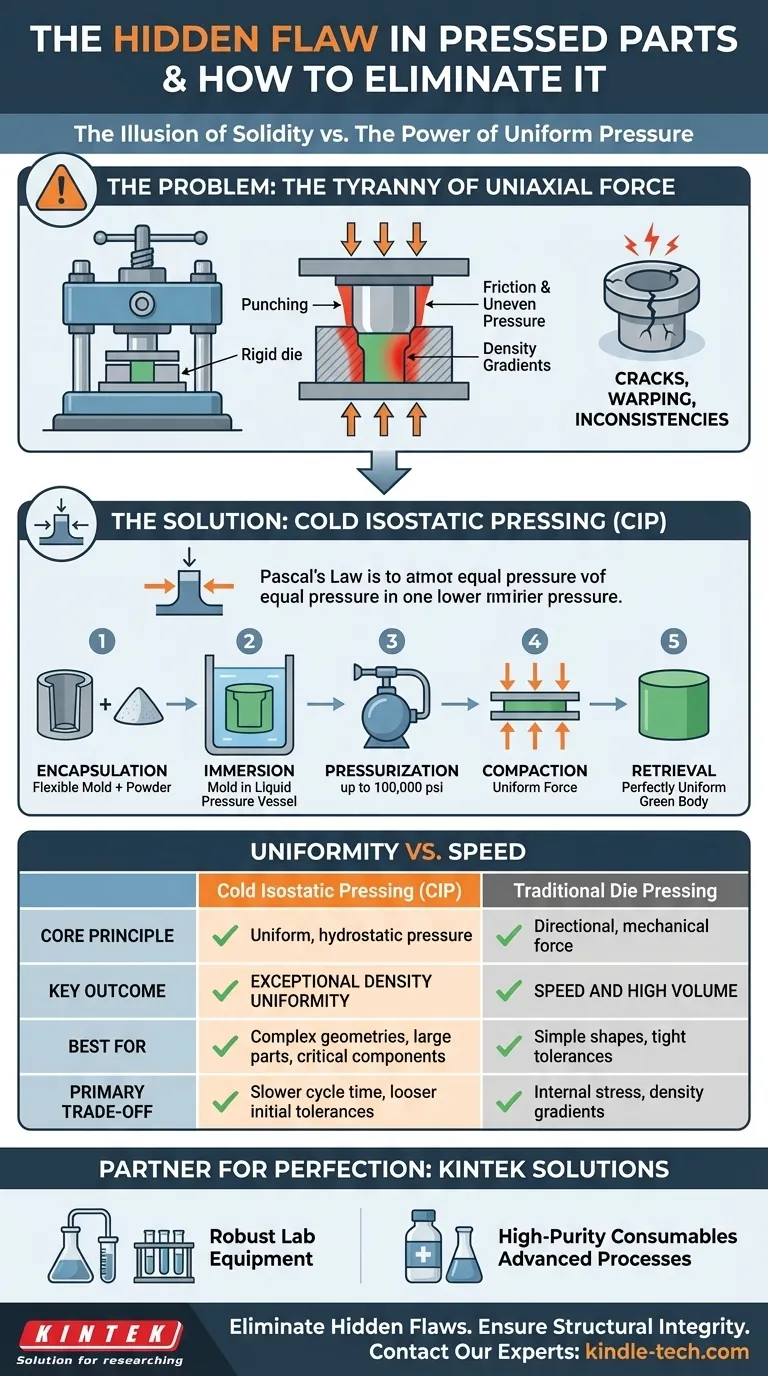
As the powder is compressed, particles rub against the rigid die walls. This friction prevents pressure from being transmitted evenly throughout the component. The powder directly under the punch becomes incredibly dense, while the material at the bottom corners remains looser.
The result is a part with significant density gradients. These are not just minor variations; they are built-in stress points that can cause a component to warp during heating, shrink unevenly, or crack under load.
An Elegant Solution: Pressure from Everywhere at Once
What if you could squeeze a component from all directions simultaneously, with perfectly uniform force? This is the core principle of Cold Isostatic Pressing (CIP), and it represents a fundamentally more elegant approach to compaction.
Instead of brute force from one direction, CIP leverages Pascal's Law. By submerging a flexible mold in a liquid and pressurizing that liquid, the force is applied equally to every single point on the object's surface. There is no die wall friction because the "walls" are a fluid.
The process is a deliberate, multi-stage application of this principle.
The Process of Uniformity
- Encapsulation: The raw powder is sealed inside a flexible, watertight elastomer mold. This mold defines the part's shape but doesn't resist the pressure to come.
- Immersion: The sealed mold is placed into a pressure vessel, which is then filled with a liquid medium (like water or oil). This liquid is the great equalizer.
- Pressurization: An external pump pressurizes the liquid, sometimes up to an immense 100,000 psi (690 MPa). This hydrostatic pressure envelops the mold.
- Compaction: The force is transmitted through the flexible mold to the powder, compacting the particles together with perfect uniformity, creating a dense, solid "green body."
- Retrieval: The pressure is released, the liquid is drained, and the perfectly uniform green body is removed.
The resulting component is free from the internal density gradients that plague uniaxially pressed parts. Its internal structure is homogeneous, predictable, and fundamentally stronger.
The Anatomy of a Decision: Uniformity vs. Speed
Choosing a manufacturing process is a psychological exercise as much as a technical one. It forces you to define what you truly value: speed or perfection? Volume or integrity?
CIP is not a replacement for all other methods. It is a strategic choice for when material quality is non-negotiable.
| Feature | Cold Isostatic Pressing (CIP) | Traditional Die Pressing |
|---|---|---|
| Core Principle | Uniform, hydrostatic pressure | Directional, mechanical force |
| Key Outcome | Exceptional Density Uniformity | Speed and High Volume |
| Best For | Complex geometries, large parts, critical components | Simple shapes, tight tolerances |
| Primary Trade-off | Slower cycle time, looser initial tolerances | Internal stress, density gradients |
If your goal is to produce millions of simple washers at the lowest cost, die pressing is the logical choice.
But if you are creating a complex turbine blade, a large ceramic insulator, or a medical implant where internal flaws could be catastrophic, you are no longer optimizing for speed. You are optimizing for certainty. For these applications, CIP is the superior path.
From Theory to Practice: Equipping for Perfection
The pursuit of flawless materials is not just a theoretical exercise. It requires precise, reliable equipment capable of harnessing immense pressures with perfect control. Achieving the uniform density promised by CIP is impossible without a foundation of high-quality laboratory tools and consumables.
This is where the theoretical meets the practical. At KINTEK, we specialize in providing the robust lab equipment and high-purity consumables that empower researchers and manufacturers to move beyond the limitations of traditional methods. Our solutions are designed to support advanced processes like Cold Isostatic Pressing, giving you the tools to build components with the highest possible material integrity.
Eliminating the hidden flaws in your materials begins with embracing a better principle of pressure. To ensure your components have the uniform density and structural integrity they require, it's time to explore advanced processing. Contact Our Experts
Visual Guide
Related Products
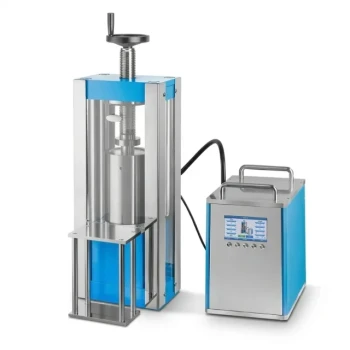
- Electric Split Lab Cold Isostatic Press CIP Machine for Cold Isostatic Pressing
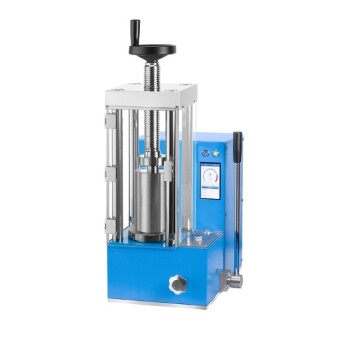
- Electric Lab Cold Isostatic Press CIP Machine for Cold Isostatic Pressing
- Automatic Lab Cold Isostatic Press CIP Machine Cold Isostatic Pressing
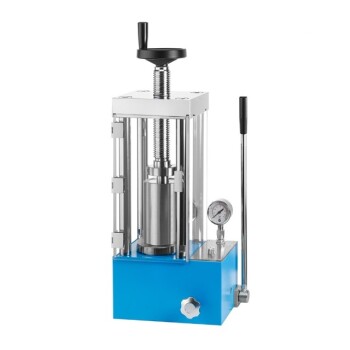
- Manual Cold Isostatic Pressing Machine CIP Pellet Press
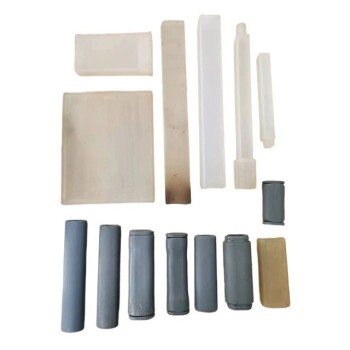
- Isostatic Molding Pressing Molds for Lab