Blog The Silent Interface: Mastery Over Electrode Decay
The Silent Interface: Mastery Over Electrode Decay

The Silent Interface: Mastery Over Electrode Decay

1 week ago

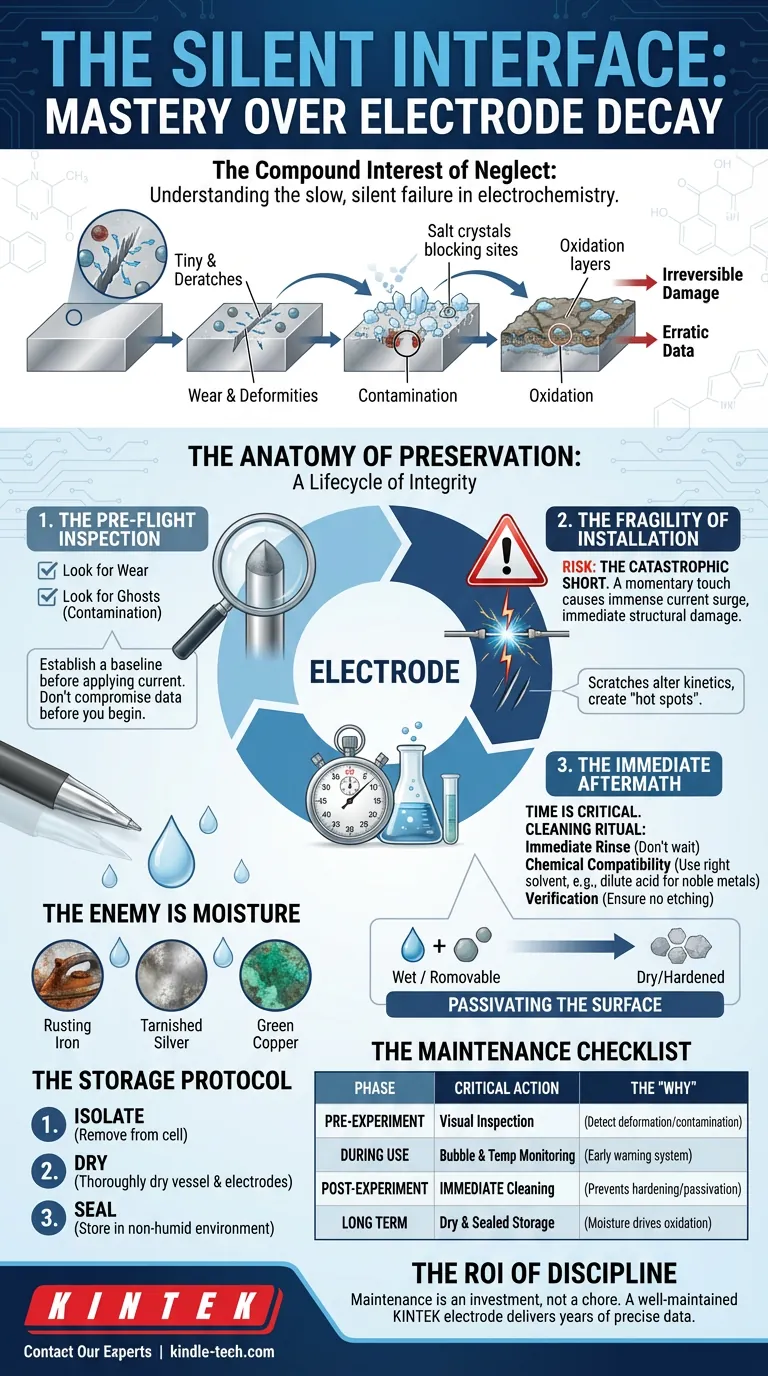
The Compound Interest of Neglect

In the laboratory, entropy is undefeated.

We often think of equipment failure as a dramatic event—a shattered beaker or a blown fuse. But in electrochemistry, failure is usually silent. It is a slow, creeping accumulation of microscopic errors.

An electrode does not stop working all at once. It fades.

A scratch here disrupts current distribution. A drying salt crystal there blocks an active site. Oxidation slowly reclaims the metal. By the time you notice the data is erratic, the damage is already irreversible.

The difference between a reliable experiment and a waste of resources is not luck. It is the discipline of maintenance.

The Anatomy of Preservation

The electrode is the interface between the physical and the chemical. It is a precision instrument disguised as a piece of metal.

Treating it with "care" is too vague. You need a system. A protocol reduces the cognitive load of the operator and ensures that the physics of the reaction remain constant.

Here is the lifecycle of electrode integrity.

1. The Pre-Flight Inspection

Before a pilot takes off, they walk around the plane. They are looking for anomalies. You must do the same.

Before applying current, inspect the surface. You are establishing a baseline.

  • Look for wear: Are there physical deformities?
  • Look for ghosts: Is there contamination from the last experiment?

If the surface is compromised before you begin, your data is compromised before you record it.

2. The Fragility of Installation

There is a specific moment of high risk: the installation.

Electrodes are often physically robust but electrochemically sensitive. Scratches alter reaction kinetics. They create "hot spots"—localized areas where current flows unevenly.

The Catastrophic Short: The greatest danger is the short circuit. A momentary touch between electrodes during setup generates an immense current surge. This isn't just a spark; it is immediate, irreversible structural damage to the cell.

3. The Immediate Aftermath

The most critical variable in cleaning is time.

When an experiment ends, the clock starts. Reaction products are wet and removable. Give them an hour, and they dry. Give them a day, and they harden.

The residue effectively "passivates" the surface. It builds a wall between the electrode and the electrolyte.

The Cleaning Ritual:

  • Immediate Rinse: Do not wait.
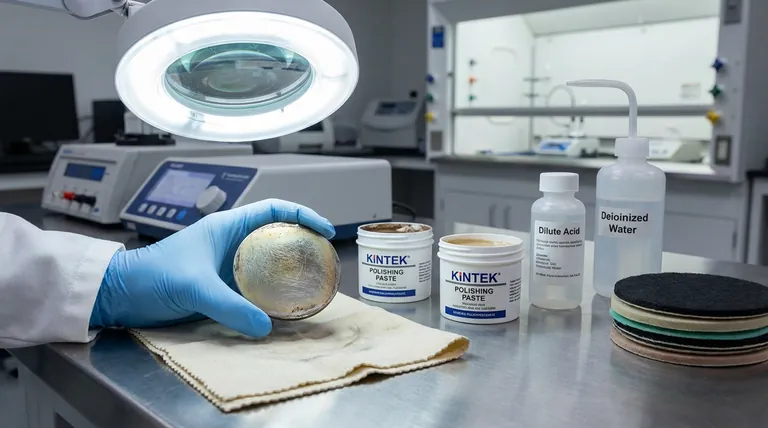
  • Chemical Compatibility: Use the right solvent. For noble metals like platinum, a dilute acid soak (e.g., 1M nitric acid) followed by deionized water is standard.
  • Verification: Ensure the cleaning agent itself doesn't etch the material.

The Enemy is Moisture

Iron rusts. Silver tarnishes. Copper turns green.

Nature is constantly trying to return refined metals to their oxide states. Water is the catalyst for this process.

If you store an electrode wet, you are inviting corrosion. If you store it in a humid room, you are accepting slow degradation.

The Storage Protocol:

  1. Isolate: Pour the electrolyte into a sealed container. Never leave it in the cell.
  2. Dry: Thoroughly dry the vessel and the electrodes.
  3. Seal: Store components in a non-humid environment.

Summary: The Maintenance Checklist

The goal is not just cleanliness; it is consistency. By standardizing your care, you remove variables from your data.

Phase Critical Action The "Why"
Pre-Experiment Visual Inspection To detect deformation or "ghost" contamination.
During Use Bubble & Temp Monitoring Early warning system for reaction failure.
Post-Experiment Immediate Cleaning Prevents residue from hardening and passivating the surface.
Long Term Dry & Sealed Storage Moisture is the primary driver of oxidation.

The ROI of Discipline

Maintenance is often viewed as a chore—the tax we pay for doing science.

In reality, it is an investment. A well-maintained electrode from KINTEK can deliver years of precise data. A neglected one will become a variable you cannot control.

We build our equipment to withstand the rigors of the laboratory, but we rely on your discipline to keep them singing.

If you are looking for equipment that rewards this level of precision—or if you need advice on the chemical compatibility of your current setup—we are here to help.

Contact Our Experts

Visual Guide

The Silent Interface: Mastery Over Electrode Decay Visual Guide

Related Products

Related Articles

Related Products

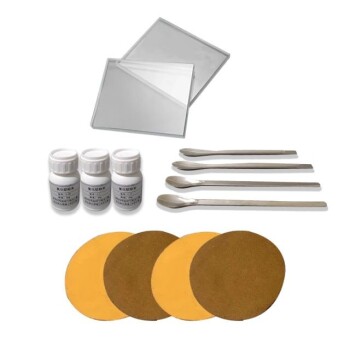
Electrode Polishing Material for Electrochemical Experiments

Electrode Polishing Material for Electrochemical Experiments

Looking for a way to polish your electrodes for electrochemical experiments? Our polishing materials are here to help! Follow our easy instructions for best results.

Glassy Carbon Sheet RVC for Electrochemical Experiments

Glassy Carbon Sheet RVC for Electrochemical Experiments

Discover our Glassy Carbon Sheet - RVC. Perfect for your experiments, this high-quality material will elevate your research to the next level.

Platinum Sheet Electrode for Battery Lab Applications

Platinum Sheet Electrode for Battery Lab Applications

Platinum sheet is composed of platinum, which is also one of the refractory metals. It is soft and can be forged, rolled and drawn into rod, wire, plate, tube and wire.

Rotating Platinum Disk Electrode for Electrochemical Applications

Rotating Platinum Disk Electrode for Electrochemical Applications

Upgrade your electrochemical experiments with our Platinum Disc Electrode. High-quality and reliable for accurate results.

Platinum Sheet Electrode for Laboratory and Industrial Applications

Platinum Sheet Electrode for Laboratory and Industrial Applications

Elevate your experiments with our Platinum Sheet Electrode. Crafted with quality materials, our safe and durable models can be tailored to fit your needs.

Custom PTFE Teflon Parts Manufacturer for PTFE Mesh F4 Sieve

Custom PTFE Teflon Parts Manufacturer for PTFE Mesh F4 Sieve

PTFE mesh sieve is a specialized test sieve designed for particle analysis in various industries, featuring a non-metallic mesh woven from PTFE filament. This synthetic mesh is ideal for applications where metal contamination is a concern . PTFE sieves are crucial for maintaining the integrity of samples in sensitive environments, ensuring accurate and reliable results in particle size distribution analysis.

Proton Exchange Membrane for Batteries Lab Applications

Proton Exchange Membrane for Batteries Lab Applications

Thin proton exchange membrane with low resistivity; high proton conductivity; low hydrogen permeation current density; long life; suitable for electrolyte separators in hydrogen fuel cells and electrochemical sensors.

Automatic Lab Cold Isostatic Press CIP Machine Cold Isostatic Pressing

Automatic Lab Cold Isostatic Press CIP Machine Cold Isostatic Pressing

Efficiently prepare samples with our Automatic Lab Cold Isostatic Press. Widely used in material research, pharmacy, and electronic industries. Provides greater flexibility and control compared to electric CIPs.

Lab Sterile Slapping Type Homogenizer for Tissue Mashing and Dispersing

Lab Sterile Slapping Type Homogenizer for Tissue Mashing and Dispersing

The slapping sterile homogenizer can effectively separate the particles contained in and on the surface of solid samples, ensuring that the mixed samples in the sterile bag are fully representative.

Warm Isostatic Press WIP Workstation 300Mpa for High Pressure Applications

Warm Isostatic Press WIP Workstation 300Mpa for High Pressure Applications

Discover Warm Isostatic Pressing (WIP) - A cutting-edge technology that enables uniform pressure to shape and press powdered products at a precise temperature. Ideal for complex parts and components in manufacturing.

Oil Free Diaphragm Vacuum Pump for Laboratory and Industrial Use

Oil Free Diaphragm Vacuum Pump for Laboratory and Industrial Use

Oil-free diaphragm vacuum pump for labs: clean, reliable, chemical-resistant. Ideal for filtration, SPE, and rotary evaporation. Maintenance-free operation.

Anion Exchange Membrane for Laboratory Use

Anion Exchange Membrane for Laboratory Use

Anion exchange membranes (AEMs) are semipermeable membranes, usually made of ionomers, designed to conduct anions but reject gases such as oxygen or hydrogen.

Laboratory Oscillating Orbital Shaker

Laboratory Oscillating Orbital Shaker

Mixer-OT orbital shaker uses brushless motor, which can run for a long time. It is suitable for vibration tasks of culture dishes, flasks and beakers.

Portable Digital Display Automatic Laboratory Sterilizer Lab Autoclave for Sterilization Pressure

Portable Digital Display Automatic Laboratory Sterilizer Lab Autoclave for Sterilization Pressure

Portable autoclave sterilization pressure is a device that uses pressure saturated steam to quickly and effectively sterilize items.

Laboratory Small Constant Temperature Heated Magnetic Stirrer Heater and Stirrer

Laboratory Small Constant Temperature Heated Magnetic Stirrer Heater and Stirrer

The Laboratory Small Constant Temperature Heating Magnetic Stirrer is a versatile tool designed for precise temperature control and efficient mixing in various laboratory applications.

Custom PTFE Teflon Parts Manufacturer for Culture Dish and Evaporation Dish

Custom PTFE Teflon Parts Manufacturer for Culture Dish and Evaporation Dish

The PTFE culture dish evaporating dish is a versatile laboratory tool known for its chemical resistance and high-temperature stability. PTFE, a fluoropolymer, offers exceptional non-stick properties and durability, making it ideal for various applications in research and industry, including filtration, pyrolysis, and membrane technology.

Laboratory High Pressure Horizontal Autoclave Steam Sterilizer for Lab Use

Laboratory High Pressure Horizontal Autoclave Steam Sterilizer for Lab Use

The horizontal autoclave steam sterilizer adopts the gravity displacement method to remove the cold air in the inner chamber, so that the inner steam and cold air content is less, and the sterilization is more reliable.

Vacuum Hot Press Furnace Machine for Lamination and Heating

Vacuum Hot Press Furnace Machine for Lamination and Heating

Experience clean and precise lamination with Vacuum Lamination Press. Perfect for wafer bonding, thin-film transformations, and LCP lamination. Order now!

Laboratory Disc Rotary Mixer for Efficient Sample Mixing and Homogenization

Laboratory Disc Rotary Mixer for Efficient Sample Mixing and Homogenization

Efficient Laboratory Disc Rotary Mixer for Precise Sample Mixing, Versatile for Various Applications, DC Motor and Microcomputer Control, Adjustable Speed and Angle.

Desktop Fast Laboratory Autoclave Sterilizer 35L 50L 90L for Lab Use

Desktop Fast Laboratory Autoclave Sterilizer 35L 50L 90L for Lab Use

The desktop fast steam sterilizer is a compact and reliable device used for rapid sterilization of medical, pharmaceutical, and research items. It efficiently sterilizes surgical instruments, glassware, medicines, and resistant materials, making it suitable for various applications.


Leave Your Message