Blog The Silent Vessel: Precision, Light, and the Case for All-Quartz Cells
The Silent Vessel: Precision, Light, and the Case for All-Quartz Cells

The Silent Vessel: Precision, Light, and the Case for All-Quartz Cells

4 hours ago

The Invisible Variable

In any rigorous experiment, we obsess over the variables we can see.

We calibrate the potentiostat. We purify the solvent. We polish the electrode until it mirrors our own exhaustion. We control the temperature to the decimal point.

But we often ignore the one variable that literally holds everything together: the container.

In most laboratories, the beaker or the cell is assumed to be a neutral participant. It is just a vessel. It is supposed to be invisible.

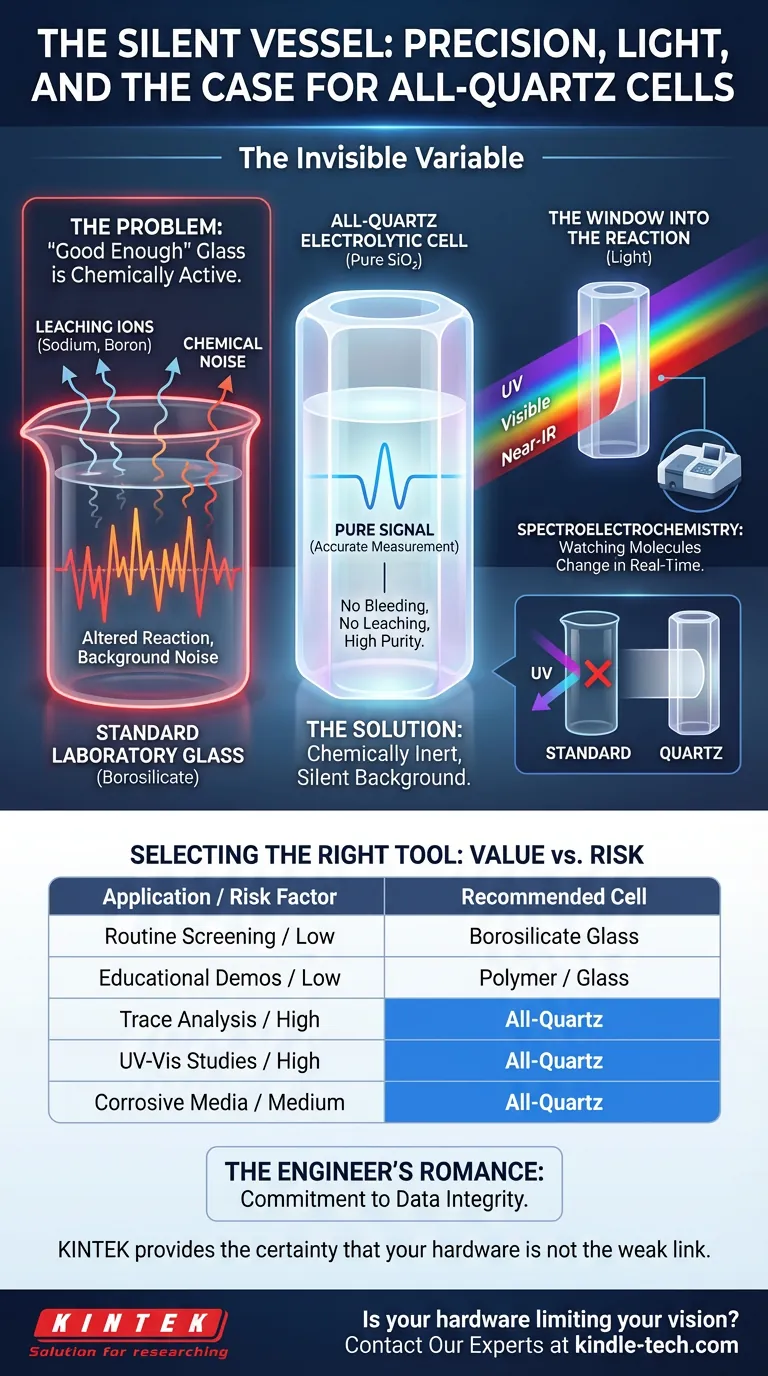
But standard glass is not invisible. It is chemically active.

For general chemistry, borosilicate glass is a miracle material. But for high-precision electrochemistry, it introduces "noise." And in a field defined by measuring micro-currents and molecular shifts, noise is the enemy of truth.

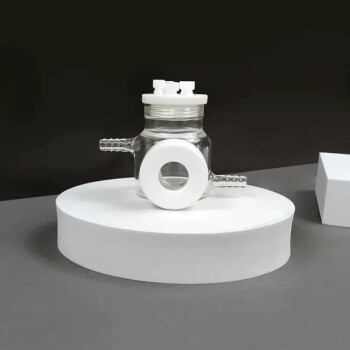
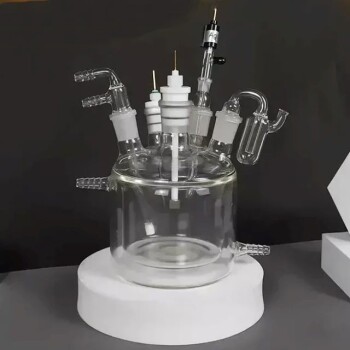
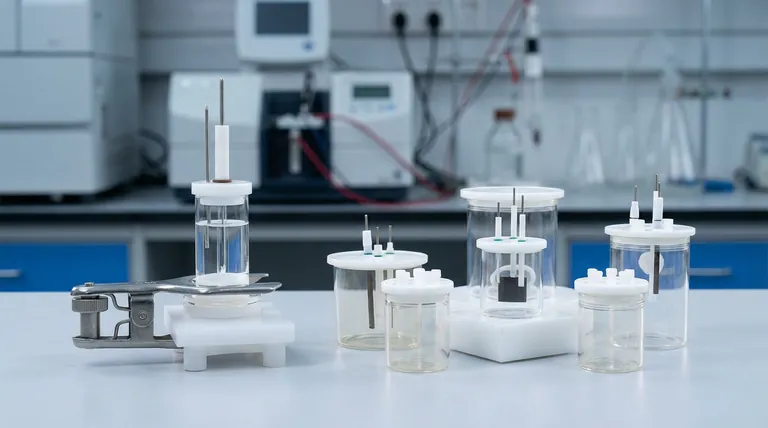
This is why the All-Quartz Electrolytic Cell exists. It is an instrument designed for those who cannot afford to have their container participate in the reaction.

The Problem with "Good Enough" Glass

Standard laboratory glassware is made of borosilicate. It is durable, cheap, and thermal-resistant.

However, it is not chemically pure.

Over time, or under specific chemical stress, standard glass bleeds. It leaches ions—specifically sodium and boron—into your solution.

In a sophomore chemistry class, this doesn't matter. In high-purity electrochemical analysis, it is a disaster.

The Contamination Effect

When you are performing Voltammetry or Coulometric Analysis, you are measuring the flow of electrons.

If your glass vessel leaches ions into the electrolyte, those ions become rogue actors. They can:

  • Create background noise in current readings.
  • Alter the reaction pathway.
  • Shift reference potentials.

The all-quartz cell is the engineer's answer to this uncertainty. Quartz is essentially pure silicon dioxide ($SiO_2$). It is chemically inert.

It does not bleed. It does not leach. It offers a "silent" background, ensuring that the signal you detect comes from your sample, not your hardware.

The Window into the Reaction

There is a second reason engineers and chemists gravitate toward quartz, and it is more romantic than chemical inertness.

It is about light.

Electrochemistry tells us what is happening electrically (current and voltage). Spectroscopy tells us what is happening structurally (molecules absorbing light).

Combining them gives us Spectroelectrochemistry. It allows us to watch a molecule change its identity in real-time as we electrify it.

The Blindness of Glass

Standard glass is opaque to ultraviolet (UV) light. It acts as a wall.

If your reaction intermediate absorbs light in the UV range, and you are using a glass cell, you are blind to it.

Quartz is transparent across a massive spectrum:

  • Ultraviolet (UV)
  • Visible Light
  • Near-Infrared (IR)

An all-quartz cell acts as a literal window. It allows you to shine a beam through the solution directly onto the electrode surface. You can witness the birth of short-lived intermediates or monitor the growth of a thin film.

It turns a blind electrical signal into a visible chemical narrative.

The Psychology of the Trade-off

If quartz is so superior, why isn't it used for everything?

Because perfection is expensive.

Quartz is difficult to machine. It requires higher melting temperatures and specialized fabrication. Consequently, an all-quartz cell costs significantly more than its borosilicate counterpart.

It is also more brittle. It handles thermal shock well, but mechanical shock—dropping it in the sink—is usually fatal to the cell.

This creates a decision matrix for the researcher. It forces a question of value:

  • Is good enough actually good enough? For routine screening or education, yes.
  • Is the cost of failure higher than the cost of the equipment? For trace analysis or mechanistic studies, yes.

Selecting the Right Tool

Here is how to determine if your experiment demands quartz:

Application The Risk factor Recommended Cell
Routine Screening Low. Trace ions won't affect results. Borosilicate Glass
Educational Demos Low. Durability is the priority. Polymer / Glass
Trace Analysis High. Impurities skew quantification. All-Quartz
UV-Vis Studies High. Glass blocks UV light. All-Quartz
Corrosive Media Medium. Glass may etch/leach faster. All-Quartz

The Engineer's Romance

There is a specific satisfaction in using tools that are exactly as good as they need to be.

The all-quartz cell represents a commitment to the integrity of the data. It is a choice to eliminate the "invisible variables" that plague sloppy science.

It provides a chemically silent environment and an optically clear view. It removes the doubt that the vessel might be interfering with the discovery.

At KINTEK, we understand this nuance. We don't just supply lab equipment; we supply the certainty that your hardware is not the weak link in your experiment.

Whether you are conducting delicate spectroelectrochemistry or high-purity synthesis, our all-quartz cells are designed to disappear—leaving you with nothing but the reaction you intended to study.

Is your hardware limiting your vision?

Contact Our Experts

Visual Guide

The Silent Vessel: Precision, Light, and the Case for All-Quartz Cells Visual Guide

Related Products

Related Articles

Related Products

Quartz Electrolytic Electrochemical Cell for Electrochemical Experiments

Quartz Electrolytic Electrochemical Cell for Electrochemical Experiments

Looking for a reliable quartz electrochemical cell? Our product boasts excellent corrosion resistance and complete specifications. With high-quality materials and good sealing, it's both safe and durable. Customize to meet your needs.

Super Sealed Electrolytic Electrochemical Cell

Super Sealed Electrolytic Electrochemical Cell

Super-sealed electrolytic cell offers enhanced sealing capabilities, making it ideal for experiments that require high airtightness.

Electrolytic Electrochemical Cell for Coating Evaluation

Electrolytic Electrochemical Cell for Coating Evaluation

Looking for corrosion-resistant coating evaluation electrolytic cells for electrochemical experiments? Our cells boast complete specifications, good sealing, high-quality materials, safety, and durability. Plus, they're easily customizable to meet your needs.

Electrolytic Electrochemical Cell Gas Diffusion Liquid Flow Reaction Cell

Electrolytic Electrochemical Cell Gas Diffusion Liquid Flow Reaction Cell

Looking for a high-quality gas diffusion electrolysis cell? Our liquid flow reaction cell boasts exceptional corrosion resistance and complete specifications, with customizable options available to suit your needs. Contact us today!

Side Window Optical Electrolytic Electrochemical Cell

Side Window Optical Electrolytic Electrochemical Cell

Experience reliable and efficient electrochemical experiments with a side window optical electrolytic cell. Boasting corrosion resistance and complete specifications, this cell is customizable and built to last.

H-Type Double-Layer Optical Electrolytic Electrochemical Cell with Water Bath

H-Type Double-Layer Optical Electrolytic Electrochemical Cell with Water Bath

Double-layer H-type optical water bath electrolytic cells, with excellent corrosion resistance and a wide range of specifications available. Customization options are also available.

Double-Layer Water Bath Electrolytic Electrochemical Cell

Double-Layer Water Bath Electrolytic Electrochemical Cell

Discover the temperature-controllable electrolytic cell with a double-layer water bath, corrosion resistance, and customization options. Complete specifications included.

Electrolytic Electrochemical Cell with Five-Port

Electrolytic Electrochemical Cell with Five-Port

Streamline your laboratory consumables with Kintek's Electrolytic Cell with five-port design. Choose from sealed and non-sealed options with customizable electrodes. Order now.

H Type Electrolytic Cell Triple Electrochemical Cell

H Type Electrolytic Cell Triple Electrochemical Cell

Experience versatile electrochemical performance with our H-type Electrolytic Cell. Choose from membrane or non-membrane sealing, 2-3 hybrid configurations. Learn more now.

PTFE Electrolytic Cell Electrochemical Cell Corrosion-Resistant Sealed and Non-Sealed

PTFE Electrolytic Cell Electrochemical Cell Corrosion-Resistant Sealed and Non-Sealed

Choose our PTFE Electrolytic Cell for reliable, corrosion-resistant performance. Customize specifications with optional sealing. Explore now.

Thin-Layer Spectral Electrolysis Electrochemical Cell

Thin-Layer Spectral Electrolysis Electrochemical Cell

Discover the benefits of our thin-layer spectral electrolysis cell. Corrosion-resistant, complete specifications, and customizable for your needs.

Customizable Swagelok Type Test Cells for Advanced Battery Research Electrochemical Analysis

Customizable Swagelok Type Test Cells for Advanced Battery Research Electrochemical Analysis

The KINTEK Swagelok-type test cell is a modular, T-shaped device constructed from high-quality, chemically inert materials.

Customizable PEM Electrolysis Cells for Diverse Research Applications

Customizable PEM Electrolysis Cells for Diverse Research Applications

Custom PEM test cell for electrochemical research. Durable, versatile, for fuel cells & CO2 reduction. Fully customizable. Get a quote!

Customizable CO2 Reduction Flow Cell for NRR ORR and CO2RR Research

Customizable CO2 Reduction Flow Cell for NRR ORR and CO2RR Research

The cell is meticulously crafted from high-quality materials to ensure chemical stability and experimental accuracy.

FS Electrochemical Hydrogen Fuel Cells for Diverse Applications

FS Electrochemical Hydrogen Fuel Cells for Diverse Applications

KINTEK's FS Electrochemical Cell: Modular PEM fuel cell stack for R&D and training. Acid-resistant, scalable, and customizable for reliable performance.

Flat Corrosion Electrolytic Electrochemical Cell

Flat Corrosion Electrolytic Electrochemical Cell

Discover our flat corrosion electrolytic cell for electrochemical experiments. With exceptional corrosion resistance and complete specifications, our cell guarantees optimal performance. Our high-quality materials and good sealing ensure a safe and durable product, and customization options are available.

Gold Electrochemical Sheet Electrode Gold Electrode

Gold Electrochemical Sheet Electrode Gold Electrode

Discover high-quality gold sheet electrodes for safe and durable electrochemical experiments. Choose from complete models or customize to meet your specific needs.

Battery Lab Equipment Battery Capacity and Comprehensive Tester

Battery Lab Equipment Battery Capacity and Comprehensive Tester

The scope of application of the battery comprehensive tester can be tested: 18650 and other cylindrical, square lithium batteries, polymer batteries, nickel-cadmium batteries, nickel-metal hydride batteries, lead-acid batteries, etc.

Button Battery Disassembly and Sealing Mold for Lab Use

Button Battery Disassembly and Sealing Mold for Lab Use

The simple sealing and disassembly mold can be directly used on ordinary tablet presses, which can save costs, is convenient and fast, and can be used to encapsulate and disassemble button batteries. Other specifications can be customized.

Shaking Incubators for Diverse Laboratory Applications

Shaking Incubators for Diverse Laboratory Applications

Precision lab shaking incubators for cell culture & research. Quiet, reliable, customizable. Get expert advice today!


Leave Your Message