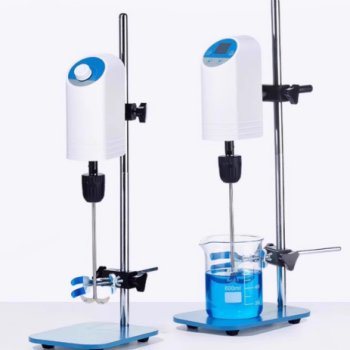
Effective synthesis of AEP-functionalized OTMO requires rigorous control over both physical mixing and the chemical environment. In this process, a magnetic stirrer provides the high-speed rotation necessary to achieve molecular-level mixing between the highly viscous oligomers and AEP. Simultaneously, a nitrogen atmosphere acts as a protective shield, isolating the reaction from atmospheric oxygen and moisture to prevent oxidation and ensure the structural accuracy of the final amino-terminated product.
The success of this reaction hinges on two factors: overcoming the physical resistance of high-viscosity fluids and neutralizing the chemical threat of environmental contaminants.
Optimizing Reaction Kinetics via Mechanical Agitation
Overcoming High Viscosity
The primary physical challenge in this synthesis is the texture of the reagents. Oligotetramethylene oxide (OTMO) and the resulting reaction mixture often exhibit high viscosity.
Without active intervention, these thick fluids resist flow, creating stagnant zones where reagents fail to interact. A magnetic stirrer generates the mechanical force needed to disrupt this resistance and maintain a homogenous fluid state.
Ensuring Molecular-Level Mixing
For the Michael addition reaction to proceed efficiently, the reactants must make contact at the molecular level.
High-speed rotation drives the AEP molecules into the oligomer matrix. This thorough contact ensures that the reaction is not diffusion-limited, allowing the chemical transformation to occur uniformly throughout the vessel.
Preserving Chemical Integrity via Environmental Control
Creating an Inert Environment
The chemical environment is just as critical as the physical mixture. A nitrogen atmosphere is employed to displace standard air from the reaction vessel.
By filling the headspace and creating a continuous blanket over the reactants, nitrogen creates an inert environment. This physically isolates the sensitive chemical mixture from the surrounding atmosphere.
Preventing Oxidation of Active Groups
Aminoethylpiperazine (AEP) contains active amino groups that are susceptible to degradation.
If exposed to atmospheric oxygen, these groups can oxidize. The nitrogen purge prevents this oxidation, preserving the reactivity of the AEP so it can correctly functionalize the OTMO rather than degrading into unwanted byproducts.
Eliminating Moisture Interference
Atmospheric moisture can trigger side reactions that compete with the desired Michael addition.
By excluding moisture, nitrogen ensures that the reaction pathway remains specific. This protection guarantees the structural accuracy of the amino-terminated product, resulting in a synthesized polymer that matches the theoretical design.
Critical Operational Considerations
The Limits of Magnetic Coupling
While magnetic stirrers are effective, they have torque limitations.
If the viscosity of the OTMO mixture increases significantly during the reaction, the magnetic coupling between the drive magnet and the stir bar may break ("spin out"). Operators must monitor rotation speed to ensure the bar remains coupled and agitation remains constant.
Integrity of the Nitrogen Seal
The protective benefit of nitrogen is entirely dependent on the vessel's seal.
It is not enough to simply introduce nitrogen; the system must maintain positive pressure or a continuous flow. Any leak or break in the atmosphere allows oxygen and moisture to re-enter, potentially compromising the structural purity of the entire batch in moments.
Making the Right Choice for Your Goal
To ensure the highest quality AEP-functionalized OTMO, align your equipment use with your specific quality targets:
- If your primary focus is reaction homogeneity: Prioritize high-speed magnetic stirring to overcome oligomer viscosity and ensure the reagents are thoroughly mixed.
- If your primary focus is product purity: Ensure a continuous, sealed nitrogen atmosphere to eliminate oxidation and moisture-induced side reactions.
By maintaining strict control over mixing dynamics and atmospheric exposure, you ensure the reproducible synthesis of high-quality functionalized polymers.
Summary Table:
| Component | Primary Function | Impact on Synthesis |
|---|---|---|
| Magnetic Stirrer | High-speed mechanical agitation | Overcomes viscosity for molecular-level mixing |
| Nitrogen Atmosphere | Inert gas shielding | Prevents oxidation and moisture-induced side reactions |
| Michael Addition | Chemical reaction mechanism | Ensures precise amino-termination of the polymer |
| Viscosity Control | Resistance management | Prevents stagnant zones and ensures reaction uniformity |
Elevate Your Polymer Synthesis with KINTEK Precision
Achieving the structural accuracy required for AEP-functionalized OTMO demands equipment that masters both physical mixing and environmental control. KINTEK specializes in advanced laboratory solutions designed for high-viscosity applications and sensitive chemical reactions.
From high-torque magnetic stirrers and precision homogenizers to specialized electrolytic cells and high-temperature high-pressure reactors, we provide the tools researchers need to eliminate side reactions and ensure product purity. Whether you are working on battery research, advanced ceramics, or complex polymer functionalization, our comprehensive portfolio of laboratory equipment and consumables (including PTFE products and crucibles) is built to meet the most rigorous standards.
Ready to optimize your lab's performance? Contact KINTEK today to discover how our expert-grade equipment can enhance your synthesis outcomes.
References
- Daria Slobodinyuk, Dmitriy Kiselkov. Simple and Efficient Synthesis of Oligoetherdiamines: Hardeners of Epoxyurethane Oligomers for Obtaining Coatings with Shape Memory Effect. DOI: 10.3390/polym15112450
This article is also based on technical information from Kintek Solution Knowledge Base .
Related Products
- Laboratory Small Constant Temperature Heated Magnetic Stirrer Heater and Stirrer
- Custom PTFE Teflon Parts Manufacturer for Magnetic Stirring Bar
- High Performance Laboratory Stirrers for Diverse Applications
- Three-dimensional electromagnetic sieving instrument
- Custom PTFE Teflon Parts Manufacturer for PTFE Stirring Bar Recovery Rod
People Also Ask
- What role does a magnetic stirrer with heating play in ZnO nanoparticle synthesis? Precision Control for Quality Results
- What role does a constant temperature heating magnetic stirrer play in MFC-HAp synthesis? Achieve Material Homogeneity
- What is the function of a laboratory magnetic stirrer in Ni–Cr–P electrodeposition? Optimize Ion Transport & Coating
- Why is a laboratory magnetic stirrer required for benzoic acid esters? Boost Reaction Speed & Yield with High RPM
- What role does a laboratory magnetic stirrer play in TiO2 and TiO2-Ag sol preparation? Master Chemical Kinetics