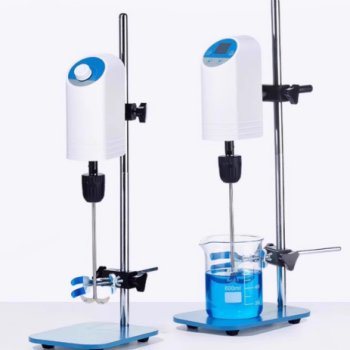
Precision laboratory stirring and temperature control systems are the critical determinants of the structural integrity and catalytic efficiency of supported niobium catalysts like Pd/NbOPO4/SBA-15. These systems ensure the uniform distribution of niobium precursors and noble metals across the support, which is the foundational requirement for high-performance catalysis.
By guaranteeing the high dispersion of active components, precision control systems maximize the availability of essential acid sites. This directly improves the catalyst's turnover frequency (TOF) and enhances its physical stability during demanding biomass conversion processes.
The Link Between Process Control and Catalyst Structure
Achieving Uniform Dispersion
During impregnation or hydrothermal synthesis, the primary goal is to spread the active components—specifically niobium precursors and noble metals like palladium—evenly across the SBA-15 mesoporous silica support.
Precision stirring eliminates concentration gradients within the mixture. This prevents the active materials from clumping together, ensuring a homogeneous coating on the support surface.
Maximizing Active Site Exposure
The catalytic power of Pd/NbOPO4/SBA-15 relies heavily on specific chemical features known as Brønsted and Lewis acid sites.
When temperature and mixing are strictly controlled, the dispersion of the niobium components is optimized. High dispersion significantly increases the surface exposure of these acid sites, making them available to participate in chemical reactions.
Regulating Component Morphology
While the primary reference focuses on dispersion, it is important to note the broader principle that thermal precision dictates the final state of metal species.
Just as precise heating controls the migration of iron species in zeolites to form active centers, accurate temperature control in niobium synthesis ensures the active phase forms correctly without degrading the delicate mesoporous structure of the SBA-15.
Impact on Performance and Longevity
Boosting Turnover Frequency (TOF)
A well-dispersed catalyst processes reactants more efficiently. By maximizing the exposed surface area of the active acid sites, the catalyst achieves a higher turnover frequency.
This means the system can convert complex biomass molecules at a faster rate, directly increasing process productivity.
Enhancing Catalyst Stability
Inconsistent synthesis conditions often lead to "hot spots" or weak interaction between the metal and the support.
Precision systems mitigate this risk, creating a robust interaction between the Pd/NbOPO4 and the SBA-15 structure. This results in enhanced stability, allowing the catalyst to withstand the rigors of conversion reactions without deactivating prematurely.
Understanding the Trade-offs
The Risk of Thermal Fluctuation
Even minor deviations in temperature control can alter the morphology of the active species.
If the temperature overshoots or fluctuates, it may cause the active components to migrate to undesirable locations or aggregate, significantly reducing the number of accessible acid sites.
The Cost of Poor Mixing
Inadequate stirring leads to localized zones of high concentration.
This results in large, inactive clusters of metal rather than a fine dispersion. These clusters lower the overall efficiency (TOF) and represent a waste of expensive noble metal precursors.
Making the Right Choice for Your Project
To maximize the efficacy of your Pd/NbOPO4/SBA-15 production, prioritize your equipment parameters based on your specific catalytic goals:
- If your primary focus is Reaction Speed (TOF): Prioritize stirring precision to ensure maximum dispersion, which directly correlates to the highest possible exposure of Brønsted and Lewis acid sites.
- If your primary focus is Catalyst Lifespan (Stability): Focus on rigorous temperature control to foster strong, uniform anchoring of the precursors to the SBA-15 support, preventing leaching or deactivation.
Investing in precision control is not merely a procedural refinement; it is the prerequisite for unlocking the full chemical potential of your catalyst.
Summary Table:
| Control Parameter | Impact on Catalyst Structure | Performance Benefit |
|---|---|---|
| Precision Stirring | Ensures uniform precursor dispersion; prevents clumping | Higher Turnover Frequency (TOF) |
| Temperature Control | Regulates morphology and phase formation of active sites | Enhanced Stability & Durability |
| Mixing Consistency | Eliminates concentration gradients on SBA-15 support | Maximized Acid Site Exposure |
| Thermal Stability | Prevents migration and aggregation of noble metals | Prolonged Catalyst Lifespan |
Elevate Your Catalyst Synthesis with KINTEK Precision Solutions
Unlock the full chemical potential of your Pd/NbOPO4/SBA-15 and other supported catalysts. At KINTEK, we specialize in providing high-performance laboratory equipment designed for the rigorous demands of material science. From precision stirring systems that guarantee uniform dispersion to high-temperature furnaces (muffle, tube, vacuum) and hydrothermal reactors that offer unmatched thermal control, our tools ensure your catalysts achieve maximum TOF and stability.
Whether you are focusing on biomass conversion or advanced battery research, our comprehensive range of crushing systems, hydraulic presses, and high-pressure reactors provides the reliability your lab deserves. Don't let process fluctuations compromise your research results.
Ready to optimize your production? Contact KINTEK today for a tailored equipment consultation!
References
- J. Moreira, Daniel Bastos de Rezende. Uso de compostos de nióbio como catalisadores na produção de biocombustíveis: uma revisão. DOI: 10.18540/jcecvl8iss1pp13417-01-30e
This article is also based on technical information from Kintek Solution Knowledge Base .
Related Products
- Laboratory Small Constant Temperature Heated Magnetic Stirrer Heater and Stirrer
- High Performance Laboratory Stirrers for Diverse Applications
- Customizable Laboratory High Temperature High Pressure Reactors for Diverse Scientific Applications
- Laboratory Rapid Thermal Processing (RTP) Quartz Tube Furnace
- High Temperature Constant Temperature Heating Circulator Water Bath Chiller Circulator for Reaction Bath
People Also Ask
- What role does a magnetic stirrer with heating play in ZnO nanoparticle synthesis? Precision Control for Quality Results
- What role does a constant temperature heating magnetic stirrer play in MFC-HAp synthesis? Achieve Material Homogeneity
- What is the function of a laboratory magnetic stirrer in Ni–Cr–P electrodeposition? Optimize Ion Transport & Coating
- Why is a laboratory magnetic stirrer required for benzoic acid esters? Boost Reaction Speed & Yield with High RPM
- What role does a laboratory magnetic stirrer play in TiO2 and TiO2-Ag sol preparation? Master Chemical Kinetics