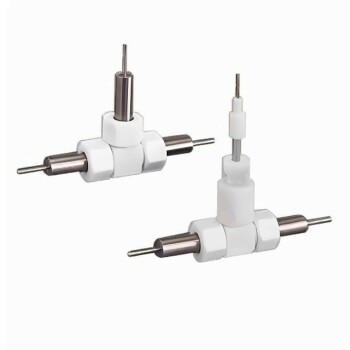
In the precise characterization of High-Entropy Alloys (HEAs), a standard three-electrode electrochemical cell functions by distinctly separating the roles of current transmission and potential measurement. The High-Entropy Alloy sample itself serves as the Working Electrode (WE), while a Platinum (Pt) electrode acts as the Counter Electrode (CE) to complete the circuit, and a Saturated Calomel Electrode (SCE) functions as the Reference Electrode (RE) to provide a stable voltage baseline.
The core advantage of this configuration is the decoupling of current flow from potential measurement. By routing current through the auxiliary electrode while keeping the reference electrode isolated from current, the system prevents electrode polarization interference, ensuring that the interfacial impedance data reflects only the true properties of the alloy.
The Role of Each Component
The Subject of Investigation: The Working Electrode
The Working Electrode (WE) is the focal point of the experiment. In this context, it consists of the High-Entropy Alloy sample you are testing. All measurements recorded are intended to characterize the specific electrochemical reactions occurring at the interface of this alloy.
The Stable Standard: The Reference Electrode
The Reference Electrode (RE) provides a constant, known potential against which the working electrode is measured. The standard setup utilizes a Saturated Calomel Electrode (SCE) for this purpose. Crucially, the RE does not draw current; its sole purpose is to ensure accurate potential monitoring without adhering to the fluctuations caused by current flow.
The Load Bearer: The Counter Electrode
The Counter Electrode (CE), also known as the auxiliary electrode, is responsible for completing the electrical circuit. Typically composed of inert Platinum (Pt), this electrode facilitates the transfer of current through the electrolyte. By handling the current load, it allows the reference electrode to remain undisturbed.
Why This Configuration Matters
Isolating Interfacial Impedance
The primary goal of using a three-electrode system for HEAs is the precise isolation of interfacial impedance data. In simpler setups, the resistance of the solution or the polarization of the counter electrode can obscure the data. This configuration filters out those variables.
Eliminating Polarization Interference
When current flows through an electrode, its potential can shift away from equilibrium—a phenomenon known as polarization. By ensuring the Reference Electrode draws no current, the system guarantees that the measured potential is not skewed by polarization artifacts. This ensures the data captured is accurate to the alloy's surface behavior.
Critical Considerations and Constraints
Material Specificity
The accuracy of this setup relies heavily on the materials chosen. The use of Platinum for the counter electrode is critical because it is chemically inert; a reactive counter electrode could introduce contaminants or competing reactions that alter the results.
The Necessity of Complexity
While a two-electrode system is simpler to construct, it fails to separate the current-carrying role from the potential-measuring role. The "trade-off" for the accuracy of the three-electrode cell is the requirement for distinct, high-quality components like the SCE and Pt electrode. Skimping on these components reintroduces the very interference you are trying to eliminate.
Making the Right Choice for Your Experiment
To ensure your HEA testing yields valid data, apply the principles of the three-electrode system as follows:
- If your primary focus is accurate potential measurement: Ensure your Reference Electrode (SCE) is functioning correctly and is completely isolated from the current path to prevent polarization.
- If your primary focus is current load capacity: Verify that your Counter Electrode (Pt) has sufficient surface area to facilitate current transfer without limiting the reaction at the Working Electrode.
Success in HEA testing depends not just on the alloy, but on the rigorous isolation of variables provided by this specific cell architecture.
Summary Table:
| Component | Material Example | Primary Function |
|---|---|---|
| Working Electrode (WE) | High-Entropy Alloy (HEA) | The subject of investigation; site of electrochemical reactions. |
| Reference Electrode (RE) | Saturated Calomel (SCE) | Provides a stable potential baseline; draws no current to avoid polarization. |
| Counter Electrode (CE) | Platinum (Pt) | Completes the electrical circuit; facilitates current transfer through the electrolyte. |
Elevate Your HEA Research with Precision Engineering
Accurate electrochemical characterization requires more than just a setup—it requires high-quality, reliable instrumentation. KINTEK specializes in providing researchers with the premium laboratory equipment needed to isolate variables and ensure data integrity.
Whether you are analyzing interfacial impedance or testing the corrosion resistance of High-Entropy Alloys, our comprehensive range of electrolytic cells, electrodes, and specialized equipment like high-temperature furnaces, crushing systems, and hydraulic presses are designed to meet the rigorous demands of material science.
Ready to optimize your electrochemical testing? Contact KINTEK Today to Find the Right Solution for Your Lab
References
- Santiago Brito-García, Ionelia Voiculescu. EIS Study of Doped High-Entropy Alloy. DOI: 10.3390/met13050883
This article is also based on technical information from Kintek Solution Knowledge Base .
Related Products
- H Type Electrolytic Cell Triple Electrochemical Cell
- Electrolytic Electrochemical Cell Gas Diffusion Liquid Flow Reaction Cell
- PTFE Electrolytic Cell Electrochemical Cell Corrosion-Resistant Sealed and Non-Sealed
- Electrolytic Electrochemical Cell with Five-Port
- Electrolytic Electrochemical Cell for Coating Evaluation
People Also Ask
- What is a H type cell? A Guide to Divided Electrochemical Cells for Accurate Experiments
- How should the electrolyte be prepared and added to the H-type electrolytic cell? Best Practices for Purity and Safety
- What is the technical necessity of using an H-type electrolytic cell for NO3RR tests? Protect Your Ammonia Yields
- How does the design of an H-type electrolytic cell benefit the neutral water electrolysis process for metal recovery?
- What is the primary function of an H-type electrolytic cell in NitRR? Ensure Accurate Product Yields