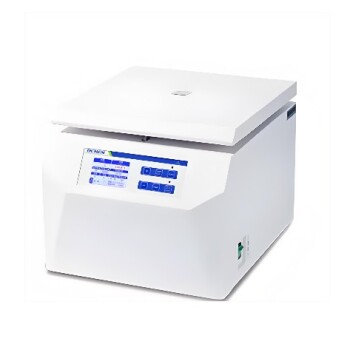
A benchtop drying oven serves as the critical regulatory environment for transforming liquid pectin solutions into solid films. By maintaining a constant thermal baseline, typically at 40 °C, it drives the controlled evaporation of water and acid solvents to ensure the material cures uniformly without compromising its physical structure.
The oven’s primary role is to provide a stable thermal environment that ensures regulated solvent evaporation. This controlled process is essential for achieving uniform film thickness and preserving the flexibility required for the final biopolymer product.
The Mechanics of Film Formation
Regulating Solvent Evaporation
Pectin film formation begins with a solution containing solvents, specifically water and acid solutions. The benchtop oven provides the precise thermal energy required to drive these solvents out of the mixture.
Unlike open-air drying, which is subject to environmental humidity changes, the oven enforces regulated evaporation. This ensures the transition from liquid to solid occurs at a predictable and steady rate.
Establishing Thermal Consistency
The casting process is highly sensitive to temperature fluctuations. A benchtop drying oven creates a constant thermal environment, typically set around 40 °C.
This stability is vital for the initial curing of the film. It prevents the formation of structural gradients that occur when different parts of a film dry at different temperatures.
Impact on Material Quality
Achieving Uniform Thickness
One of the most common defects in casting is uneven surface topography. By controlling the rate of evaporation, the oven minimizes the movement of the solution during the drying phase.
This stability allows the film to settle evenly. The result is a final product with thickness uniformity across the entire surface area, which is critical for consistent testing data.
Preserving Flexibility
The physical properties of a pectin film are determined during the drying phase. If a film dries too quickly or unevenly, it often becomes brittle.
The controlled environment of the oven maintains the necessary balance during curing. This helps retain the necessary flexibility of the final product, ensuring it can be handled without cracking.
Critical Considerations for Oven Drying
Temperature Sensitivity
While the oven facilitates drying, strict adherence to the temperature guideline is necessary. The reference explicitly notes a typical setting of 40 °C.
Deviating significantly from this temperature can alter the evaporation dynamics. Higher temperatures may degrade the pectin structure, while lower temperatures may fail to cure the film adequately.
The Risk of Over-Drying
The goal is "regulated" evaporation, not total desiccation. The oven facilitates the removal of solvents to form the film.
However, precise timing is required to ensure the film retains the specific properties needed for its application. The process must be monitored to ensure the initial curing phase transitions correctly into the final state.
Optimizing Your Casting Process
To maximize the quality of your pectin-based films, consider the following based on your specific objectives:
- If your primary focus is reproducibility: Rely on the oven's constant thermal environment to eliminate variables that cause batch-to-batch thickness inconsistencies.
- If your primary focus is mechanical integrity: Maintain the temperature strictly at 40 °C to balance evaporation speed with the preservation of film flexibility.
Controlled evaporation is the difference between a brittle, uneven sheet and a high-quality, flexible film.
Summary Table:
| Feature | Contribution to Film Formation | Impact on Material Quality |
|---|---|---|
| Thermal Baseline (40°C) | Maintains a stable environment for initial curing | Prevents structural gradients and degradation |
| Regulated Evaporation | Drives out water and acid solvents steadily | Ensures transition from liquid to solid without brittleness |
| Precision Control | Minimizes solution movement during drying | Results in uniform thickness across the entire surface |
| Controlled Environment | Protects against humidity fluctuations | Preserves mechanical integrity and final film flexibility |
Elevate Your Biopolymer Research with KINTEK
Precision is the key to high-quality pectin film formation. KINTEK specializes in advanced laboratory equipment, offering high-performance benchtop drying ovens and cooling solutions (ULT freezers, freeze dryers) designed to provide the stable thermal environments your research demands. Whether you are focused on film thickness uniformity or mechanical integrity, our comprehensive portfolio—including PTFE products, ceramics, and crushing systems—ensures your lab is equipped for excellence.
Ready to optimize your casting process? Contact us today to find the perfect thermal solution for your laboratory!
References
- Belkis Akachat, Malika Barkat. Development of Pectin-Based Films with Encapsulated Lemon Essential Oil for Active Food Packaging: Improved Antioxidant Activity and Biodegradation. DOI: 10.3390/foods14030353
This article is also based on technical information from Kintek Solution Knowledge Base .
Related Products
- Laboratory Scientific Electric Heating Blast Drying Oven
- Benchtop High Speed Small Lab Centrifuge for Serum Separation and Low Temperature Dehydration
- 56L Vertical Laboratory Vacuum Drying Oven
- 23L Laboratory Vacuum Drying Oven
People Also Ask
- How does a laboratory electric drying oven contribute to the formation of the initial coating? Expert Insights
- What role does a precision laboratory drying oven play in the synthesis of GO-PANI nanocomposites? Protect Material Integrity
- What role does a laboratory drying oven play in the preparation of zinc oxide nanoparticle precursors?
- What is the necessity of using a laboratory drying oven when processing MoO3/GO composite nanopowders? Find out here.
- What is the role of a laboratory drying oven in cellulose citrate production? Ensure Material Stability & Purity