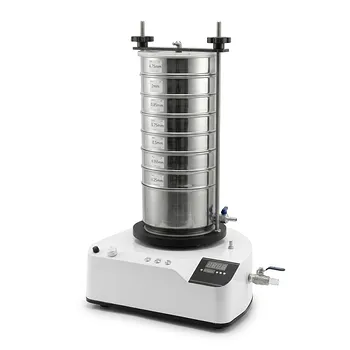
A dry impact-blending device utilizes high-speed mechanical energy to synthesize composite particles. By employing a rapidly spinning rotor, the device generates intense centrifugal and impact forces that drive softer electrolyte particles to collide with harder electrode particles. This mechanical action forces the electrolyte to deform and fuse onto the electrode surface, creating a cohesive composite without the need for liquid solvents.
The core value of this technology lies in its ability to exploit the difference in hardness between materials. It uses impact force to plastically deform soft electrolytes, creating a dense, continuous coating over electrode particles solely through mechanical fusion.
The Mechanics of Impact Blending
Generating High-Intensity Forces
The process begins with a high-speed rotor located inside the device's chamber.
As the rotor spins, it generates powerful centrifugal and impact forces. These forces are the primary drivers for all particle interactions within the system.
Breaking Down Agglomerates
Before coating can occur, raw materials often exist as clumps.
The high-intensity mechanical force effectively breaks up these agglomerates. This ensures that individual particles are exposed and available for the coating process.
Creating the Composite Interface
The Host-Guest Interaction
The device operates on a "host and guest" principle.
The electrode particles act as the host, providing a hard foundation. The electrolyte particles act as the guest, serving as the coating material.
Plastic Deformation and Fusion
This is the critical mechanism for solid-state battery preparation.
Because the electrolyte particles are softer than the electrode host, the impact force causes them to undergo plastic deformation. They do not just sit on the surface; they physically flatten and spread out.
Achieving a Continuous Layer
The deformation leads to fusion between the two materials.
This results in a dense and continuous coating layer of electrolyte surrounding the electrode. This uniformity is essential for efficient ion transfer in the final battery cell.
Understanding the Trade-offs
Material Hardness Dependency
The process relies heavily on the relative hardness of the materials.
It functions best when the guest particle (electrolyte) is significantly softer than the host (electrode). If the coating material is too hard, it may not deform or fuse correctly, leading to poor coverage.
solvent-Free Constraints
While eliminating solvents is a benefit, it removes the ability to use chemical surface modifiers during the mixing phase.
The adhesion relies entirely on mechanical interlocking and physical fusion. Therefore, the input energy must be precisely controlled to ensure bonding without damaging the underlying electrode structure.
Making the Right Choice for Your Goal
To determine if dry impact-blending is the right approach for your solid-state battery development, consider your specific constraints:
- If your primary focus is coating quality: Prioritize this method to achieve a dense, void-free interface through plastic deformation, which improves ionic conductivity.
- If your primary focus is manufacturing safety and simplicity: Adopt this technology to eliminate the handling, recovery, and drying steps associated with toxic or flammable solvents.
This technology represents a shift from chemical processing to precision mechanical engineering, offering a streamlined path to high-performance composite particles.
Summary Table:
| Feature | Impact-Blending Mechanism | Benefit for Batteries |
|---|---|---|
| Energy Source | High-speed rotor (centrifugal/impact forces) | Efficiently breaks agglomerates and fuses materials |
| Particle Interaction | Host (Electrode) vs. Guest (Electrolyte) | Creates dense, continuous coating without solvents |
| Bonding Type | Plastic deformation and mechanical fusion | Enhanced ionic conductivity at the interface |
| Process Safety | Solvent-free dry processing | Eliminates toxic chemical handling and drying steps |
Revolutionize Your Battery Research with KINTEK Precision Engineering
Transitioning to solvent-free manufacturing requires the right mechanical equipment to ensure material integrity and coating uniformity. KINTEK specializes in advanced laboratory solutions designed for high-performance battery development. From our high-energy crushing and milling systems to precision hydraulic presses and high-temperature furnaces, we provide the tools you need to master particle synthesis.
Ready to optimize your composite particle preparation? Contact KINTEK experts today to discover how our milling and material processing equipment can enhance your solid-state battery research and streamline your laboratory workflows.
Related Products
- Laboratory Vibratory Sieve Shaker Machine for Dry and Wet Three-Dimensional Sieving
- Three-dimensional electromagnetic sieving instrument
- High Energy Vibratory Laboratory Ball Mill Grinding Mill Single Tank Type
People Also Ask
- How does a laboratory vibratory sieve shaker facilitate the microstructural study of gas-atomized alloy powders?
- What role does a laboratory vibrating sieve shaker play in the LiFePO4 powder processing workflow? Ensure Batch Quality
- Why use a vibratory sieve shaker for PET powder? Achieve Precise Particle Size Control for Chemical Research
- What is the principle of vibratory sieve shaker? Achieve Accurate Particle Size Analysis
- What is the function of a vibratory sieve shaker? Achieve Precise Particle Size Analysis