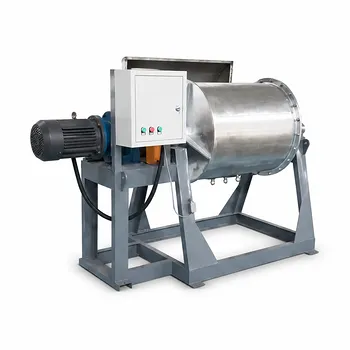
Mechanical ball milling systems act as a catalyst for structural precision, utilizing high-energy impact and shear forces to achieve nanometer-scale size reduction and forced mixing of solid precursors. By pulverizing materials like pitch and salt templates into a highly uniform physical blend, the system significantly increases the reaction activity for subsequent heat treatment, ultimately dictating the porosity and kinetic efficiency of the final carbon material.
Core Takeaway: Mechanical ball milling transforms raw precursors into highly reactive, nanostructured blends, ensuring the formation of a uniformly distributed porous architecture that is essential for high-performance zinc-ion hybrid supercapacitors.
The Physical Transformation of Precursors
Nanometer-Scale Size Reduction
High-energy ball milling utilizes the kinetic energy of grinding media to break down bulk carbon sources into nanometer-scale particles. This process drastically increases the geometric surface area, providing more active sites for chemical interactions during the synthesis phase.
Increasing Surface Energy and Reactivity
The intense mechanical impact does more than just reduce size; it "activates" the material by increasing its surface energy. These refined particles possess higher reactivity, which is critical for promoting solid-state reactions and phase transitions that would otherwise require much higher temperatures.
Enhancing Structural and Chemical Uniformity
Forced Mixing of Solid Templates
In the preparation of carbon for zinc-ion systems, pitch and salt templates must be intimately combined. Ball milling achieves a level of forced mixing that standard stirring cannot, ensuring that the template is perfectly distributed throughout the carbon precursor matrix.
Promoting Atomic Diffusion
The high-frequency impacts from the milling media facilitate atomic diffusion between different solid components. This creates a foundation for a chemical homogeneity that ensures the final carbon product has a consistent internal structure rather than localized clusters of inactive material.
Impact on Electrochemical Performance
Creating a Uniform Porous Architecture
Because the precursors are mixed at a molecular or near-nanoscale level, the subsequent heat treatment creates a highly organized and uniformly distributed porous structure. This architecture is vital for providing the high surface area needed for ion adsorption in hybrid supercapacitors.
Improving Electrolyte Wetting and Kinetics
A refined particle size ensures that the resulting electrode material can be fully wetted by the aqueous electrolyte. This deep penetration allows zinc ions to access active sites more efficiently, directly improving the rate performance and power density of the device.
Understanding the Trade-offs and Pitfalls
Potential for Material Contamination
The high-energy nature of ball milling can cause wear on the grinding jars and balls, potentially introducing metallic impurities into the carbon precursor. These contaminants can trigger unwanted side reactions or self-discharge in the final zinc-ion hybrid supercapacitor.
Risk of Over-Milling and Structural Damage
Excessive milling time or intensity can lead to "over-milling," where the crystal structure of the precursor is completely destroyed or unwanted amorphous phases are formed. Furthermore, overly fine powders may suffer from particle agglomeration, which paradoxically reduces the effective surface area.
Applying Ball Milling to Your Synthesis Goals
How to Apply This to Your Project
To optimize the preparation of carbon materials for high-performance zinc-ion systems, consider your primary processing objective:
- If your primary focus is maximizing power density: Prioritize high-energy milling to achieve the smallest possible particle size, which facilitates faster ion diffusion and better electrolyte wetting.
- If your primary focus is structural consistency: Focus on the duration of forced mixing between the carbon source and the salt template to ensure a perfectly uniform distribution of pores after carbonization.
- If your primary focus is material purity: Utilize chemically inert grinding media, such as zirconia or high-grade alumina, and optimize milling cycles to minimize wear and prevent metallic contamination.
By masterfully controlling the mechanical activation of precursors, researchers can engineer carbon materials that meet the rigorous kinetic demands of next-generation energy storage.
Summary Table:
| Process Step | Mechanism | Benefit for Supercapacitors |
|---|---|---|
| Size Reduction | High-energy impact | Increases active sites & geometric surface area |
| Forced Mixing | Molecular blending | Ensures a uniformly distributed porous architecture |
| Surface Activation | Mechanical energy | Increases reactivity for subsequent heat treatment |
| Kinetic Improvement | Nanoscale refinement | Enhances zinc-ion diffusion and electrolyte wetting |
Elevate Your Supercapacitor Research with KINTEK
Precision in precursor preparation is the key to high-performance energy storage. KINTEK provides professional-grade crushing and milling systems designed to achieve the nanometer-scale uniformity and high surface energy your carbon materials require.
Beyond milling, we support your entire synthesis workflow with:
- High-temperature furnaces (muffle, tube, vacuum, CVD) for precise carbonization and atmosphere control.
- High-temperature high-pressure reactors and autoclaves for advanced hydrothermal synthesis.
- Hydraulic presses and battery research tools for high-quality electrode fabrication.
- Electrolytic cells and electrodes to validate your electrochemical performance.
Don't let contamination or inconsistent mixing compromise your results. Contact us today to find the perfect equipment solution for your lab’s unique research goals!
References
- Himanshu Gupta, Prashanth W. Menezes. Recent technological advances in designing electrodes and electrolytes for efficient zinc ion hybrid supercapacitors. DOI: 10.1039/d3ya00259d
This article is also based on technical information from Kintek Solution Knowledge Base .
Related Products
- High-Energy Omnidirectional Planetary Ball Mill Milling Machine for Laboratory
- Laboratory Planetary Ball Mill Rotating Ball Milling Machine
- Stainless Steel Laboratory Ball Mill for Dry Powder and Liquid with Ceramic Polyurethane Lining
- High Energy Planetary Ball Mill Milling Machine for Laboratory
- Laboratory Planetary Ball Mill Cabinet Planetary Ball Milling Machine
People Also Ask
- How does a planetary ball mill solve mixing challenges with PEO? Unlock solid-state synthesis for insoluble dopants
- What is the role of a planetary ball mill in preparing doped high-nickel cathode materials? Enhance Battery Stability
- Why is a planetary ball mill used for LNMO precursor powders? Optimize Particle Uniformity & Battery Performance
- What is the function of a planetary ball mill in the solid-state synthesis of LiTa2PO8? Achieve High-Purity Electrolytes
- What is the critical role of a planetary ball mill in the processing of inorganic fillers? Enhance Battery Performance