Planetary ball milling solves the solubility problem by eliminating the need for solvents entirely. Instead of relying on chemical dissolution, it uses high-energy mechanochemical forces to physically blend high-molecular-weight dopants with Polyethylene Oxide (PEO) in a solid state.
The Core Insight Traditional solution casting fails when dopants are too large to dissolve in standard solvents. Planetary ball milling circumvents this by using intense kinetic energy to force uniform mixing, resulting in composite electrolytes with superior mechanical strength.
Overcoming the Solubility Barrier
The Limitation of Solution Casting
High-molecular-weight dopants often present a fundamental processing challenge: they are insoluble in the conventional solvents used for PEO.
This incompatibility renders traditional solution casting methods ineffective. If the dopant cannot dissolve, it cannot be mixed uniformly into the matrix using liquid-phase techniques.
The Solid-State Solution
Planetary ball milling addresses this by shifting the process to solid-phase synthesis.
By processing the materials as solids, the technique completely bypasses the chemical limitations of solvents. This allows for the successful integration of insoluble polymers, PEO, and lithium salts into a single cohesive material.
The Mechanics of High-Energy Mixing
Opposing Rotation Generates Force
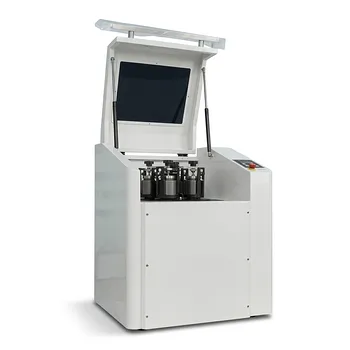
The effectiveness of this method stems from the mill's unique mechanical action. Grinding jars rotate around a central axis, while a "sun wheel" rotates in the opposite direction.
Impact and Shear
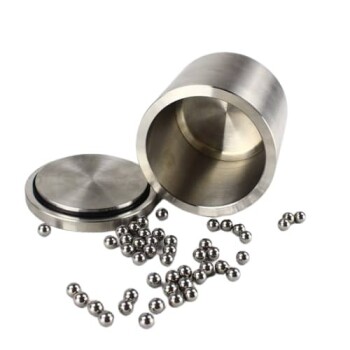
This opposing motion creates intense kinetic energy. The grinding balls inside the jars collide with the material, subjecting it to significant impact and friction.
Mechanochemical Synthesis
These forces do more than just grind; they drive mechanochemical reactions. The intense impact forces the PEO matrix and the insoluble dopants to mix at a level of uniformity that static mixing cannot achieve.
Understanding the Trade-offs
Process Parameter Sensitivity
While powerful, this process is not "set and forget." The quality of the grinding result relies heavily on the precise control of speed and movement.
optimization is Required
Because the mixing relies on physical force rather than chemical diffusion, you must actively manage the interaction between the grinding jars and the sun wheel. Incorrect settings may fail to generate the necessary force for uniform dispersion or could over-process the material.
Making the Right Choice for Your Goal
To leverage planetary ball milling effectively for your PEO composites, consider the following:
- If your primary focus is Materials Compatibility: Use this method to process high-molecular-weight dopants that are otherwise insoluble in standard solvents.
- If your primary focus is Material Performance: Rely on the intense shear forces to produce composite electrolytes with enhanced mechanical strength and superior mixing uniformity.
By replacing chemical solvency with kinetic energy, you can unlock material combinations that were previously impossible to process.
Summary Table:
| Feature | Traditional Solution Casting | Planetary Ball Milling |
|---|---|---|
| Processing State | Liquid phase (requires solvents) | Solid phase (solvent-free) |
| Dopant Compatibility | Limited to soluble materials | High (works with insoluble dopants) |
| Mixing Mechanism | Chemical dissolution | Kinetic energy & impact forces |
| Key Outcome | Solvent residues possible | Uniform dispersion & high strength |
Revolutionize Your Material Synthesis with KINTEK
Ready to overcome solubility barriers in your PEO research? KINTEK specializes in advanced laboratory equipment designed for the most demanding material science applications. Whether you need high-performance crushing and milling systems to achieve uniform solid-state mixing or hydraulic presses for pelletizing your composite electrolytes, we have the precision tools you need.
From high-temperature furnaces for thermal treatment to specialized battery research tools and consumables, KINTEK provides a comprehensive ecosystem for energy storage and polymer science. Don't let processing challenges stall your innovation—our team of experts is here to help you select the ideal equipment for your specific workflows.
Contact KINTEK today to discuss your laboratory needs
Related Products
- High Energy Planetary Ball Mill for Laboratory Horizontal Tank Type Milling Machine
- High-Energy Omnidirectional Planetary Ball Mill Milling Machine for Laboratory
- Laboratory Planetary Ball Mill Rotating Ball Milling Machine
- High Energy Planetary Ball Mill Milling Machine for Laboratory
- High Energy Planetary Ball Mill Machine for Laboratory Horizontal Tank Type
People Also Ask
- What is the role of a planetary ball mill in sulfide-based solid-state batteries? Engineer High-Performance Cathodes
- What are the parameters of a planetary ball mill? Master Speed, Time, and Media for Perfect Grinding
- What is the function of a planetary ball mill for nanostructured eutectic steel? Essential Prep for High-Strength Alloys
- What role does a planetary ball mill play in the preparation of NASICON-type solid electrolytes like LATP and LAGP?
- What is the function of a planetary ball mill in solid-state electrolyte prep? Milling vs. SDS Methods Explained