At its core, a pyrolysis system is a high-temperature thermal decomposition process that chemically converts materials like biomass or plastic into valuable substances. It functions as a closed reactor, applying intense heat in a completely oxygen-free environment to break down complex molecules without setting them on fire. This absence of oxygen is the critical factor that distinguishes pyrolysis from combustion.
Pyrolysis is not burning; it is a precise form of chemical decomposition. By eliminating oxygen and applying controlled heat, it breaks down materials into a mixture of liquid fuel (pyrolysis oil), combustible gas (syngas), and solid residue (char), transforming waste into resources.
The Core Principle: Thermal Decomposition Without Oxygen
A Closed, Heated System
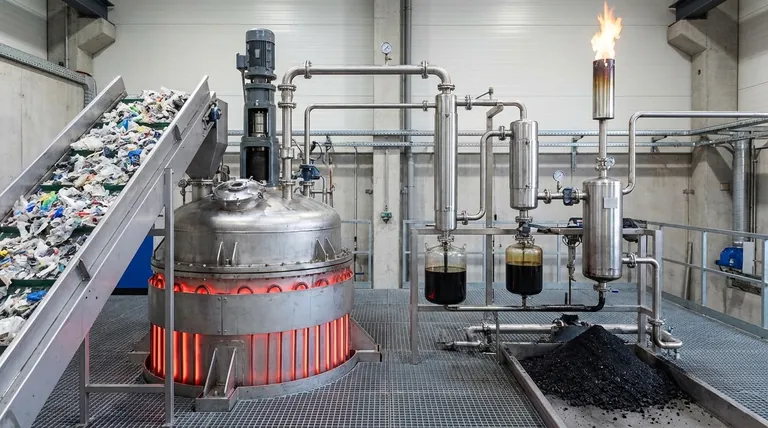
A pyrolysis reactor is an airtight vessel that operates on fundamental thermodynamic principles. An external source applies heat to the material inside, raising its temperature to several hundred degrees Celsius.
Because the system is closed off from the atmosphere, there is no oxygen to support combustion. This is the single most important aspect of the process.
What Happens to the Material?
The intense heat energy causes the long, complex molecules within the feedstock (like the polymers in plastic or the cellulose in wood) to vibrate violently and break apart into smaller, less complex molecules.
This process, known as thermal cracking or depolymerization, results in a mix of outputs:
- Liquid: A dark, viscous liquid known as pyrolysis oil or bio-oil.
- Gas: A blend of combustible gases (like hydrogen, methane, and carbon monoxide) called syngas.
- Solid: A carbon-rich solid residue called char (from biomass) or carbon black (from plastics and tires).
The Difference from Burning (Combustion)
It is crucial to distinguish pyrolysis from burning. Combustion is an oxidation reaction that requires oxygen and releases heat, producing carbon dioxide and water.
Pyrolysis is a decomposition reaction that requires a constant input of energy and happens in the absence of oxygen. It doesn't destroy the material; it transforms it into a new set of chemical products.
A Practical Example: The Plastic Pyrolysis Workflow
To make this concrete, consider the end-to-end process for converting plastic waste into fuel.
Step 1: Preparation and Preprocessing
Raw plastic waste is first shredded into smaller, more uniform pieces to increase surface area and ensure even heating.
The shredded material is then dried and processed to remove any non-plastic contaminants like metal, paper, or dirt. High-purity feedstock is essential for a high-quality final product.
Step 2: The Pyrolysis Reaction
The prepared plastic is fed into the oxygen-free reactor. Heat is applied, and the plastic waste decomposes into a mix of hydrocarbon vapor and solid carbon black.
Step 3: Separation and Refinement
The hot vapor is directed out of the reactor and into a series of condensers, where it cools and liquefies into raw pyrolysis oil.
Any non-condensable gas (syngas) is typically captured. Often, this gas is recycled to power the burners that heat the reactor, making the system more energy-efficient.
Step 4: Final Products
The process yields purified pyrolysis oil, which can be stored and used as an industrial fuel or further refined. The solid carbon black is collected, and the syngas is used to sustain the operation.
Common Types of Pyrolysis Reactors
The method of heat transfer defines the type of reactor and its ideal application.
Fixed-Bed Reactors
This is one of the simplest designs. The feedstock (substrate) is loaded onto a stationary "bed" inside the vessel. Heat is applied to the reactor's outer walls, and it slowly diffuses inward to decompose the material.
This method is reliable and straightforward but can have less efficient heat transfer compared to other designs.
Ablative Reactors
Ablative pyrolysis is a more dynamic, pressure-driven process. The feedstock is pressed mechanically or centrifugally against a very hot reactor wall.
The material essentially "melts" layer by layer upon contact, and the resulting liquid film acts as a lubricant for subsequent material. This method provides extremely rapid and efficient heat transfer.
Understanding the Trade-offs
Pyrolysis is a powerful technology, but it comes with specific engineering challenges.
Feedstock Purity is Critical
The performance of a pyrolysis system is highly sensitive to the input material. Contaminants like PVC plastic, moisture, or inorganic materials can reduce the quality of the oil and may even damage the equipment.
Energy Balance is Key
Pyrolysis is an endothermic process, meaning it requires a net input of energy to function. A well-designed system must efficiently recycle the energy produced from its own syngas to minimize external energy costs and remain viable.
Output Complexity
The raw pyrolysis oil is not a drop-in replacement for diesel or gasoline. It is a complex mixture of many different organic compounds that often requires further distillation and purification before it can be used as a high-grade fuel or chemical feedstock.
Making the Right Choice for Your Goal
Understanding the fundamentals of pyrolysis allows you to align the technology with a specific objective.
- If your primary focus is waste-to-energy: You will want a system that maximizes the yield of liquid oil and combustible syngas for power generation or heating.
- If your primary focus is high-value material recovery: You will need a system with precise temperature and pressure controls to create specific chemical feedstocks or high-purity carbon black.
- If your primary focus is simple waste volume reduction: A basic, robust fixed-bed reactor is often sufficient to convert bulky waste into a dense, stable, and easily managed char.
Ultimately, pyrolysis is a powerful tool of chemical transformation, offering a strategic alternative to incineration and landfilling.
Summary Table:
| Pyrolysis Output | Description | Common Uses |
|---|---|---|
| Pyrolysis Oil | Dark, viscous liquid from condensed vapors. | Industrial fuel, chemical feedstock. |
| Syngas | Combustible gas blend (e.g., hydrogen, methane). | Often recycled to heat the reactor. |
| Char / Carbon Black | Carbon-rich solid residue. | Fuel, soil amendment, or industrial filler. |
Ready to transform your waste streams into valuable resources? KINTEK specializes in advanced pyrolysis systems for converting biomass, plastic, and other materials into fuel and chemicals. Our reactors are engineered for efficiency, reliability, and optimal yield. Contact our experts today to discuss how a pyrolysis solution can meet your specific waste-to-energy or material recovery goals.
Visual Guide

Related Products
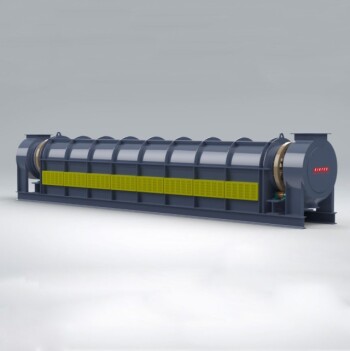
- Electric Rotary Kiln Small Rotary Furnace Biomass Pyrolysis Plant
- Electric Rotary Kiln Pyrolysis Furnace Plant Machine Calciner Small Rotary Kiln Rotating Furnace
- Electric Rotary Kiln Continuous Working Small Rotary Furnace Heating Pyrolysis Plant
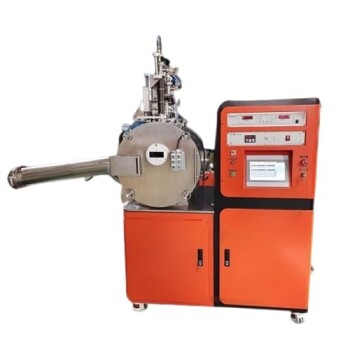
- Chemical Vapor Deposition CVD Equipment System Chamber Slide PECVD Tube Furnace with Liquid Gasifier PECVD Machine
- Vacuum Induction Melting Spinning System Arc Melting Furnace
People Also Ask
- What are the reactions involved in pyrolysis of biomass? Unlock the Chemistry for Tailored Bio-Products
- How are rotary kilns heated? Direct vs. Indirect Heating Methods Explained
- What are the characteristics of the slipping, slumping, and rolling modes of bed motion? Optimize Your Rotary Process
- What is the temperature of a rotating kiln? It Depends on Your Material and Process Goal
- Is rotary kiln a furnace? Discover the Key Differences for Industrial Processing