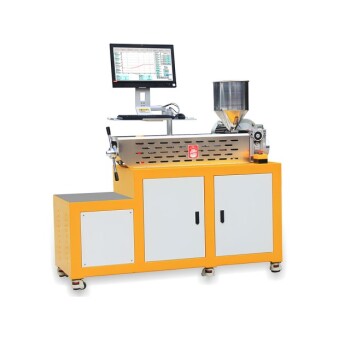
High-energy dispersion equipment serves as the critical mechanical driver for preparing high-performance composite electrolyte slurries. By utilizing intense shear or impact forces—typically generated by ball mills or high-speed stirrers—these devices physically break down TiO2 nanoparticle aggregates to ensure a homogeneous distribution within the polymer matrix.
Core Insight: The value of high-energy dispersion extends beyond simple mixing; it is a structural prerequisite for electrochemical performance. By forcing a uniform dispersion, the equipment maximizes Lewis acid-base interactions, which are necessary to reduce polymer crystallinity and establish efficient ion transport channels.
The Physical Mechanism of Dispersion
Breaking Aggregates with Force
Standard mixing is often insufficient for nanoparticles, which naturally tend to clump together. High-energy equipment applies specific shear and impact forces to overcome these inter-particle attractions.
Achieving Uniform Distribution
The primary goal is to transition from large clusters of TiO2 to individual, well-spaced nanoparticles. This uniform spacing is essential for the filler to interact effectively with the surrounding polymer chains.
Impact on Electrolyte Chemistry and Structure
Facilitating Lewis Acid-Base Interactions
When TiO2 particles are uniformly dispersed, their surface area is maximized. This allows for extensive Lewis acid-base interactions between the ceramic filler and the polymer matrix.
Reducing Polymer Crystallinity
The interactions facilitated by high-energy dispersion disrupt the ordered structure of the polymer (specifically PEO). This effectively reduces the crystallinity of the material, a vital step for performance as ions move more freely in amorphous regions.
Enhancing Mechanical Strength
A well-dispersed composite behaves as a unified structural material rather than a polymer with weak points caused by clumps. The result is a membrane with significantly enhanced mechanical strength, making it more durable for practical battery applications.
The Critical Role of Process Control
The Consequence of Low Energy
Without sufficient energy input, TiO2 fillers remain agglomerated. These clusters fail to interact chemically with the polymer matrix, rendering the addition of the filler effectively useless regarding conductivity enhancement.
Establishing Transport Channels
The ultimate output of this high-energy process is the creation of efficient ion transport channels. By modifying the polymer structure and reducing crystallinity, the equipment establishes the necessary conditions for ions to conduct through the electrolyte.
Optimizing Your Slurry Strategy
If your primary focus is Ion Conductivity: Ensure your dispersion process is aggressive enough to maximize surface area for Lewis acid-base interactions, which is the key driver for reducing crystallinity.
If your primary focus is Membrane Durability: Prioritize uniform dispersion to eliminate agglomerates, which act as stress concentrators and weaken the overall mechanical strength of the electrolyte.
High-energy dispersion is not just a mixing step; it is the fundamental process that activates the electrochemical and mechanical potential of your composite material.
Summary Table:
| Mechanism Feature | Impact on Slurry Preparation | Benefit to Electrolyte |
|---|---|---|
| Shear & Impact Forces | Breaks down nanoparticle aggregates | Uniform particle distribution |
| Surface Area Maximization | Facilitates Lewis acid-base interactions | Reduced polymer crystallinity |
| Structural Homogeneity | Eliminates stress concentration points | Enhanced mechanical strength |
| Energy Optimization | Creates amorphous ion pathways | Superior ionic conductivity |
Elevate Your Battery Research with KINTEK Precision
Unlock the full potential of your composite materials with KINTEK’s industry-leading high-energy dispersion solutions. Whether you are developing next-generation solid-state batteries or advanced polymer electrolytes, our specialized crushing and milling systems, high-speed shakers, and homogenizers ensure the perfect TiO2 dispersion every time.
From high-temperature high-pressure reactors to precision hydraulic presses and essential ceramic crucibles, KINTEK provides the comprehensive laboratory equipment and consumables needed to turn your research into high-performance reality.
Ready to optimize your slurry conductivity and membrane durability? Contact our technical experts today to find the perfect equipment configuration for your laboratory.
Related Products
- High-Energy Omnidirectional Planetary Ball Mill Machine for Laboratory
- High Energy Vibratory Ball Mill for Lab Use
- High Energy Vibratory Laboratory Ball Mill Double Tank Type
- High-Energy Omnidirectional Planetary Ball Mill Milling Machine for Laboratory
- High Energy Vibratory Laboratory Ball Mill Grinding Mill Single Tank Type
People Also Ask
- What is the function of a high-energy planetary ball mill in preparing MAB phase precursors? Optimize MBene Synthesis
- What is the function of a high-energy planetary ball mill? Unlock Nanoscale Precision in Powder Metallurgy
- Why is a high-energy planetary ball mill preferred over traditional casting for nanocrystalline HEAs?
- What role does a high-energy planetary ball mill play in Mo-La2O3 alloying? Achieve Superior Microstructure Control
- What is the role of a high-energy planetary ball mill in W-Cu powder preparation? Achieve Superior Material Uniformity