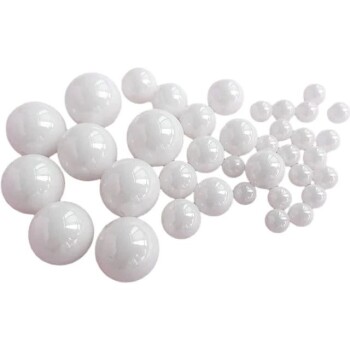
The diameter of zirconia grinding balls acts as the primary regulator of kinetic energy in the mechanochemical synthesis of Na3PS4. Specifically, larger grinding balls (such as those with a 10 mm diameter) generate significantly higher impact forces, accelerating reaction kinetics and enabling the rapid formation of the high-conductivity cubic phase in as little as 20 to 60 minutes.
Core Takeaway Optimizing grinding ball size is fundamentally about managing collision energy to drive solid-state reactions. Larger balls provide the necessary force to synthesize high-purity cubic phases quickly, while smaller balls deliver lower impact energy, requiring significantly longer processing times to achieve comparable results.
The Physics of Mechanochemical Synthesis
Impact Energy and Reaction Speed
The size of the grinding media directly determines the collision kinetic energy imparted during the milling process.
Larger balls possess greater mass, which translates to higher impact energy when accelerated in a planetary ball mill. This intensified energy is crucial for driving the reaction between raw materials (Na2S and P2S5) rapidly.
Achieving Phase Purity
The goal of this synthesis is to create the high-conductivity cubic phase of Na3PS4.
High-energy impacts from larger balls facilitate this specific crystallization directly. By providing sufficient shear and impact forces, the process bypasses the need for subsequent high-temperature thermal treatments to fix the phase.
The Cost of Smaller Media
Using smaller grinding balls results in reduced kinetic energy per collision.
While smaller media can be effective, they significantly extend the processing time required to complete the reaction. You must run the mill longer to accumulate the total energy needed to fully convert the precursors into the desired electrolyte phase.
Why Material Selection Matters
The Role of Density
The effectiveness of the ball size is amplified by the material properties of zirconia.
Zirconia is selected for its high density, which maximizes the kinetic energy transfer of every impact. A lighter material of the same size would not generate the same force, potentially failing to drive the amorphization or alloying necessary for synthesis.
Preventing Contamination
Phase purity is not just about the crystal structure; it is also about chemical composition.
Zirconia is chemically inert and wear-resistant. This prevents the introduction of metallic impurities during high-energy milling, ensuring the electrochemical stability required for moisture-sensitive solid-state electrolytes.
Understanding the Trade-offs
Efficiency vs. Control
While larger balls (e.g., 10 mm) offer speed, the process is aggressive.
The rapid kinetics (20-60 minutes) are highly efficient for bulk synthesis. However, operators must monitor the process to ensure the reaction does not generate excessive heat or mechanical stress that could degrade the material if run far beyond the completion point.
Processing Time Variations
Reliability in synthesis depends on matching the ball size to your time constraints.
If you switch to smaller balls to achieve a different particle distribution, you must account for the kinetic penalty. Failing to extend the milling time when using smaller media will result in incomplete reactions and lower phase purity.
Making the Right Choice for Your Goal
To optimize the synthesis of Na3PS4 solid-state electrolytes, align your grinding media selection with your specific processing targets:
- If your primary focus is Rapid Synthesis: distinct use of 10 mm zirconia balls is recommended to maximize impact energy and achieve the cubic phase in under an hour.
- If your primary focus is Electrochemical Stability: Ensure you strictly use high-density zirconia media to utilize its inertness, preventing metallic contamination that degrades electrolyte performance.
Select the ball size that delivers the highest kinetic energy your precursors can withstand to maximize efficiency without compromising purity.
Summary Table:
| Parameter | Larger Media (e.g., 10mm) | Smaller Media | Impact on Synthesis |
|---|---|---|---|
| Kinetic Energy | High Impact Force | Lower Impact Force | Controls reaction speed and phase formation |
| Processing Time | Rapid (20-60 mins) | Extended/Longer | Larger balls significantly reduce milling time |
| Phase Purity | Direct Cubic Phase | Risk of Incomplete Reaction | High energy bypasses need for thermal treatment |
| Contamination | Minimal (Zirconia) | Minimal (Zirconia) | High density & inertness prevent impurities |
Elevate Your Solid-State Electrolyte Research with KINTEK
Precision in mechanochemical synthesis starts with high-performance equipment. KINTEK specializes in advanced laboratory solutions designed for the rigorous demands of battery research. From our high-density zirconia grinding media and planetary ball mills to our specialized crushing and milling systems, we provide the tools you need to achieve high-purity cubic Na3PS4 with maximum efficiency.
Our comprehensive portfolio also includes high-temperature high-pressure reactors, argon-compatible glove box tools, and vacuum furnaces to support every stage of your solid-state electrolyte development.
Ready to optimize your milling kinetics? Contact KINTEK today to find the perfect media and equipment configuration for your lab's specific needs.
Related Products
- Laboratory Jar Ball Mill with Alumina Zirconia Grinding Jar and Balls
- Precision Machined Zirconia Ceramic Ball for Engineering Advanced Fine Ceramics
- Laboratory Jar Mill with Agate Grinding Jar and Balls
- Laboratory Ball Mill Jar Mill with Metal Alloy Grinding Jar and Balls
- High Energy Planetary Ball Mill Milling Machine for Laboratory
People Also Ask
- What are the primary functions of using a ball mill for BZCY72 powder? Achieve High Purity and Enhanced Sintering
- In what way does a laboratory ball mill affect material properties when modifying PHBV/pulp fiber composites?
- Why is a laboratory ball mill required for ultra-fine fly ash? Unlock Nano-Scale Adsorption Power
- What is the function of a laboratory ball mill in the preparation of AMMCs? Optimize Dispersion & Grain Refinement
- What is the function of a laboratory ball mill in the pretreatment of waste tire char (WTC)? Optimize Material Reactivity