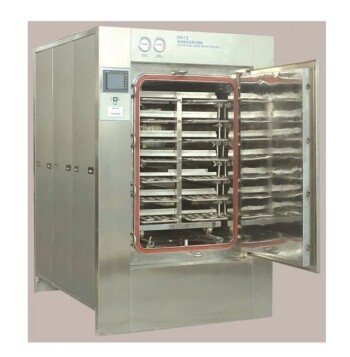
Effective decontamination relies on matching your preparation method to the physics of the autoclave. To ensure steam penetration in gravity-assisted units, you must actively introduce water into the bag to generate steam from the inside out. In contrast, vacuum cycle autoclaves do not require added water, but demand that bags be tied loosely to facilitate mechanical air removal and prevent bursting.
The success of your sterilization cycle depends on whether you are trying to displace air or extract it. Gravity cycles require added water to prevent dry heat pockets, while vacuum cycles require venting paths to prevent bag rupture during depressurization.
Optimizing for Gravity-Assisted Autoclaves
Overcoming Air Entrapment
Gravity-assisted (or displacement) autoclaves operate by allowing steam to displace heavier air. However, plastic bags act as barriers, trapping air inside and insulating the waste.
Without internal moisture, the waste inside the bag is subjected to dry heat rather than saturated steam. Dry heat is significantly less effective at sterilization than moist heat.
The Standard Water Addition Protocol
To counteract this, you must generate steam inside the bag.
For a standard 30 L bag, add approximately 0.25 L (one cup) of water before sealing. When the autoclave heats up, this water turns to steam, driving out the trapped air and ensuring the solid materials are exposed to sterilizing conditions.
Handling High-Risk Material (BSL-3)
For high-risk waste, such as materials from a BSL-3 laboratory, adding water to a bag filled with waste poses a safety hazard. The action of pouring water can displace air and release dangerous aerosols.
To mitigate this, add the water to the bag before placing the waste inside.
Alternatively, place the waste in a meltable inner bag inside the standard autoclave bag. Add the water to the outer bag only. This allows steam generation without direct manipulation of the hazardous material.
Optimizing for Vacuum Cycle Autoclaves
Mechanical Air Removal
Vacuum cycle autoclaves use a pump to forcibly extract air from the chamber and the load before steam is introduced.
Because the machine mechanically removes air, adding water to the bag is not necessary. The vacuum process ensures that steam will eventually penetrate the load once the air is evacuated.
The Necessity of Venting
The critical requirement for vacuum cycles is airflow. Bags must be tied loosely.
The opening must be sufficient to allow air to be sucked out and steam to flow in.
Avoiding Container Rupture
If a bag is tied tightly or the waste is in an airtight container, the pressure differential created during the vacuum stage can be extreme.
A sealed environment cannot equalize pressure rapidly enough. This frequently causes tightly sealed bags to burst inside the chamber, leading to potential contamination of the autoclave and a failed cycle.
Understanding the Trade-offs and Risks
The Consequence of Dry Loads
In a gravity cycle, failing to add water results in a "dry load." The temperature may reach the set point, but without moisture, the kill rate for pathogens drops precipitously. You risk processing waste that is thermally treated but not sterile.
The Risk of Sealed Vacuum Loads
In a vacuum cycle, the trade-off for not needing water is the absolute need for venting. A tight seal defeats the purpose of the vacuum pump.
While the vacuum is efficient, it is aggressive. Relying on the bag to pop open on its own is unsafe; it creates a mess and compromises the integrity of the containment during the process.
Making the Right Choice for Your Goal
To ensure valid decontamination results, apply the following protocols based on your equipment and waste type:
- If your primary focus is a Standard Gravity Cycle: Add 0.25 L of water to a 30 L bag to ensure internal steam generation.
- If your primary focus is High-Risk (BSL-3) Safety: Add water to the bag before the waste, or use a meltable inner bag system, to prevent aerosol release.
- If your primary focus is a Vacuum Cycle: Do not add water, but ensure the bag is tied loosely to allow air extraction without bursting.
Match your preparation technique to the autoclave's mechanism to guarantee that "processed" actually means "sterile."
Summary Table:
| Autoclave Type | Key Preparation Step | Water Requirement | Venting/Sealing Method | Goal |
|---|---|---|---|---|
| Gravity-Assisted | Add internal water | ~0.25 L per 30 L bag | Tied to allow displacement | Create steam from inside-out |
| Vacuum Cycle | Ensure airflow paths | No water needed | Tied loosely/unsealed | Enable mechanical air removal |
| BSL-3 (High Risk) | Pre-load water | Add water before waste | Use meltable inner bags | Prevent hazardous aerosol release |
Ensure your laboratory's safety and compliance with KINTEK's advanced sterilization solutions. From high-performance autoclaves and high-pressure reactors to precision high-temperature furnaces and muffle units, KINTEK provides the robust equipment and essential consumables—including PTFE products, ceramics, and crucibles—needed for demanding research environments. Whether you are managing BSL-3 waste or complex battery research, our technical experts are ready to help you optimize your workflow for maximum efficiency and sterility. Contact KINTEK today to find the perfect equipment for your lab!
Related Products
- Portable High Pressure Laboratory Autoclave Steam Sterilizer for Lab Use
- Laboratory Horizontal Autoclave Steam Sterilizer Lab Microcomputer Sterilizer
- Desktop Fast High Pressure Laboratory Autoclave Sterilizer 16L 24L for Lab Use
- Portable Digital Display Automatic Laboratory Sterilizer Lab Autoclave for Sterilization Pressure
- Desktop Fast Laboratory Autoclave Sterilizer 35L 50L 90L for Lab Use
People Also Ask
- Why is a laboratory high-pressure autoclave sterilizer necessary? Ensure Accuracy in Antibacterial Research
- What is the role of a laboratory high-pressure autoclave in the conversion of furfural to piperidine? Optimize Yields
- What are the two types of autoclave used in the laboratory? Gravity vs. Pre-Vacuum Explained
- What precautions should be taken during autoclave in laboratory? A Complete Safety Guide to Prevent Burns and Explosions
- What extreme conditions does a laboratory autoclave simulate? Testing Wear Resistance of Nuclear Fuel Cladding