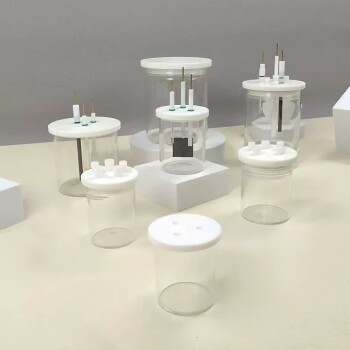
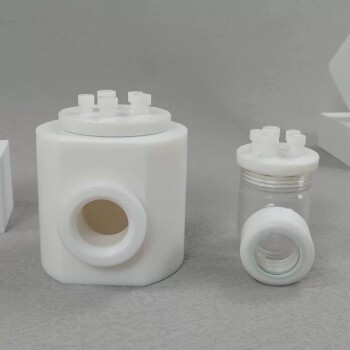
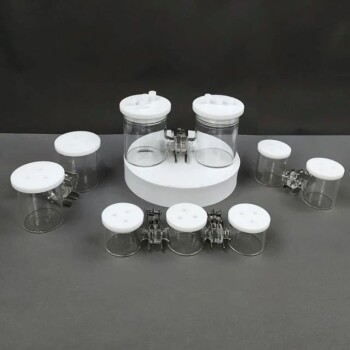
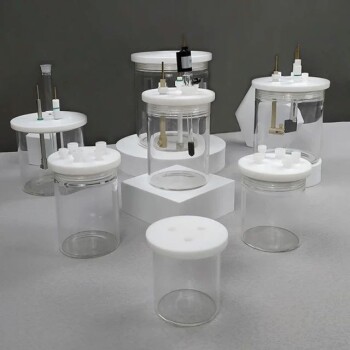
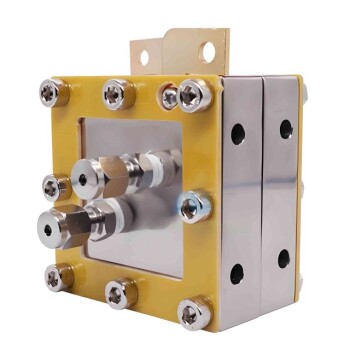
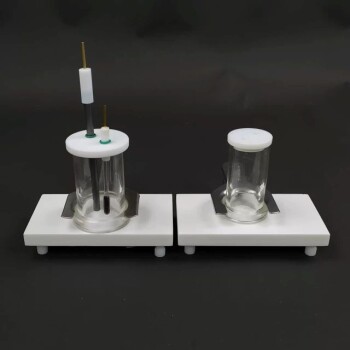
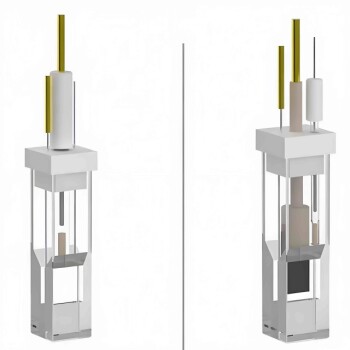
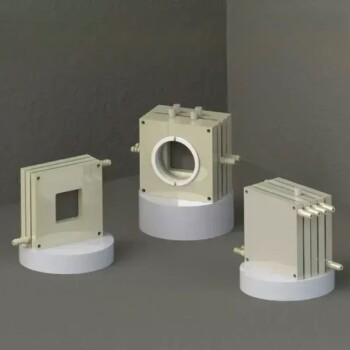
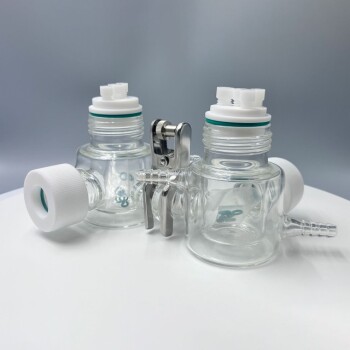
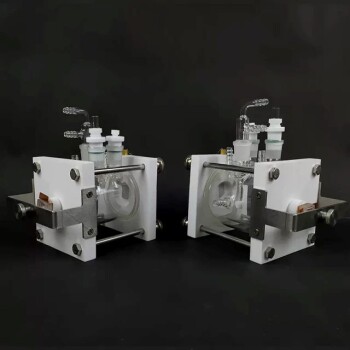
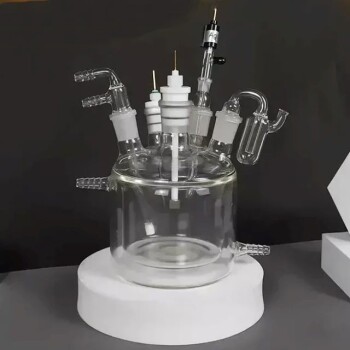
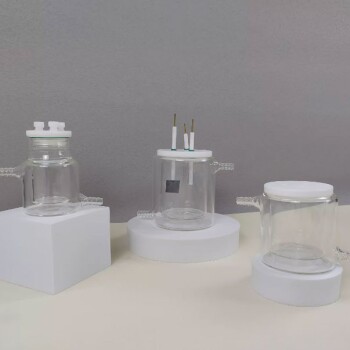
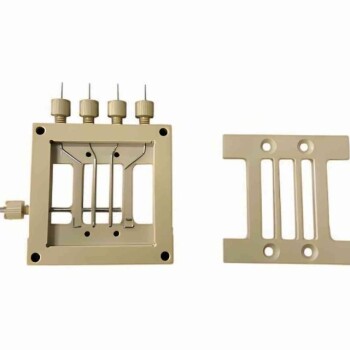
The primary advantage of a three-electrode electrolytic cell equipped with a quartz window is the preservation of optical fidelity across the full solar spectrum. By using quartz instead of standard glass, the system ensures high-efficiency light transmission—particularly in the ultraviolet-visible (UV-Vis) region—allowing simulated sunlight to reach the photoanode without spectral distortion or intensity loss.
Core Takeaway: In photoelectrochemical testing, the window material is a critical optical component; using quartz prevents the absorption of specific wavelengths characteristic of ordinary glass, ensuring that measured photocurrent and conversion efficiencies differ based on the material's properties, not the test equipment's limitations.
The Critical Role of Optical Transparency
Overcoming Spectral Filtering
Standard laboratory glass often absorbs light in specific wavebands, particularly within the ultraviolet range. This creates a "filtering" effect that alters the spectrum of light reaching your sample.
Quartz provides extremely high light transmittance across both ultraviolet and visible wavebands. This ensures that the light generated by external sources, such as Xenon lamps, reaches the working electrode exactly as intended.
Maximizing Illumination Efficiency
For accurate testing, the illumination intensity at the electrode surface must match the source intensity. Any loss at the window interface introduces calculation errors.
A quartz window allows for the lossless transmission of the simulated light source. This is essential for determining the true quantum efficiency of the material being tested.
Enhancing Data Accuracy and Realism
Precise Photocurrent Response
To characterize a material's photoelectric performance, you must measure its response to specific light stimuli.
Because quartz eliminates spectral interference, the current-voltage (IV) curves and photocurrent responses you measure are accurate reflections of the material's capability. This isolates the variable of interest: the photoelectric conversion efficiency of the working electrode.
Simulating Real-World Conditions
Photovoltaic and photoelectrochemical applications operate under the full solar spectrum. Testing environments must replicate this to be valid.
The high-efficiency transmission of the quartz window enables the simulation of real-world photovoltaic environments. This allows researchers to reliably assess not only immediate performance but also the chemical stability of the photoanode under realistic operating conditions.
Understanding the Trade-offs
The Risk of "Ordinary" Glass
While it may be tempting to use standard glassware for general electrochemistry, it is unsuitable for photoelectric applications.
Ordinary glass acts as an unintended filter. If used, you risk underestimating the efficiency of your material, particularly if the material relies on UV light for excitation (such as many wide-bandgap semiconductors).
System Fragility and Cost
While the references focus on performance, it is worth noting that quartz is generally more expensive and sometimes more brittle than borosilicate glass.
However, in the context of photoelectric characterization, this is a necessary investment. The cost of the component is outweighed by the value of data integrity and the elimination of optical artifacts.
Making the Right Choice for Your Goal
When configuring your photoelectrochemical setup, choose your cell components based on your specific analytical requirements.
- If your primary focus is accurate efficiency benchmarking: You must use a quartz window to ensure the calculation of solar-to-hydrogen (STH) or photoelectric conversion efficiency is not skewed by window absorption.
- If your primary focus is testing UV-active materials (like TiO2): Quartz is non-negotiable, as standard glass blocks the UV wavelengths necessary to activate the material.
Ultimately, the quartz window transforms the electrolytic cell from a simple container into a precision optical instrument.
Summary Table:
| Feature | Quartz Window Cell | Standard Glass Cell |
|---|---|---|
| Light Transmittance | High (>90%) across UV-Vis-NIR | Limited; filters UV wavelengths |
| Spectral Fidelity | Full spectrum transmission | Spectral distortion/filtering |
| Measurement Accuracy | High; reflects true material performance | Lower; introduces calculation errors |
| Best Application | Photoelectrochemistry & Solar Simulation | General aqueous electrochemistry |
| Efficiency Analysis | Ideal for STH and IPCE benchmarks | Inaccurate for UV-active materials |
Precision Tools for Your Photoelectrochemical Research
Don't let subpar equipment compromise your data integrity. KINTEK specializes in high-performance laboratory solutions designed for the most demanding research environments. Our precision-engineered electrolytic cells and electrodes—including specialized quartz-window cells—ensure you achieve the optical fidelity and spectral accuracy required for cutting-edge photovoltaic and battery research.
Why choose KINTEK?
- Comprehensive Laboratory Range: From high-temperature furnaces and vacuum systems to advanced crushing and milling equipment.
- Precision Consumables: High-quality ceramics, crucibles, and PTFE products to support every stage of your workflow.
- Specialized Solutions: Expertly designed autoclaves, reactors, and cooling solutions tailored for material science.
Upgrade your lab's testing capabilities today. Contact our technical experts at KINTEK to find the perfect configuration for your research goals!
References
- Fatma Bayrakçeken Nişancı. Controllable Electrochemical Synthesis and Photovoltaic Performance of Bismuth Oxide/Graphene Oxide Nanostructure Arrays. DOI: 10.28979/jarnas.1039429
This article is also based on technical information from Kintek Solution Knowledge Base .
Related Products
- Quartz Electrolytic Electrochemical Cell for Electrochemical Experiments
- Side Window Optical Electrolytic Electrochemical Cell
- H Type Electrolytic Cell Triple Electrochemical Cell
- Optical Window Glass Substrate Wafer Quartz Plate JGS1 JGS2 JGS3
- Electrolytic Electrochemical Cell with Five-Port
People Also Ask
- Why is a quartz electrolytic cell used for acrylic acid wastewater? Ensure Chemical Stability & Data Integrity
- How does the design of an electrochemical electrolytic cell influence the coating uniformity? Optimize Your Catalysts
- What are the key features of quartz that make it suitable for electrolytic cells? Discover the 4 Pillars of Superior Performance
- What is the correct shutdown and disassembly procedure after an experiment? Ensure Safety and Protect Your Equipment
- How do the electrochemical cell and three-electrode testing system collaborate? Optimize Zinc Anode Deposition Control