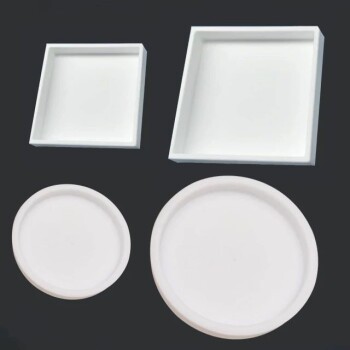
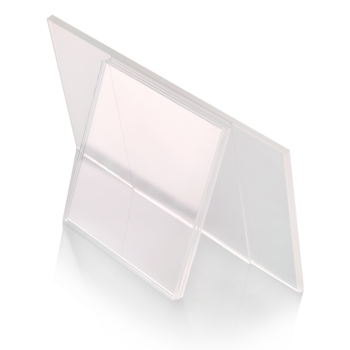
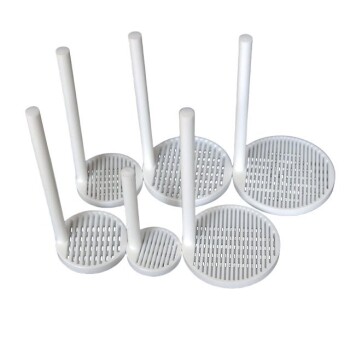
Using PTFE (polytetrafluoroethylene) or PP (polypropylene) as casting substrates provides superior release characteristics and improves the drying uniformity of aqueous tapes. These materials significantly reduce interface resistance, allowing solvents to migrate evenly and preventing defects like warping, curling, or thickness irregularities. Their inherent non-stick properties ensure that thin membranes—often as thin as 100 micrometers—can be peeled away completely without mechanical damage or contamination.
PTFE and PP substrates solve the critical challenge of adhesion and uneven drying in aqueous tape casting. By leveraging low surface energy and chemical inertness, these materials ensure a flat, high-purity final product that detaches effortlessly after the solvent evaporates.
Enhancing Structural Integrity and Flatness
Mitigating Drying Defects
The use of PTFE or PP plates improves the separation between the wet tape edges and the substrate during the drying phase. This controlled separation prevents the "edge-pinning" effect common with glass or metal, which often leads to internal stresses.
Promoting Uniform Solvent Migration
Compared to traditional glass or silicone surfaces, these plastics reduce interface resistance. This allows the solvent to migrate more uniformly from the bottom of the tape toward the sides, which is essential for maintaining a consistent drying rate across the entire surface.
Ensuring Surface Flatness
By balancing the drying kinetics, these substrates effectively mitigate thickness warping and curling. This ensures that the tape remains flat on its support throughout the process, resulting in a more geometrically stable ceramic or polymer membrane.
Superior Release and Non-Stick Properties
Low Surface Energy and Easy Peeling
PTFE and PP possess extremely low surface energy, which creates a naturally non-stick environment. After the solvent has evaporated, the formed electrolyte or ceramic film can be easily and completely peeled off without tearing or sticking.
Preventing Membrane Damage
In applications like PEO-LLZTO composite electrolytes, the ability to peel the film away without force is vital. This prevents membrane damage and ensures that the surface remains smooth and uniform, rather than being distorted by adhesion to the substrate.
Maintaining Chemical Purity
The chemical inertness of PTFE and PP ensures that the substrate does not react with the slurry, even when using aggressive aqueous or organic solvents. This prevents the introduction of impurities into the membrane, which is critical for high-performance battery and fuel cell components.
Understanding the Trade-offs
Adhesion Challenges
While the non-stick nature is an advantage for peeling, it can occasionally make the initial slurry wetting difficult. If the surface energy is too low, the aqueous slurry may bead up rather than spreading into a uniform thin film, requiring the use of specific surfactants.
Thermal Expansion and Rigidity
Plastic substrates have different thermal expansion coefficients than glass or stainless steel. During high-temperature drying or curing, the substrate may expand more than the tape, potentially introducing mechanical stress if the drying cycle is not carefully controlled.
Durability and Surface Wear
Although PTFE is highly resistant to chemicals, it is a softer material than glass or steel. Over time, the surface can develop scratches or indentations from cleaning or casting blades, which will eventually be mirrored as defects in the cast tapes.
Making the Right Choice for Your Project
Choosing the right substrate depends on your specific slurry chemistry and the required precision of the final tape.
- If your primary focus is Ease of Recovery: PTFE is the gold standard because its extremely low friction coefficient and non-stick surface allow for damage-free peeling of even the most fragile membranes.
- If your primary focus is Dimensional Stability: Rigid PP plates provide a cost-effective balance of chemical resistance and structural stiffness to prevent warping during uniform solvent evaporation.
- If your primary focus is Chemical Purity: Both PTFE and PP are excellent choices as they resist almost all acids, bases, and organic solvents, ensuring no leaching occurs during the casting process.
By selecting these advanced plastic substrates, you transition from struggling with adhesion to achieving a repeatable, high-quality casting process.
Summary Table:
| Feature | Key Benefit | Process Improvement |
|---|---|---|
| Surface Energy | Extremely low (Non-stick) | Damage-free peeling of thin (<100µm) membranes |
| Drying Kinetics | Reduced interface resistance | Prevents warping, curling, and thickness irregularities |
| Chemical Inertness | High resistance to solvents | Ensures high-purity tapes with zero leaching/contamination |
| Separation | Mitigates "edge-pinning" | Reduces internal stresses for perfectly flat final products |
Elevate Your Material Casting Precision with KINTEK
Transition from adhesion struggles to a repeatable, high-quality casting process. KINTEK specializes in laboratory equipment and consumables, offering a comprehensive range of PTFE products, ceramics, and crucibles designed for superior release and purity.
Beyond consumables, our portfolio supports your entire research workflow with:
- High-Temperature Furnaces: Muffle, tube, and vacuum systems for precise sintering.
- Sample Preparation: Hydraulic presses, crushing systems, and milling equipment.
- Energy Research Tools: Battery research consumables and high-pressure reactors.
Ready to optimize your lab's efficiency? Contact our experts today to find the ideal substrates and equipment tailored to your specific project needs!
References
- Yifei Yan, Olivera Kesler. Fabrication of flat stainless steel substrates with improved oxidation behavior for metal-supported solid oxide cells using aqueous tape casting. DOI: 10.1007/s43939-023-00063-5
This article is also based on technical information from Kintek Solution Knowledge Base .
Related Products
- Custom PTFE Teflon Parts Manufacturer for Conductive Glass Substrate Cleaning Rack
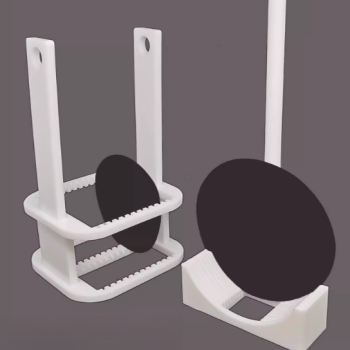
- Custom PTFE Wafer Holders for Lab and Semiconductor Processing
- Custom PTFE Teflon Parts Manufacturer for Hydrothermal Synthesis Reactor Polytetrafluoroethylene Carbon Paper and Carbon Cloth Nano-growth
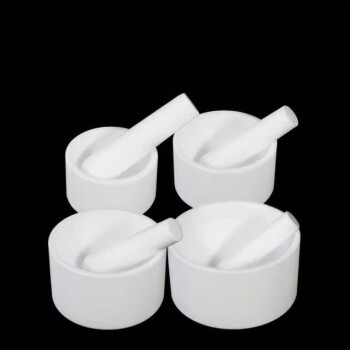
- Custom Machined and Molded PTFE Teflon Parts Manufacturer with PTFE Crucible and Lid
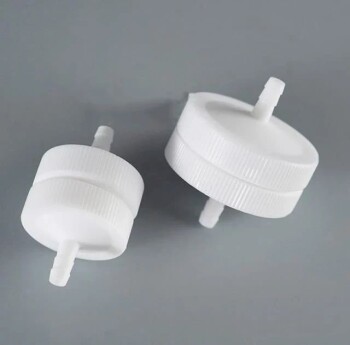
- Custom PTFE Teflon Parts Manufacturer for Sampling Filters
People Also Ask
- How should an appropriate PTFE cleaning basket be selected? A Guide to Efficient and Safe Lab Cleaning
- Why are PTFE containers required for PCT leaching tests? Ensure Chemical Inertness and Analytical Precision
- How should a PTFE cleaning basket be cleaned before its initial use? A Critical First Step for Process Integrity
- What material is a PTFE cleaning basket made of? Unlocking Superior Chemical and Thermal Resistance
- What should be monitored during the cleaning process when using a PTFE cleaning basket? Ensure Reliable Results & Prevent Damage